

Types of Concrete Floor Sealers and How They Perform
Selecting the best sealant for concrete floors requires a comprehensive understanding of how specialized chemical formulations interact with bare concrete substrates. Unprotected concrete is fundamentally dynamic and porous, characterized by microscopic pore structures and capillaries through which ambient moisture, volatile liquids, vehicle fluids, and daily debris can penetrate. Over extended periods, this unmitigated absorption can lead to internal degradation, surface dusting, cracking, and premature structural wear. Selecting an appropriate sealer chemistry mitigates these vulnerabilities by either sealing the surface film or penetrating deeply into the matrix. To review the foundational principles behind protective treatments, explore our guide on Concrete Sealer 101: What It Does and Key Benefits.
Protective treatments generally divide into four core polymer and chemical categories, each presenting distinct performance characteristics depending on substrate conditions, environmental exposure, and heavy-use demands:
- Penetrating Sealers: Engineered with reactive chemical compounds like silanes, siloxanes, or silicates, these formulations migrate deep into the porous network of the concrete slab. Rather than creating a visible surface layer, they react chemically with free calcium hydroxide within the pore walls to form a hydrophobic silica barrier. Penetrating sealers generally preserve the natural color, texture, and inherent slip resistance of the surface while maintaining moisture vapor breathability, allowing internal vapors to vent without causing surface delamination.
- Acrylic Sealers: Formulated in both water-based and solvent-based suspensions, acrylic sealers create a flexible topical film across the slab. They enhance natural substrate coloration and provide immediate resistance against light surface dust and mild chemical splashes. Because thin acrylic topical films wear down gradually under regular foot and vehicle traffic, periodic reapplication is typically required every few years to sustain consistent visual sheen and barrier properties.
- Epoxy Resins: Offering a dense, high-build topical barrier, professional epoxy resin systems bond directly to mechanically profiled concrete surfaces. Epoxy systems provide substantial resistance against high mechanical loads, impact, heavy abrasions, and aggressive chemical exposure, serving as a dependable foundational base coat for multi-layer protective systems.
- Polyurethane Sealers: Providing elevated UV stability, flexibility, and scratch resistance, top-tier polyurethane sealers deliver roughly twice the dry-film thickness of standard acrylics. Advanced formulations such as PDS – Smith’s Poly-SEAL+ combine specialized polyurethane polymers to achieve impressive Taber abrasion resistance and rapid cure times across residential, commercial, and industrial concrete floors.
Water-Based vs. Solvent-Based Floor Sealants
The choice of carrier fluid significantly influences application safety, environmental parameters, indoor air quality, odor levels, and visual outcome:
- Water-Based Sealers: These systems utilize water as the primary carrier medium for protective resins. They typically exhibit low volatile organic compound (VOC) emissions, produce minimal odor during application, and allow straightforward tool cleanup. Water-based systems are often preferred for enclosed residential or commercial spaces where ventilation may be restricted.
- Solvent-Based Sealers: Industrial solvents distribute the active resin solids evenly across the concrete surface. Although solvent-based formulas often deliver deeper color enhancement and a high-gloss finish, they emit noticeable chemical odors during cure phases and require meticulous adhesion checks alongside adherence to strict regional atmospheric regulations.
Joint Sealants and Expansion Joint Protection
A comprehensive concrete protection strategy requires careful treatment of structural control joints and expansion gaps. Unsealed joints allow debris accumulation, permit unmitigated water penetration underneath the slab, and increase the likelihood of edge spalling under heavy rolling equipment. Highly resilient elastomeric polyurethanes designed specifically for dynamic joint protection, such as Sikaflex® PRO-3 SL, feature high elongation capabilities and self-leveling properties designed to accommodate structural expansion and contraction without joint failure.
For smaller non-structural cracks or perimeter contraction joints, specialized self-leveling formulas like PL Concrete Self-Leveling facilitate clean installation. Proper joint geometry typically demands a width-to-depth ratio of approximately 1:0.8 to sustain long-term flexibility and structural movement without tearing.
Key Factors in Selecting the Best Sealant for Concrete Floors

Identifying the optimal concrete sealing solution requires a meticulous assessment of the operating environment, structural moisture dynamics, traffic loads, and regulatory parameters. For further information on detailed system selection, consult our resource on Sealer or Later: Choosing the Right Concrete Coating Sealers.
- Traffic Intensity and Wear Profile: Heavy vehicle staging, frequent forklift traffic, and continuous mechanical movement require high-solids topical systems or multi-coat polyaspartic coatings rather than light penetrating treatments or thin acrylic films.
- Moisture Vapor Emission Rates (MVER): Concrete slabs naturally act as moisture pathways, drawing ground moisture upward via capillary action. Quantitative moisture testing helps determine whether the slab requires a breathable penetrating sealer or a specialized epoxy moisture mitigation barrier to prevent adhesive failure.
- Environmental and Air Quality Compliance: Regional guidelines strictly govern indoor air quality and VOC emissions, making low-VOC, solvent-free, or 100% solids chemical systems advantageous for occupant safety and regulatory compliance.
Surface Preparation and Professional Application Methods
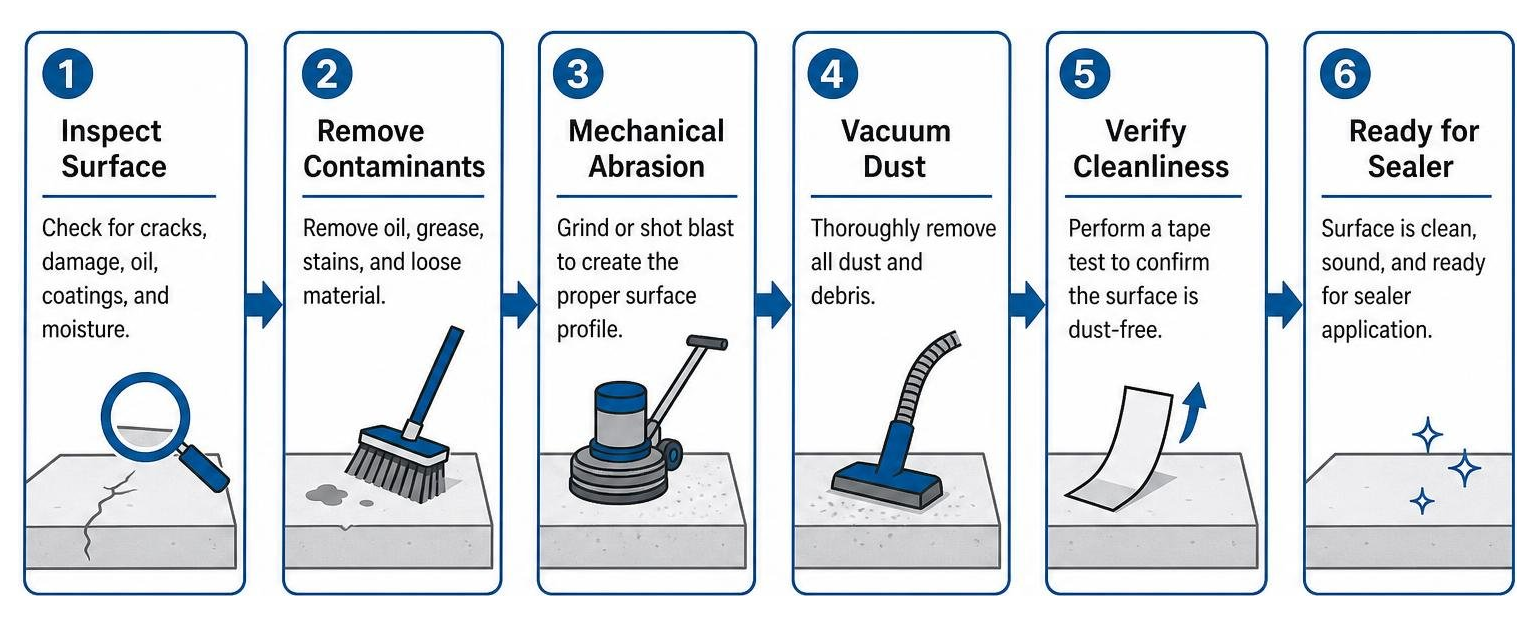
The long-term bond strength of any high-performance concrete sealant depends almost entirely on surface preparation. Even advanced resin formulas can fail prematurely if applied over contaminated, unprofiled, or dusty concrete surfaces:
- Mechanical Diamond Grinding: Professional mechanical diamond grinding removes weak surface laitance, opens clogged capillaries, and establishes a standardized Concrete Surface Profile (CSP) of 2 to 3, providing optimal mechanical keying for subsequent resin coats.
- Industrial Dust Extraction: Dust and particulate debris interfere with coating adhesion. Using heavy-duty industrial vacuum systems equipped with HEPA filtration eliminates fine silica dust from deep within the open pores.
- Adhesion and Surface Testing: Technicians perform tape tests and water drop evaluations across prepared slabs to verify surface cleanliness and ensure no residual oils, curing compounds, or sealers remain to impede mechanical bonding.
Depending on viscosity and polymer structure, professional installation utilizes low-pressure sprayers for deep penetrating silanes or commercial squeegees and heavy-duty rollers for high-solids topical polymers.
Longevity Expectations and Maintenance Cycles
Service life varies considerably depending on substrate preparation, traffic volume, thermal exposure, and material chemistry. While thin acrylic films may require maintenance touch-ups every few years in active spaces, high-build polyaspartic and multi-coat epoxy systems installed by Denver Floor Coatings offer extended functional lifespans under appropriate maintenance regimens. Utilizing professional application standards helps maintain capillary protection, slip resistance, and surface integrity for years to come.
Floor Sealant Solutions for High-Traffic Residential and Commercial Spaces

Demanding environments demand durable chemical resistance, superior impact absorption, and low-maintenance cleaning protocols. For an in-depth look at coating choices, review our complete guide on Concrete Sealing 101: A Complete Guide to Sealing Concrete.
Identifying the Best Sealant for Concrete Floors in High-Traffic Garages
Residential and commercial garage floors face relentless exposure to heavy vehicular weight, hot tires, road salt, automotive fluids, and severe temperature fluctuations. Thin topical sealers frequently suffer from hot-tire pickup—a failure mechanism where warm chemical compounds in tire rubber soften and pull surface films away from bare concrete slabs.

To achieve exceptional resilience and clean aesthetics, Denver Floor Coatings installs multi-layered epoxy and polyaspartic floor systems through our dedicated Professional Residential Sealing Services. Advanced polyaspartic topcoats deliver UV stability, excellent chemical defense against fluid spills, and fast cure times, allowing garage transformations to be completed efficiently with minimal downtime.
Choosing the Best Sealant for Concrete Floors in Commercial Basements and Facilities
Commercial basements, storage hubs, industrial warehouses, and manufacturing plants routinely experience ground moisture vapor pressure rising through below-grade slabs. Unchecked vapor pressure can cause unvented, low-grade surface sealers to blister, bubble, and separate over time.
For high-traffic commercial spaces, property owners rely on Denver Floor Coatings and our specialized Commercial Coating Solutions to implement durable, moisture-tolerant coating systems that meet safety requirements while withstanding rolling equipment and heavy foot traffic.
Troubleshooting Common Sealer Issues and Re-Coating Guidelines
Understanding potential failure modes helps safeguard your investment in commercial or residential concrete surfacing. Learn more in our Beginner’s Guide to Best Floor Coating for Concrete.
Preventing Peeling, Whitening, and Moisture Trapping
- Hazing and Whitening: Occurs when ambient or internal moisture becomes trapped beneath a non-breathable surface film. This typically happens when sealers are applied over excessively damp concrete or in high-humidity conditions.
- Blistering and Pinholing: Caused by applying resinous coatings during peak ambient temperatures or direct sunlight, forcing expanding air pockets and evaporating solvents to push through curing surface films.
- Peeling and Delamination: Usually indicates inadequate substrate preparation, such as bypassing diamond grinding, leaving fine dust particles on the concrete, or applying excessively thick single applications.
Sealing Previously Coated Concrete Surfaces
Applying fresh protective coatings over previously treated concrete requires thorough evaluation to verify structural adhesion and inter-coat compatibility:
- Solvent Compatibility Testing: Applying a targeted solvent like xylene or acetone to a small, hidden test area helps evaluate the existing film. If the surface becomes soft or tacky within minutes, an existing acrylic coat may accept re-coating after thorough cleaning and light mechanical abrasion.
- Complete Coating Removal: If an old coating exhibits widespread flaking, cracking, or chemical incompatibility, complete diamond grinding by Denver Floor Coatings is essential to restore bare, clean concrete before applying a high-performance system.
Frequently Asked Questions About Concrete Floor Sealants
How long does a concrete floor sealant typically last before needing reapplication?
Service life depends on traffic volume, substrate condition, chemical exposure, and sealer chemistry. Light topical acrylics may require touch-ups every few years. Deep penetrating silane or siloxane treatments often remain effective for five to ten years under normal conditions, while professional multi-coat epoxy and polyaspartic systems installed by Denver Floor Coatings provide extended durability with simple routine cleaning.
Can concrete floor sealers stop water from rising up through a slab from below?
Standard clear sealers are primarily designed to repel top-down liquid spills rather than resist continuous hydrostatic pressure from beneath the slab. Managing heavy upward moisture vapor transmission generally requires deep silicate treatments or specialized moisture-mitigating epoxy primers specifically formulated for negative-side vapor control.
Are low-VOC or water-based sealers durable enough for high-traffic garage floors?
While modern low-VOC water-based acrylics perform well in light residential or foot-traffic areas, heavily used garage floors benefit significantly from industrial-grade polyaspartic or multi-layer epoxy flake systems. These systems provide superior resistance to hot tire pickup, automotive chemicals, and abrasion.
Conclusion
Selecting the best sealant for concrete floors involves balancing material performance, visual preferences, environmental conditions, and expected traffic patterns. Penetrating sealers preserve the natural texture and breathability of raw concrete, while high-build epoxy and polyaspartic coating systems deliver durable protection against intense daily wear, heavy equipment, and aggressive chemicals.
At Denver Floor Coatings, we specialize in transforming residential garages, basements, and commercial spaces into highly functional, resilient, and beautiful environments. Our expert team ensures every project receives thorough mechanical prep and precise application using industry-leading materials engineered for long-term satisfaction.
If you are ready to enhance and protect your concrete floor, contact Denver Floor Coatings today. Visit our Floor Coating Services page or reach out through our Contact Page to request a professional, personalized estimate for your upcoming project!