

Choosing the Right Coatings for Garage Floor Protection
The best coatings for garage floor surfaces depend on how you utilize your space and the specific daily demands placed on the concrete slab. A professionally installed epoxy or polyaspartic system featuring a decorative flake finish represents an exceptionally reliable choice for garages that regularly accommodate heavy passenger vehicles, rolling tool chests, seasonal road salts, automotive fluids, and active household traffic. When engineered and applied correctly, these advanced resinous systems create a seamless, non-porous surface that substantially enhances concrete protection against chemical staining, surface abrasion, and hot-tire delamination.
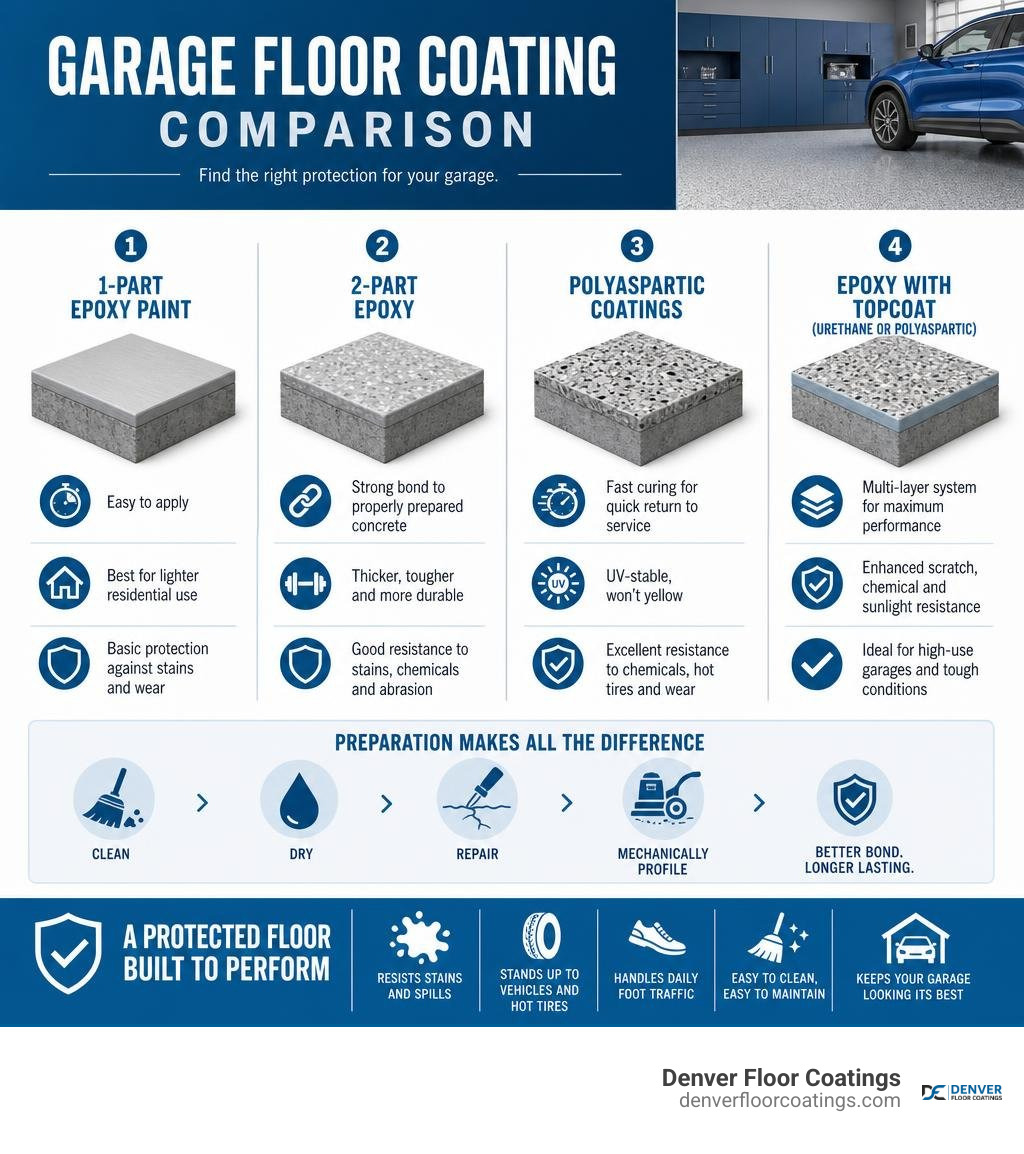
Selecting an optimal flooring solution requires understanding the primary resin technologies available on the market today:
- Single-Component Floor Enamels: Traditional 1-part paints that dry through water evaporation, generally suitable for light-duty residential utility areas with minimal vehicle traffic.
- Two-Part Industrial Epoxy Systems: High-build, reactive polymer systems that chemically cross-link to form a dense, impact-resistant barrier across the slab.
- Pure Polyaspartic Resins: Fast-curing, UV-stable aliphatic coatings engineered for superior chemical resilience, thermal stability, and accelerated return-to-service schedules.
- Hybrid Epoxy-Polyaspartic Multi-Layer Systems: Comprehensive multi-coat assemblies pairing a moisture-mitigating, high-build epoxy base with a durable, non-yellowing polyaspartic topcoat.
While the resin chemistry is fundamental to surface resilience, substrate preparation remains equally critical to overall system success. Concrete must be thoroughly inspected, mechanically profiled, structurally repaired, and cleaned before applying any resinous material. Unaddressed subsurface moisture vapor, embedded hydrocarbon residues, weak micro-layers, or neglected mechanical grinding can compromise mechanical adhesion, leading to premature blistering or flaking over time.
At Denver Floor Coatings, we specialize in high-performance epoxy and polyaspartic systems, including decorative flake finishes designed to provide clean, long-lasting garage surfaces. I am Mike Wislinsky, founder and president of Denver Floor Coatings, and I bring more than two decades of dedicated engineering and operations experience to helping property owners evaluate coatings for garage floor upgrades, understand substrate physics, and make informed choices for their homes.
Homeowners seeking the best floor coating for concrete frequently look for a durable, cleanable garage epoxy finish that resists automotive fluid spills and road debris. For specialty spaces, visual alternatives such as an epoxy galaxy floor can transform plain concrete into a visually striking, showroom-quality focal point.
Comparing the Main Types of Coatings for Garage Floor Systems
Selecting an appropriate floor system involves carefully evaluating resin formulation, dry film thickness, environmental conditions, chemical resistance, and long-term mechanical wear. Because concrete is naturally porous and prone to micro-cracking under physical and thermal stresses, understanding the molecular behavior of each material helps ensure realistic expectations and dependable results.
| Feature | Single-Component (1-Part) Paint | 100% Solids 2-Part Epoxy | Polyaspartic / Urethane Systems |
|---|---|---|---|
| Resin Base | Water-based acrylic with epoxy additives | 100% reactive epoxy resin and polyamine hardener | Aliphatic polyurea / polyaspartic ester |
| Dry Film Thickness | Very thin (~1 to 2 mils) | High-build (8 to 20+ mils per coat) | Medium to high-build (6 to 12+ mils) |
| VOC Content | Moderate to low | Zero VOCs | Low to ultra-low VOCs |
| Hot-Tire Resistance | Low to moderate | High | Exceptional |
| UV Stability | Fair (can yellow over time) | Poor (chalks/yellows under sunlight) | Exceptional (chemically non-yellowing) |
| Cure Window | 7 days for vehicle traffic | 24 to 72 hours for full service | 16 to 24 hours for return to service |
Single-Component vs. 2-Part Coatings for Garage Floor Applications
A standard single-component coating functions much like traditional exterior latex house paint. It relies solely on the physical evaporation of water or carrier solvents to coalesce into a thin film. Because there is no chemical cross-linking taking place between independent polymers, the resulting film remains relatively soft, microscopically porous, and sensitive to moisture and heat. When warm vehicle tires rest on these surfaces, the combination of tire heat and synthetic plasticizers can soften the film, causing the coating to peel away. Property owners evaluating a best non epoxy garage floor paint often discover that single-part systems may need frequent maintenance or recoating in areas subjected to routine vehicle parking.
In contrast, true two-part industrial formulations achieve their mechanical properties through an exothermic chemical reaction between an epoxy resin (Part A) and an amine-based curing agent (Part B). When mixed in precise stoichiometric ratios, these components cross-link into a rigid thermoset polymer network. This chemical bond anchors deep within the mechanically prepared pores of the concrete slab, delivering significant resistance to impact gouging, motor oil, transmission fluids, and tire friction.
Water-Based Epoxy vs. 100% Solids Industrial Formulations
Water-based and solvent-borne epoxies contain liquid carrier agents that evaporate during the curing cycle. When a 10-mil wet film of water-based epoxy with 40% solids dries, approximately 60% of the material evaporates into the air, leaving behind an effective dry film thickness of only 4 mils. Conversely, 100% solids epoxy contains no evaporative carriers or solvent additives, producing virtually zero volatile organic compounds (VOCs). When our installation team applies a 10-mil layer of 100% solids epoxy, the cured film retains its complete 10-mil thickness.
To have epoxy floors explained from an engineering perspective: high-build formulations provide the structural mass required to bridge minor substrate irregularities, encapsulate decorative media, and absorb direct physical shocks from dropped tools or automotive equipment. These monolithic surfaces also noticeably improve workspace brightness by reflecting ambient overhead light throughout the garage.
Advanced Polyaspartic and Polyurethane Topcoats
Although 100% solids epoxy serves as an exceptional high-build foundation, standard aromatic epoxy resins are naturally sensitive to ultraviolet light. Prolonged exposure to sunlight entering through open overhead garage doors can cause unshielded epoxy basecoats to gradually amber, fade, or lose their surface gloss. This limitation is effectively addressed through the application of advanced aliphatic polyaspartic and polyurethane protective topcoats.
Our quick start guide to polyaspartic floor coating denver details the specific mechanical advantages of polyaspartic technology: these formulations are chemically non-yellowing under UV radiation, maintain superior elastomeric flexibility across broad temperature ranges, and offer high resistance to abrasions caused by tracked-in road grit. Combining a robust basecoat with an aliphatic clear coat produces high performance concrete coatings that retain their clarity, luster, and functional integrity through repeated seasonal climate shifts.
Essential Surface Preparation and Substrate Compatibility

A protective floor system is fundamentally dependent on the structural integrity and surface condition of the underlying concrete slab. The vast majority of coating failures, such as peeling, localized blistering, or flaking, stem directly from insufficient surface profiling, undetected slab moisture, or chemical contamination rather than product defects.
Surface Preparation Steps for Long-Lasting Adhesion
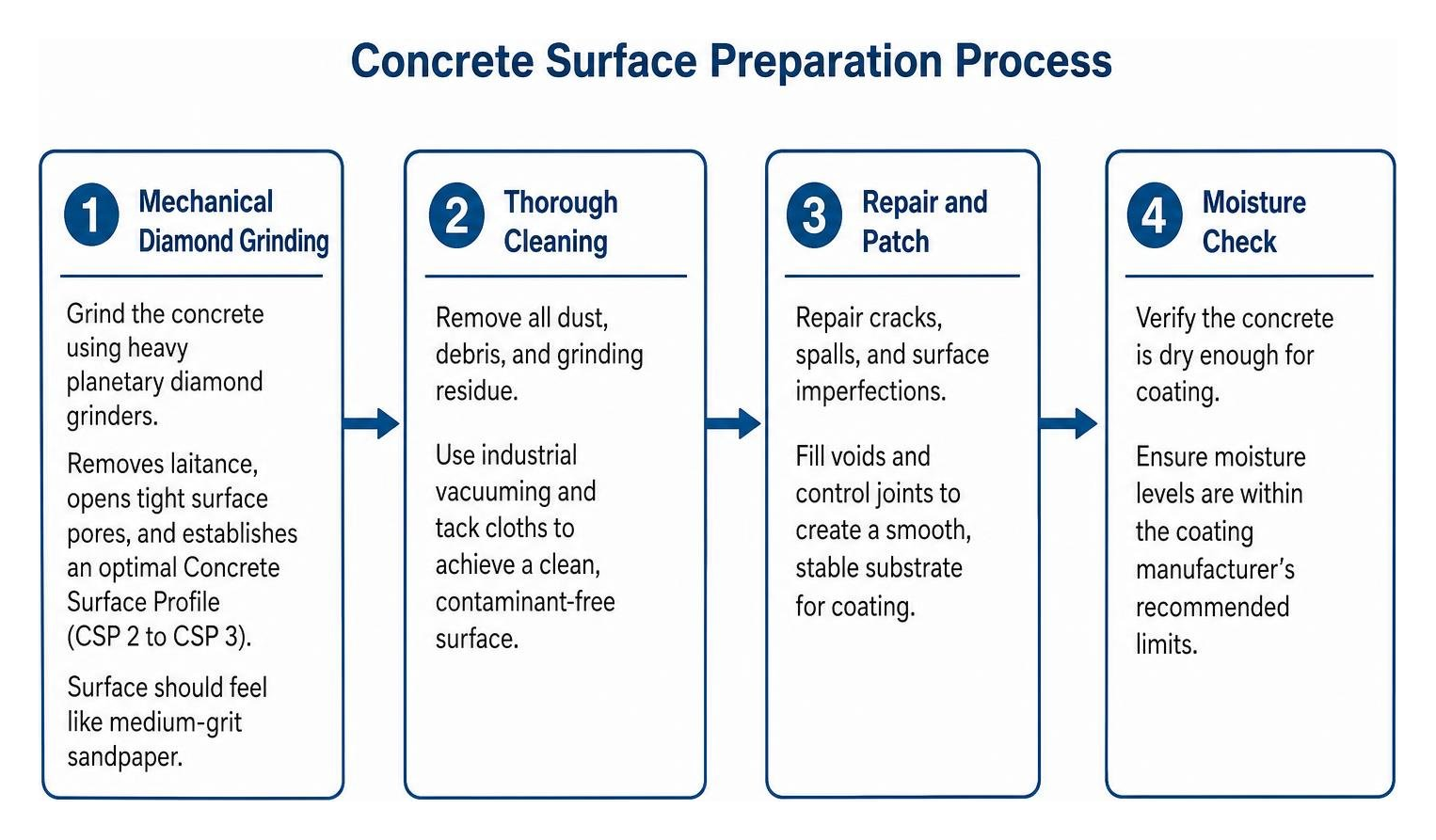
To achieve deep mechanical anchoring between the concrete matrix and our resin systems, Denver Floor Coatings adheres to a meticulous preparation methodology:
- Mechanical Diamond Grinding: We profile the slab using heavy planetary diamond grinding machinery equipped with magnetic diamond tooling. This mechanical process cuts away weak cement paste (laitance), strips away surface contaminants, opens tight capillary pores, and achieves an International Concrete Repair Institute (ICRI) Concrete Surface Profile (CSP) of 2 to 3, comparable to medium-grit sandpaper.
- Industrial Dust Extraction: Continuous-duty HEPA-filtered vacuum extraction systems operate alongside our grinding units, capturing micro-particulates and dust to ensure concrete capillaries remain completely unobstructed prior to priming.
- Moisture Vapor Assessment: Subsurface moisture transmission can create significant hydrostatic pressures beneath dense polymer films. Conducting thorough concrete moisture testing enables us to assess relative humidity levels and evaluate whether specialized moisture-mitigating primers are warranted for the slab.
- Precision Crack and Joint Restoration: Structural cracks, expansion joints, and surface spalls must be repaired with rigid or semi-rigid polymer repair compounds. We carefully chase, vacuum, and patch damaged areas to stop the split a step by step garage floor crack repair so that movement across the substrate is minimized before prime coats are applied.
Executing this proven epoxy floor installation process ensures that subsequent basecoats wet out the substrate effectively and bond mechanically with the concrete aggregate.
Installing Over Existing Coatings, Tiles, and Damaged Concrete
Property owners frequently ask whether a high-performance system can be applied over old floor paints, clear sealers, or ceramic floor tiles. Applying thick resin layers over existing finishes introduces substantial structural risk. If the underlying coat loses its bond with the concrete, any newly applied top system will inevitably detach along with it.
When evaluating how to restore your concrete floor, deteriorated coatings, lingering adhesive residues, and degraded sealers should be mechanically ground down until clean, sound concrete aggregate is exposed. Entrusting your project to resurface concrete by a professional eliminates compromised surface layers and creates an uncompromised structural foundation tailored for long-term performance.
Application, Curing Timelines, and Durability Factors

Achieving an exceptional, durable garage floor finish requires strict adherence to environmental controls, accurate polymer mixing, and proper wet-film thickness management during application.
Cure Times, Coverage, and Critical Installation Factors
During installation, the 100% solids epoxy basecoat is measured, thoroughly mixed using mechanical spiral impellers, and distributed evenly across the concrete slab using gauged squeegees before being cross-rolled. While this base layer remains in an active liquid state, decorative vinyl color flakes are broadcast across the floor until complete rejection is achieved. This full-broadcast technique ensures consistent color coverage, adds structural body to the system, and eliminates uneven visual patterns.
Once the basecoat reaches its initial set, loose flakes are recovered, the textured surface is scraped and vacuumed to achieve an even profile, and an aliphatic polyaspartic clear coat is applied. Understanding when can you finally park your car on your new epoxy floor depends on the cure mechanics of the installed materials as well as ambient room temperature and relative humidity:
- Light Foot Traffic: Generally acceptable within 16 to 24 hours after topcoat application.
- Placement of Heavy Cabinets and Storage: Typically permitted after 48 to 72 hours of curing.
- Standard Motor Vehicle Traffic: Often permissible within 24 to 48 hours for fast-curing polyaspartic systems, whereas traditional water-based coatings can require 7 full days.
Incorporating an anti slip epoxy flooring ultimate guide traction additive directly into the polyaspartic topcoat provides a balanced, slip-resistant texture that helps maintain footing when water, melting snow, or road slush enter the garage.
Maximizing Durability and Routine Maintenance of Coatings for Garage Floor Surfaces
Because cured resin systems are monolithic and non-porous, keeping them clean and functional over the years is straightforward when following basic preventative practices:
- Managing Winter De-icing Chemicals: Vehicles frequently transport corrosive road salts, chemical de-icers, and grit into the garage during winter. A properly bonded, chemical-resistant coating helps protect concrete from salt and guards against the spalling often caused by freeze-thaw cycles.
- Adopting Gentle Cleaning Protocols: Strong acidic or citrus-based cleaning agents should be avoided, as harsh solvents can gradually degrade glossy resin finishes over time. Routine cleaning is best accomplished with warm water and a neutral pH floor cleaner paired with a microfiber mop or soft foam squeegee.
- Regular Debris Removal: Sweeping away dry sand, grit, and gravel prevents fine surface scratches and keeps the clear coat looking vibrant. To review comprehensive care recommendations, explore our low maintenance flooring complete guide.
Frequently Asked Questions About Garage Floor Coatings
How long does a garage floor coating typically last?
The practical service life of any floor coating depends upon several operational factors, including vehicle weight, daily traffic volume, local climate swings, UV exposure, and the frequency of routine maintenance. While thin, paint-like coatings can begin degrading within one to three years under vehicle traffic, a high-build 100% solids epoxy base paired with an aliphatic polyaspartic clear coat generally delivers dependable performance for many years when properly maintained. For a comprehensive overview of long-term expectations, review our residential garage coatings guide 2025.
Why is mechanical diamond grinding preferred over chemical acid etching?
Chemical acid etching uses an acid solution to open concrete surface pores, but its effectiveness can be highly unpredictable on hard-troweled, dense, or oil-contaminated slabs. Etching also saturates the concrete with water and introduces chemical salts that can interfere with polymer cross-linking if not thoroughly neutralized and completely dried over several days. In contrast, mechanical diamond grinding uniformly removes weak surface laitance, opens concrete capillaries, and establishes a predictable physical profile in a dry, controlled manner, as detailed in our beginners guide to best floor coating for concrete.
What causes hot-tire pickup on garage floor coatings?
Hot-tire pickup occurs when vehicle tires, heated from highway driving, rest on a garage floor coating that has low thermal tolerance or weak adhesion to the concrete. As tires cool, the rubber contracts slightly, creating a mechanical suction effect that can pull a soft or insufficiently bonded coating straight off the slab. Selecting a high-tensile, professionally engineered multi-layer system with strong mechanical bonding is the most reliable way to mitigate hot-tire pickup, as highlighted in our guide on the best garage coating technologies.
Conclusion
Upgrading your garage with a high-performance floor coating transforms an unfinished, porous concrete slab into an attractive, resilient space built to withstand vehicle traffic, chemical spills, and seasonal climate demands. By selecting a multi-layer system that pairs the deep-penetrating adhesion of high-build epoxy with the UV stability and chemical resistance of polyaspartics, property owners can enjoy a dependable, low-maintenance floor finish for years to come.
At Denver Floor Coatings, we engineer and install heavy-duty epoxy and polyaspartic flake systems designed specifically for residential garages. If you are ready to enhance the durability and appearance of your garage, explore durable epoxy garage floor coatings or schedule your consultation with our team today to receive a customized estimate for your home.