

Why Basement Floor Refinishing Is Worth Doing Right
Basement floor refinishing is a sophisticated, multi-stage process involving the deep cleaning, mechanical repair, and application of high-performance protective coating systems to an existing concrete slab. This specialized approach allows homeowners to revitalize their below-grade environments without the significant financial burden and logistical disruption associated with removing and replacing the original concrete. When executed with industrial-grade materials and professional engineering techniques, this process can transform a dusty, porous surface into a seamless, non-porous floor that is intended to be both aesthetically striking and highly durable under typical residential conditions.
Most basements in the Denver area begin as simple utility spaces characterized by bare concrete, occasional settling cracks, and perhaps a hint of a damp odor. However, the reality of a basement floor is that it faces unique environmental pressures that upper levels of a home generally do not encounter. Because the slab sits directly on the earth, it is frequently subjected to moisture vapor transmission, temperature fluctuations, and the potential for hydrostatic pressure. Left untreated, concrete can begin to pit, scale, and crack, which may eventually turn a potentially valuable living area into an uninviting space. The geological composition of the Front Range, often featuring expansive soils, adds another layer of complexity to how these slabs behave over time.
The good news is that refinishing your basement floor is often one of the most effective ways to reclaim that square footage. Whether the goal is to create a high-end home gym, a comfortable family media room, or a clean and organized storage area, the right coating system provides the necessary foundation. However, it is important to understand that the potential longevity of the finish is largely dependent on the quality of the preparation work performed before the first drop of resin is applied. Without professional-grade mechanical profiling, even advanced coatings may struggle with adhesion issues like peeling or bubbling over time. At Denver Floor Coatings, we focus on the science of the bond to ensure the system performs as intended.
I’m Mike Wislinsky, founder of Denver Floor Coatings. With over 20 years of operations and engineering experience, I have dedicated my career since 2017 to perfecting the art and science of basement floor refinishing and high-performance concrete coatings. I have observed the technical factors that separate a floor that remains beautiful for many years from one that may begin to show signs of failure after a single season. Throughout this guide, I will share the technical insights and professional standards we utilize to ensure your basement floor becomes a lasting asset to your home.
Identifying Common Basement Concrete Issues

Before we can address the visual transformation of a basement, we must evaluate the structural and environmental conditions of the substrate. Basement slabs in the Denver metro area and across the Front Range are subject to specific geological pressures. Because these floors are below grade, they are frequently impacted by hydrostatic pressure—the force of water in the soil pushing against the foundation—and capillary action, where moisture is drawn through the porous concrete like a wick. This is particularly common in areas with high clay content, which can hold moisture against the slab for extended periods, potentially leading to various surface defects.
Common issues encountered during a site assessment include floor pitting, where the surface appears eroded, and surface scaling, where the top layer of the concrete delaminates in thin flakes. These are rarely just cosmetic concerns; they typically indicate that the concrete is reacting to moisture cycles or was improperly finished during the original pour. According to Moisture control best practices, managing the environment around the slab is a critical component of long-term floor health. For a deeper dive into these challenges, you can review our best-wet-basement-flooring-guide.
Recognizing Moisture and Humidity Signals
Moisture is a primary concern in any basement floor refinishing project. One of the most visible signs of moisture issues is efflorescence—a white, crystalline salt residue left on the surface after water evaporates. Other indicators include damp spots that persist regardless of the weather or a musty odor that suggests the presence of mold or mildew within the concrete’s pores. Effective Moisture control in basements often involves a multi-faceted approach, including our professional-grade interior coatings that are designed to act as a vapor barrier. We carefully monitor these signals to determine the appropriate mitigation strategy for each unique slab.
Structural vs. Surface Imperfections
It is essential to differentiate between minor surface flaws and potential structural warnings. Hairline cracks are a common result of concrete shrinkage and the natural settling of a home over time. However, cracks that are wider than a quarter-inch or those that exhibit vertical displacement (where one side of the crack is higher than the other) may require further investigation. Spalling, or the crumbling of the surface, is usually a localized issue caused by moisture-freeze cycles, which we address during the professional preparation phase. Detailed information on these distinctions can be found in our best-concrete-basement-flooring-guide. Our team at Denver Floor Coatings is trained to identify these nuances and apply the correct remedial measures.
The Critical Role of Preparation in Basement Floor Refinishing
At Denver Floor Coatings, we emphasize to our clients that a significant portion of a successful coating application is determined by the quality of the preparation. Even advanced polyaspartic resins may fail to adhere if they are applied to a surface that is contaminated, smooth, or improperly profiled. We utilize heavy-duty, planetary diamond grinding equipment to mechanically remove old paints, sealers, and surface contaminants. This process simultaneously opens the “pores” of the concrete, creating a specific surface profile known as CSP 2 or 3. This profile is essential because it allows the coating to achieve a mechanical bond, essentially fusing into the slab rather than merely resting on top of it.
During the grinding process, we utilize industrial-grade HEPA vacuum systems connected directly to the grinders. This ensures that the dust generated by the diamond segments is captured at the source, keeping the rest of your home clean and safe. This mechanical profiling is the industry standard for ensuring long-term adhesion and preventing future delamination. For more details on why this step is non-negotiable, see our page on the best-floor-covering-for-basement. We do not rely on shortcuts, as the mechanical bond is the foundation of everything we build.
Professional Moisture Testing for Basement Floor Refinishing
We rely on data rather than assumptions when evaluating a basement slab. Professional moisture testing is a standard part of our assessment process. High relative humidity (RH) levels within the concrete slab can lead to osmotic blistering, where moisture vapor becomes trapped under the coating and creates pressure. By understanding these levels, we can determine if a specialized moisture-mitigating primer is required to ensure the integrity of the system. You can learn more about various preparation considerations at basement-floor-covering-ideas. This data-driven approach allows us to tailor the chemistry of the coating to the specific needs of your basement.
Diamond Grinding: The Foundation of Basement Floor Refinishing
Mechanical diamond grinding is generally superior to chemical methods like acid etching. Acid etching can be inconsistent and may introduce additional moisture into the slab, whereas diamond grinding provides a uniform, predictable profile across every square inch of the floor. This process also levels minor surface irregularities and removes “laitance”—the weak, powdery layer of cement paste that often forms on the surface of concrete. If you are interested in how this mechanical process compares to other concrete finishes, read about finished-basement-polished-concrete. Our equipment is designed to handle the hardest concrete found in the Denver area, ensuring a consistent profile every time.
High-Performance Coating Systems for Modern Basements
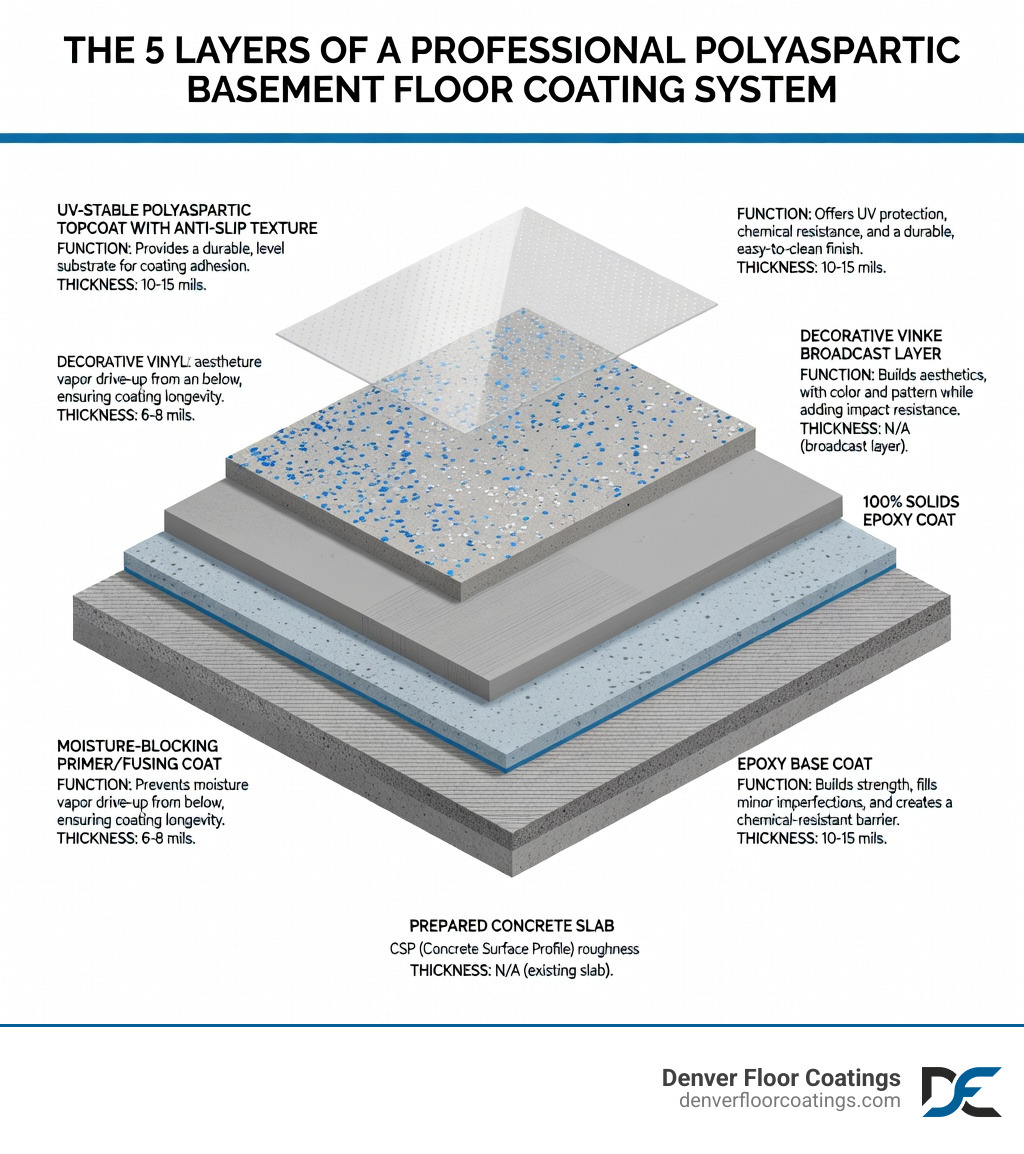
Denver Floor Coatings specializes in industrial-grade systems that are engineered to outperform standard retail products. While the term “epoxy” is often used generically, modern basement floor refinishing typically employs a sophisticated hybrid approach. We often utilize a high-solids epoxy basecoat for its exceptional bonding characteristics, followed by a polyaspartic topcoat for its high degree of durability and rapid cure times. This combination provides a floor that is designed to be flexible enough to handle minor slab movement and hard enough to resist significant wear over time.
These systems are specifically designed to manage the moisture vapor transmission common in below-grade slabs, as discussed in Epoxy coatings for water management. For a comprehensive breakdown of why these industrial systems are considered the gold standard for residential use, visit best-basement-flooring-options. By utilizing materials with high solids content, we ensure a thicker, more resilient dry film that can withstand the rigors of daily life.
The Advantages of Polyaspartic Topcoats
Polyaspartic technology represents a significant advancement for residential basement applications. Unlike traditional materials, polyaspartics are UV stable, which prevents the yellowing or ambering that can occur when sunlight enters through basement windows. They also provide high resistance to abrasion and common household chemicals. Perhaps most importantly for the homeowner, polyaspartic coatings cure very quickly, which allows for a much faster return to service than older resin technologies. Discover more in the-ultimate-guide-to-the-best-basement-flooring-options. This rapid cure time does not compromise the strength of the floor; rather, it is a result of advanced chemical engineering.
Aesthetic Versatility with Flake Finishes
One of the most rewarding aspects of basement floor refinishing is the dramatic visual improvement. We utilize decorative vinyl flakes that are broadcast into the wet basecoat until the floor reaches a state of “refusal,” meaning the entire surface is saturated with flake. This creates a multi-layered finish that can mimic the sophisticated look of granite or quartz. Beyond the aesthetics, the flake layer adds a subtle texture that enhances slip resistance and helps to mask minor imperfections in the underlying concrete. With a wide array of color combinations available, homeowners can easily coordinate the floor with their existing decor. See why this is often the best-choice-for-basement-flooring. The result is a floor that is as functional as it is beautiful.
The Professional Process for Refinishing Basement Concrete
When our team arrives at a home in Arvada, Highlands Ranch, or Boulder, we follow a rigorous, engineering-focused installation protocol. The process begins with a final site assessment to confirm that the slab and environmental conditions are optimal for the specific materials being used. We then proceed with the mechanical diamond grinding of the entire surface, ensuring that every corner and edge is properly profiled to accept the coating. This stage is critical for ensuring the chemical and mechanical bond that defines our work.
Once the grinding is complete and the floor has been thoroughly vacuumed using HEPA-filtered systems, we focus on precision repairs. This involves injecting cracks with specialized resins and using industrial mending compounds to fill pits or divots. We then apply the fusing primer or basecoat. While this layer is still wet, we broadcast the decorative flakes across the entire floor. After the basecoat has cured, we carefully scrape the floor to remove any standing flakes, ensuring a uniform texture. Finally, we apply a high-solids polyaspartic topcoat to seal the system, providing a durable and easy-to-clean wear layer. This systematic approach is designed to produce consistent, high-quality results.
Precision Repair and Leveling
We do not simply coat over existing damage; we address it. We utilize elastomeric sealants and high-strength mending compounds that are designed to bond permanently with the concrete. For floors that exhibit significant low spots or unevenness, we may employ specialized leveling compounds to create a more uniform surface. This meticulous attention to detail ensures that cracks do not “telegraph” through the finished floor, maintaining the seamless appearance of the system. Our goal is to create a substrate that is as stable as possible before the final aesthetic layers are applied.
Application and Curing Timelines
A major benefit of our high-performance systems is the efficiency of the installation. In many residential basements, the entire process can be completed in a single day. Because our polyaspartic topcoats are engineered for rapid curing, homeowners can typically walk on the new floor in clean socks within 24 hours. Heavy items, such as gym equipment or furniture, can usually be returned to the space shortly thereafter, minimizing the overall disruption to the household. This efficiency is a hallmark of the Denver Floor Coatings process, allowing you to enjoy your new space sooner.
Long-Term Benefits and Maintenance of Refinished Floors
Investing in a professionally installed basement coating from Denver Floor Coatings provides significant advantages beyond the immediate visual upgrade. The resulting surface is non-porous and seamless, which prevents the accumulation of dust, pet dander, and other allergens. This creates a more hygienic environment compared to traditional porous surfaces. Furthermore, a high-quality floor finish can enhance the overall market value of a home by transforming a utility space into a fully functional living area. For more on these long-term benefits, check out best-basement-flooring-options.
Routine Care and Cleaning Protocols
Maintaining a refinished basement floor is remarkably straightforward. Because the surface is sealed and seamless, dirt and debris remain on the surface where they can be easily removed. We recommend regular sweeping with a soft-bristle broom or the use of a microfiber mop. For a more thorough cleaning, a solution of water and a pH-neutral cleaner is typically all that is required. It is important to avoid the use of harsh abrasive tools or highly acidic cleaning agents, as these can eventually dull the finish of the topcoat. Proper care ensures the floor maintains its luster for years to come.
Expected Lifespan and Durability Factors
While the lifespan of any floor depends on specific usage patterns and environmental conditions, our professionally installed coating systems are engineered for exceptional longevity. In a typical residential basement setting, these floors are designed to provide reliable service for 15 years or more. The durability of the system is a direct result of the mechanical bond achieved during preparation and the thickness of the industrial-grade wear layers, which are significantly more resilient than standard consumer-grade products. We focus on providing a solution that stands up to the unique challenges of the Colorado climate.
Frequently Asked Questions about Basement Floor Refinishing
How long does the refinishing process typically take?
For the majority of residential basements in the Denver area, our team at Denver Floor Coatings can complete the entire installation process in a single day. While larger or more complex projects involving extensive repairs may require additional time, our use of rapid-curing polyaspartic technology is specifically designed to minimize the downtime for the homeowner. We prioritize efficiency without sacrificing the technical precision required for a high-performance finish.
Can coatings be applied to basements with previous water damage?
Yes, provided that the primary source of the water intrusion has been successfully mitigated. We can effectively repair surface damage such as scaling, pitting, and minor cracking that may have resulted from past moisture issues. However, if a basement experiences active standing water or significant bulk water intrusion, these issues must be addressed through proper drainage or waterproofing systems before our coating can be applied. We conduct thorough moisture testing to ensure the slab is ready for the application.
Are these floor coatings safe for indoor air quality?
We prioritize the safety of our clients and their homes. We utilize high-solids, low-VOC (Volatile Organic Compounds) products that are specifically formulated for indoor applications. While a slight scent may be present during the initial curing phase, it typically dissipates very quickly. Once the coating has fully cured, it is safe for families and pets, providing a stable and easy-to-maintain surface that does not harbor dust or allergens like traditional flooring might.
Conclusion
Refinishing your basement floor is a strategic investment that maximizes the usable space within your home. By converting a plain, dusty concrete slab into a beautiful, durable, and low-maintenance surface, you effectively reclaim a significant portion of your home’s square footage. Whether you are located in Castle Rock, Fort Collins, or anywhere across the Front Range, the key to a successful project lies in professional-grade preparation and the use of industrial-strength materials. At Denver Floor Coatings, we are committed to providing the expertise and high-performance systems necessary to ensure your basement floor remains a functional and attractive part of your home for years to come.
If you are ready to transform your basement into a high-quality living space, our team is prepared to help. We have the specialized equipment and the technical experience to ensure the job is done correctly the first time.
Request a free estimate from Denver Floor Coatings today and let’s transform your basement together!