

Choosing Epoxy Floor Systems That Fit the Job
The right epoxy floor system depends on how the floor will be used. A thin coating can suit lighter traffic, while thicker self-leveling or mortar systems are better suited to heavier loads and wear. Chemical exposure, moisture, thermal variation, and cleaning protocols also shape the choice. Every system needs sound, properly prepared concrete, followed by layers selected specifically for the space, such as an epoxy base and a protective topcoat.
For a residential garage, a decorative flake finish can add traction and give the floor a clean, finished look. In a busy manufacturing plant or logistics hub, the primary consideration is often a thicker build engineered for heavy equipment traffic and continuous rolling loads. Working with an experienced epoxy flooring specialist ensures that substrate conditions, thickness profiles, and cure schedules align with the operational demands of the space. Understanding when to specify a high solids epoxy versus specialized decorative applications like metallic epoxy coatings allows facility managers to balance aesthetic preferences with long-term functionality.
I’m Mike Wislinsky, founder of Denver Floor Coatings. My background in engineering and operations helps me evaluate epoxy floor systems with a focus on preparation, practical use, and lasting performance. Across commercial facilities and residential spaces throughout the Front Range, we focus on engineering reliable resin assemblies that perform predictably under daily service conditions.
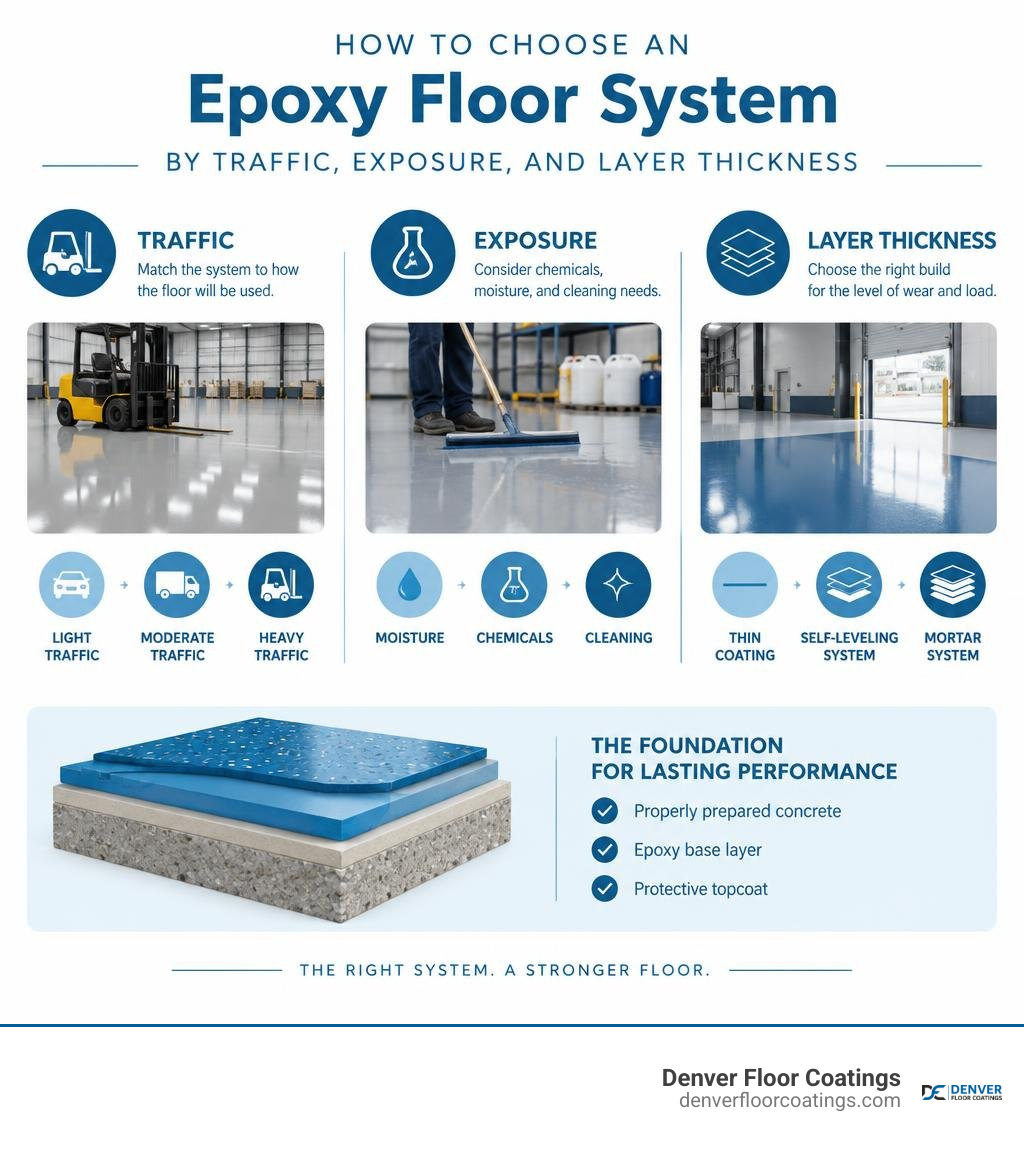
Core Categories of Epoxy Floor Systems and Their Applications
Selecting the proper resin system begins by evaluating your facility’s daily operational demands. We review our commercial epoxy coatings against specific service criteria: mechanical load, chemical exposure, thermal shock, cleaning frequency, and traffic volume.
Different operational zones require tailored system builds. Standardizing on the wrong profile leads to premature wear, whereas matching the right build to the environment maximizes reliability and lifecycle value across the floor’s operational lifespan.
| System Classification | Typical Thickness | Primary Mechanical Role | Ideal Service Environments |
|---|---|---|---|
| Thin-Film Coatings | 0.3 mm to 1.0 mm (12 to 40 mils) | Dust-proofing, light abrasion, foot traffic | Storage rooms, light assembly, residential garages |
| Self-Leveling Systems | 2.0 mm to 5.0 mm (80 to 200 mils) | Medium impact, rolling carts, forklift traffic | Warehouses, cleanrooms, automotive service bays |
| Heavy-Duty Mortars | 3.0 mm to 12.0 mm (120 to 480 mils) | Severe impact, heavy point loads, thermal cycling | Heavy manufacturing, loading docks, food processing |
Thin-Film vs. Self-Leveling Epoxy Floor Systems
Thin-film systems (0.3 to 1.0 mm) provide a dependable barrier against fluid penetration, minor scuffing, and routine foot traffic. They are an excellent option for spaces requiring dust control, light chemical resistance, and visual appeal without heavy mechanical stress. These systems typically comprise a penetrating primer and one or two pigmented body coats, creating a sealed surface that simplifies routine cleaning.
When facilities require higher impact resistance and flatter surfaces, self-leveling resins applied between 2.0 and 5.0 mm create a smooth, seamless commercial flooring finish. Self-leveling formulations flow out across the prepared slab to fill minor surface irregularities and create a uniform plane. Advanced formulations incorporate pinhole mitigation technology, which can reduce micro-pinholing by up to 98% during cure. This helps ensure a consistent, non-porous floor that resists bacterial buildup in sensitive environments such as pharmaceutical manufacturing, medical packaging, and electronic assembly facilities.
Heavy-Duty Mortar and Quartz Epoxy Floor Systems
For spaces handling severe impact, continuous steel-wheel traffic, or heavy machinery, polymer mortars applied at 3.0 to 12.0 mm offer maximum physical protection. These systems blend high-solids epoxy resins with graded silica or graded aggregates, applied via power trowel or screed box. The aggregate loading increases the compressive threshold of the matrix, absorbing high-energy point impacts and resisting rutting under static equipment loads.
For areas requiring decorative appeal alongside industrial strength, quartz-filled epoxy systems incorporate colored aggregates that distribute point loads while providing multi-tone slip resistance across wet corridors, locker rooms, and production rooms. These multi-broadcast builds encapsulate colored ceramic quartz within clear, chemical-resistant resins, delivering a textured profile that balances traction with cleanability under demanding washdown regimens.
Material Chemistry: 100% Solids, Water-Based Resins, and Protective Topcoats
Understanding resin chemistry allows facility owners to balance ease of application, volatile organic compound (VOC) compliance, and physical strength.

High-performance floor builds generally feature a multi-layer strategy combining an epoxy primer, pigmented body coats, and specialized topcoats like aliphatic polyurethane or our polyaspartic floor coating services for rapid cure times and UV stability.
Comparing Resin Formulations and Topcoat Performance
Formulations differ substantially in their chemical cross-linking density, viscosity, and carrier mechanisms:
- 100% Solids Epoxy: Contains no solvent or water carriers, meaning 100% of the wet film thickness remains after cure. These formulas yield high compressive strengths (often exceeding 13,000 psi) and robust adhesion to prepared concrete. Because no solvents evaporate during polymerization, 100% solids materials emit very low odor and virtually zero VOCs, making them suitable for occupied commercial facilities.
- Water-Based Epoxy: Uses water as a carrier. While simple to apply and lower in odor, they leave a thinner dry film and provide lower abrasion resistance. They are best reserved for light dust-proofing or as breathable primers on concrete with minor residual moisture.
- Polyurethane and Polyaspartic Topcoats: Act as protective wear layers over the structural epoxy body coats. Reviewing our epoxy floor chemical resistance guide helps identify when to pair aromatic epoxy bases with aliphatic topcoats. These topcoats deliver exceptional epoxy floor UV resistance to prevent ambering near bay doors, exterior entrances, or skylights.
Recoat windows are critical to inter-coat bonding. Under standard conditions (typically around 22 degrees Celsius or 72 degrees Fahrenheit at 50% relative humidity), subsequent layers should be placed within 24 hours of surface dry to ensure chemical cross-linking. If the recoat window passes, mechanical abrasion is necessary to re-establish a profile for mechanical interlock.
Static Control and Environmental Safety Standards
In electronics assembly, aerospace manufacturing, or volatile chemical storage, electrostatic discharge (ESD) can damage sensitive components or ignite airborne vapors. Specifying ESD flooring requires strict adherence to conductivity ranges:
- Conductive Flooring: 10^4 to 10^6 ohms resistance for immediate charge dissipation into a grounded copper grid.
- Static Dissipative Flooring: 10^6 to 10^9 ohms resistance for controlled charge drainage that protects delicate electronics without creating a rapid grounding hazard.
For wet production zones, our anti-slip epoxy flooring guide details how broadcasting aluminum oxide (such as 240-mesh grit) into topcoats elevates the static and dynamic coefficient of friction, meeting OSHA workplace safety guidelines without compromising cleanability.
Concrete Substrate Preparation and Moisture Control Protocols
No resin system can outperform the concrete beneath it. Proper mechanical preparation creates the physical profile required for high-strength adhesion.

Following recognized engineering guidelines like the NACE TR02203-2023 design standards, we profile concrete slabs to achieve a Concrete Surface Profile (CSP) of 3 to 5 using diamond grinding or shot blasting.
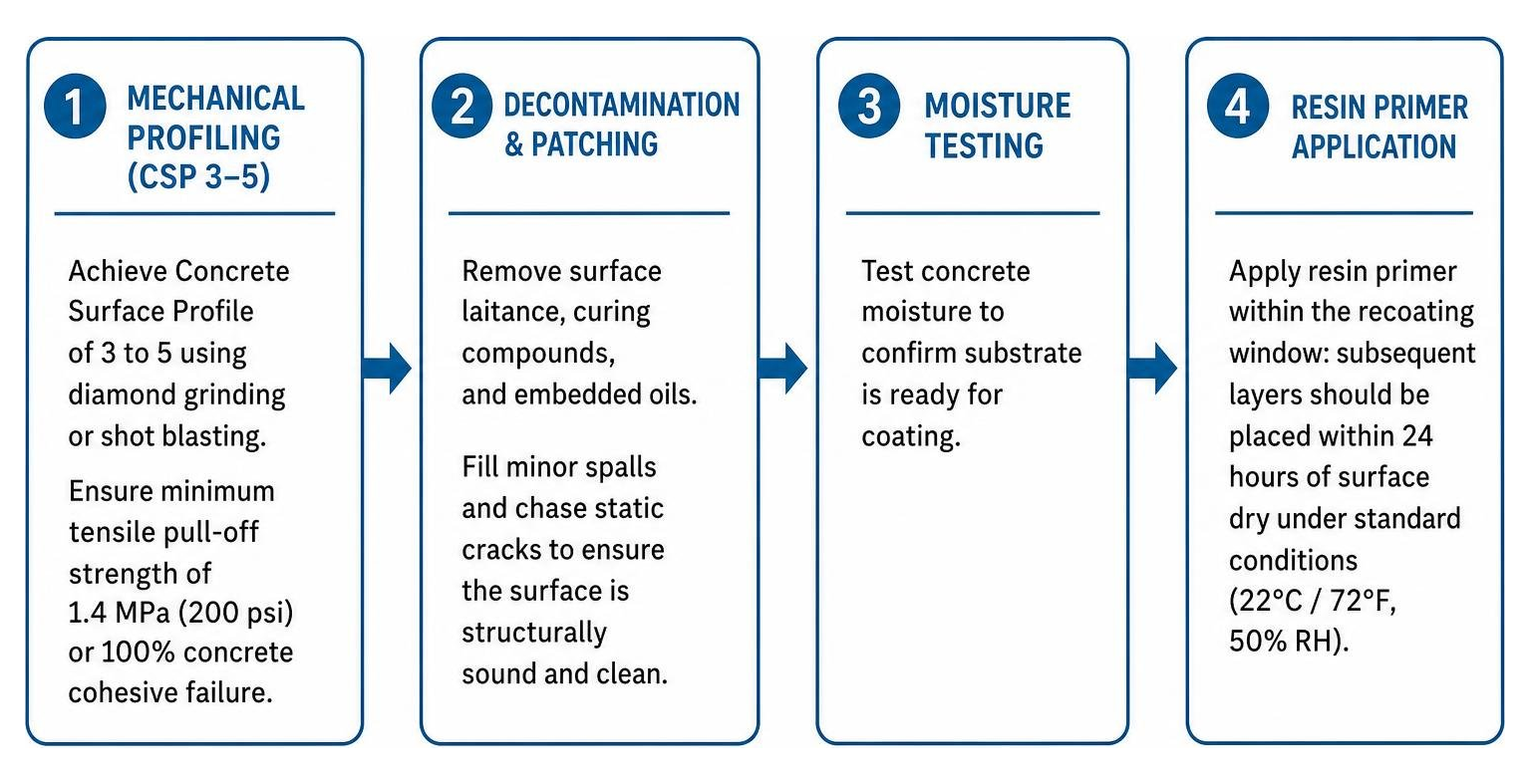
Surface Profiling and Structural Soundness
To ensure long-term bonding, the concrete substrate must demonstrate a minimum tensile pull-off strength of 1.4 MPa (200 psi) or show 100% concrete cohesive failure under testing. Opening the concrete pores allows low-viscosity primers to penetrate deeply into the matrix, anchoring the resin mechanically to the aggregate and paste.
Preparation requires completely removing surface laitance, curing compounds, sealers, and embedded oils. Concrete floor repair, such as filling minor spalls or chasing static cracks, is only a small component of our floor-coating preparation work, ensuring the surface is structurally sound and clean before primer application. Deeply contaminated areas may require specialized degreasing or localized scarification before mechanical profiling proceeds.
Moisture Testing and Joint Treatment
Moisture beneath a slab exerts hydrostatic pressure and causes osmotic blistering if trapped beneath non-breathable resin films. Conducting thorough concrete moisture testing is essential before placing non-breathable resins. Standard guidelines specify:
- Moisture Vapor Emission Rate (MVER): Equal to or less than 3 to 5 lb per 1,000 sq ft per 24 hours when tested via the ASTM F1869 Calcium Chloride method.
- Relative Humidity (In-Situ Probes): Equal to or less than 75% to 90% internal relative humidity under ASTM F2170 protocols.
When values exceed these limits, a specialized moisture-mitigating primer with low viscosity (such as 300 cps) is applied to penetrate and seal microscopic capillaries, mitigating vapor drive up to 15 to 25 lb MVER.
Joints must also be detailed correctly based on their structural role. Isolation and dynamic expansion joints should be honored through the coating system and filled with flexible elastomeric sealants. Non-moving control joints and static hairline cracks can be filled with rigid or semi-rigid epoxy fillers prior to coating to create a continuous, seamless surface.
Mechanical Performance Standards and Long-Term Maintenance
Specifying high-performance industrial floor coatings requires quantifiable metrics rather than guesswork. Laboratory performance data provides objective insight into how a system will endure under physical stress, abrasion, and aggressive cleaning routines.
A high-performance system like LABFLOOR 4E, built at 25 to 31 mils, exemplifies how engineered coatings handle punishing commercial traffic:
- Compressive Strength (ASTM D695): Up to 13,200 psi, supporting heavy manufacturing equipment and high-density racking loads.
- Tensile Strength (ASTM D2370): Up to 7,800 psi with 7% elongation (ASTM D638), providing elasticity under dynamic deflection.
- Abrasion Resistance (ASTM D4060): Only 20 mg weight loss on a Taber Abraser (CS-17 wheel, 1,000 cycles, 1 kg load), resisting wheel wear.
- Hardness (ASTM D2240): Shore D 82 for high impact tolerance and scratch resistance.
- Coefficient of Friction (ASTM E303): 1.3 for wet and dry slip mitigation when textured aggregates are incorporated.
ASTM Testing Standards for Industrial Durability
Validating resin performance relies on established laboratory tests that simulate real-world physical and chemical stressors:
- ASTM D7234: Pull-off adhesion of coatings on concrete to verify mechanical bond strength and ensure failure occurs within the concrete substrate rather than at the resin interface.
- ASTM C267: Chemical resistance of mortars and polymer systems against continuous exposure to acids, alkalis, and industrial solvents.
- ASTM D4060: Taber abrasion testing to project long-term wear patterns from wheeled traffic, pallet jacks, and dragged loads.
- ASTM D2794: Impact resistance testing to determine the resin matrix’s ability to resist cracking when subjected to direct drop impacts.
Lifecycle Maintenance and Surface Care Best Practices
While high-performance epoxy systems provide substantial durability, routine care helps preserve surface clarity, gloss, and slip resistance over time:
- Daily Debris Removal: Sweep or dry-mop daily to clear abrasive dust, metal shavings, and grit that can cause micro-scratching under traffic.
- pH-Neutral Cleaning: Wash with neutral detergents; avoid harsh acidic cleaners or high-citrus degreasers that can dull glossy topcoats or weaken thin films over extended periods.
- Immediate Spill Response: Clean chemical spills, oils, and automotive fluids promptly to prevent localized surface staining or polymer softening.
- Periodic Deep Cleaning: Use an auto-scrubber equipped with soft white or red cleaning pads for high-traffic corridors, ensuring squeegees collect all wash water to prevent mineral deposits.
Frequently Asked Questions
What thickness is required for heavy forklift and vehicle traffic?
For facilities with standard pallet jacks and moderate forklift traffic, self-leveling systems applied at 2.0 to 5.0 mm provide balanced load distribution and smooth wheel transition. For continuous, heavy forklift operations, steel wheels, or high-impact staging zones, a 3.0 to 12.0 mm heavy-duty polymer mortar is recommended to withstand repeated mechanical shocks and distribute heavy point loads.
How long must new concrete cure before installing resin systems?
Standard concrete slabs must cure for at least 28 days to allow adequate hydration and moisture reduction. Before installation, we verify moisture vapor levels and internal relative humidity to ensure the slab meets manufacturer thresholds, applying specialized moisture-barrier epoxy primers when higher moisture levels are detected.
Can polymer floors withstand aggressive chemical washdowns?
Yes, provided the resin chemistry is selected for the specific chemicals used in the facility. High-performance epoxy base layers protected by chemical-resistant polyurethane or polyaspartic topcoats resist standard industrial cleaners, lubricating oils, and sanitizers. For extreme conditions like continuous steam cleaning, high-temperature washdowns, or concentrated acids, specialized resin matrices are engineered to withstand thermal cycling and chemical exposure without delamination.
How do epoxy systems differ from decorative flake and quartz finishes?
Solid-color epoxy systems rely on pigmented resins to create a uniform, smooth surface. Decorative flake and quartz systems incorporate vinyl flakes or colored ceramic aggregates broadcast directly into the wet epoxy base coat before receiving clear protective topcoats. These multi-layer broadcast systems enhance impact resistance, conceal minor substrate imperfections, and provide adjustable slip resistance for wet or high-traffic environments.
Conclusion
A durable floor requires matching resin chemistry, system thickness, and proper mechanical preparation to your facility’s operational needs. Whether you are managing an automotive showroom, a high-traffic warehouse, or a manufacturing plant, selecting the right system provides reliable surface protection, easier cleaning, and an attractive, professional finish.
At Denver Floor Coatings, we help commercial facilities and homeowners across the Denver metro area, Front Range, and mountain communities build dependable, high-performance floors. Contact Denver Floor Coatings today for a free estimate on your upcoming project, or explore our complete range of commercial floor coating solutions to find the ideal fit for your space.