

What Is Concrete Sealing? (And Why Your Floor Needs It)
Concrete sealing is the process of applying a protective barrier to concrete surfaces to guard against moisture, spills, chemicals, and everyday wear.
Here’s a quick overview of what you need to know:
- What it does: Blocks moisture, resists discoloration, and slows surface deterioration
- Two main types: Penetrating sealers (soak into the concrete) and topical coatings (sit on top of the surface)
- How long it lasts: Lifespans vary depending on the product type, traffic, and environmental exposure
- Best for: Indoor concrete surfaces, including garage floors, commercial spaces, and industrial floors
- Key requirement: Concrete must be fully cured and properly cleaned before any sealer is applied
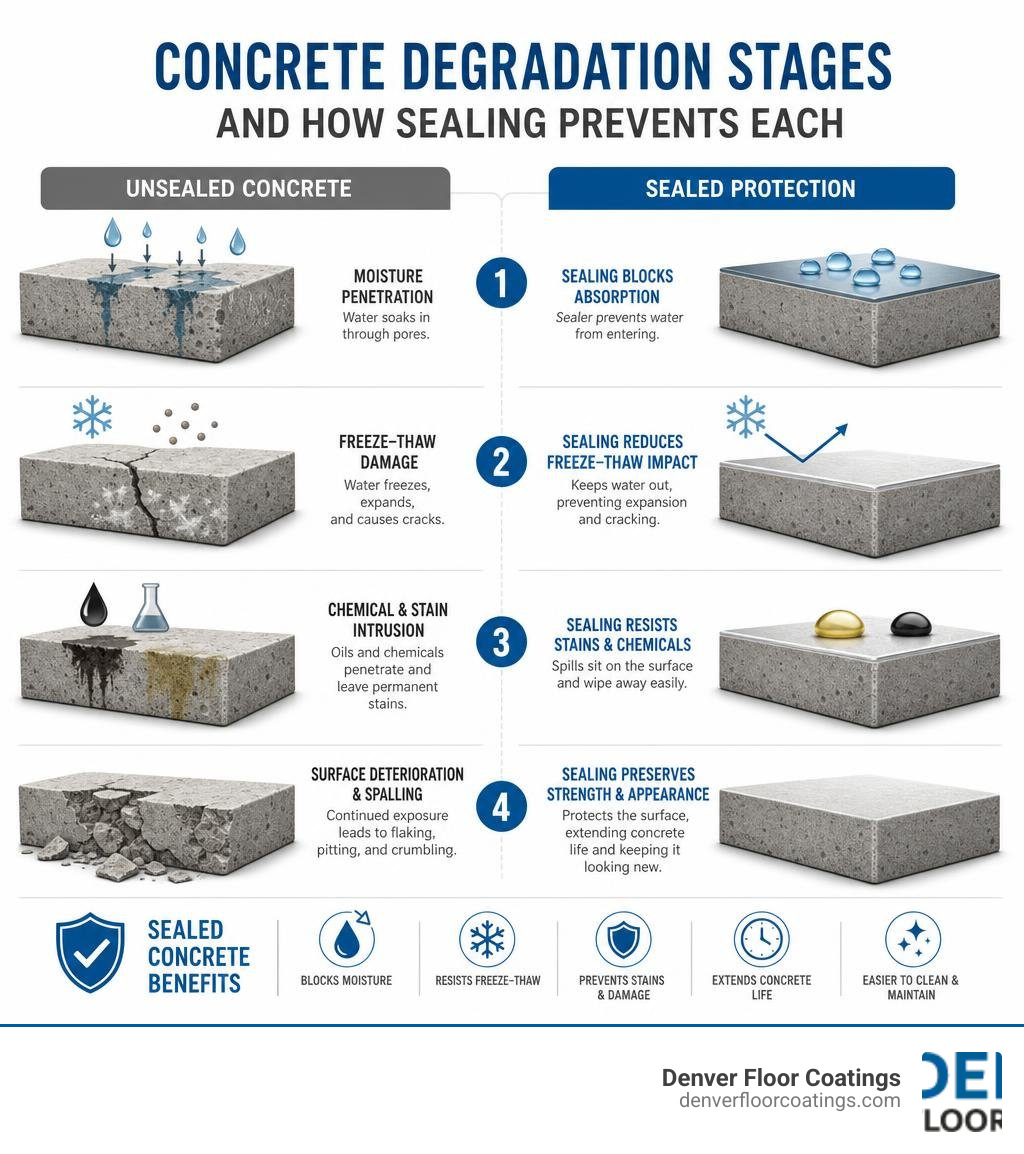
Concrete is one of the toughest building materials around, but it has a serious weakness. It’s highly porous. During the mixing and pouring process, more water is typically added to the concrete mix than is chemically required for hydration. As the concrete cures, this excess water evaporates, leaving behind a complex network of microscopic capillaries, pores, and voids. This means moisture, oil, road salt, and chemicals can seep right in, especially in a climate like Denver’s, where freeze-thaw cycles put concrete through brutal seasonal stress.
Left unsealed, concrete absorbs water. That water freezes, expands, and slowly breaks the surface apart from the inside out. This is related to frost weathering, a physical process where repeated freezing and expansion can stress porous materials. Add in de-icing salts tracked in from outside, and you have a recipe for spalling, cracking, and that powdery “dusting” that makes garage floors look perpetually dirty.
Sealing creates a barrier that slows all of this down or helps prevent it entirely, depending on the system you choose.
I’m Mike Wislinsky, Founder and President of Denver Floor Coatings, and with over 20 years of engineering and operations experience – plus nearly a decade specializing in high-performance concrete coating sealers and coating systems – I’ve seen what happens when floors are protected right versus when they’re not. In the sections below, I’ll walk you through everything you need to know to make a smart, informed decision for your floor and understand what does concrete sealer do.
Understanding Concrete Sealing and Its Core Benefits
To understand why sealing is so important, we have to look at concrete under a microscope. Even though a solid concrete slab looks completely dense, it is actually a complex network of microscopic pores, capillaries, and voids. Think of it like a hard stone sponge.
When liquids come into contact with unsealed concrete, capillary action draws them deep into the slab. This is where the damage begins. As moisture penetrates, it carries dissolved contaminants deep into the concrete matrix. When the water eventually evaporates, these contaminants remain trapped, leading to internal structural pressure and aesthetic degradation.
By applying a high-quality sealer or protective coating, we create a defensive shield that yields several core benefits:
- Moisture Protection: Water is concrete’s greatest enemy. Sealing prevents water from soaking into the pores, which is critical for surviving freeze-thaw cycles.
- Discoloration and Chemical Resistance: Spilled engine oil, gasoline, transmission fluid, and household chemicals can permanently discolor and degrade raw concrete. A protective layer keeps these contaminants on the surface so they can be wiped away easily.
- Eliminating Concrete Dusting: Raw concrete naturally sheds a fine, chalky powder over time due to traffic wear. This “dusting” settles on cars, tools, and storage bins. High-performance coatings bind the surface matrix together, virtually eliminating dusting.
- Enhanced Durability: Sealed concrete resists abrasion, heavy foot traffic, and impact far better than bare concrete, helping to extend the overall lifespan of your floor.
For a deeper dive into how these protective barriers function at a microscopic level, you can explore our detailed guide on what does concrete sealer do.
Types of Concrete Sealers and Coating Systems
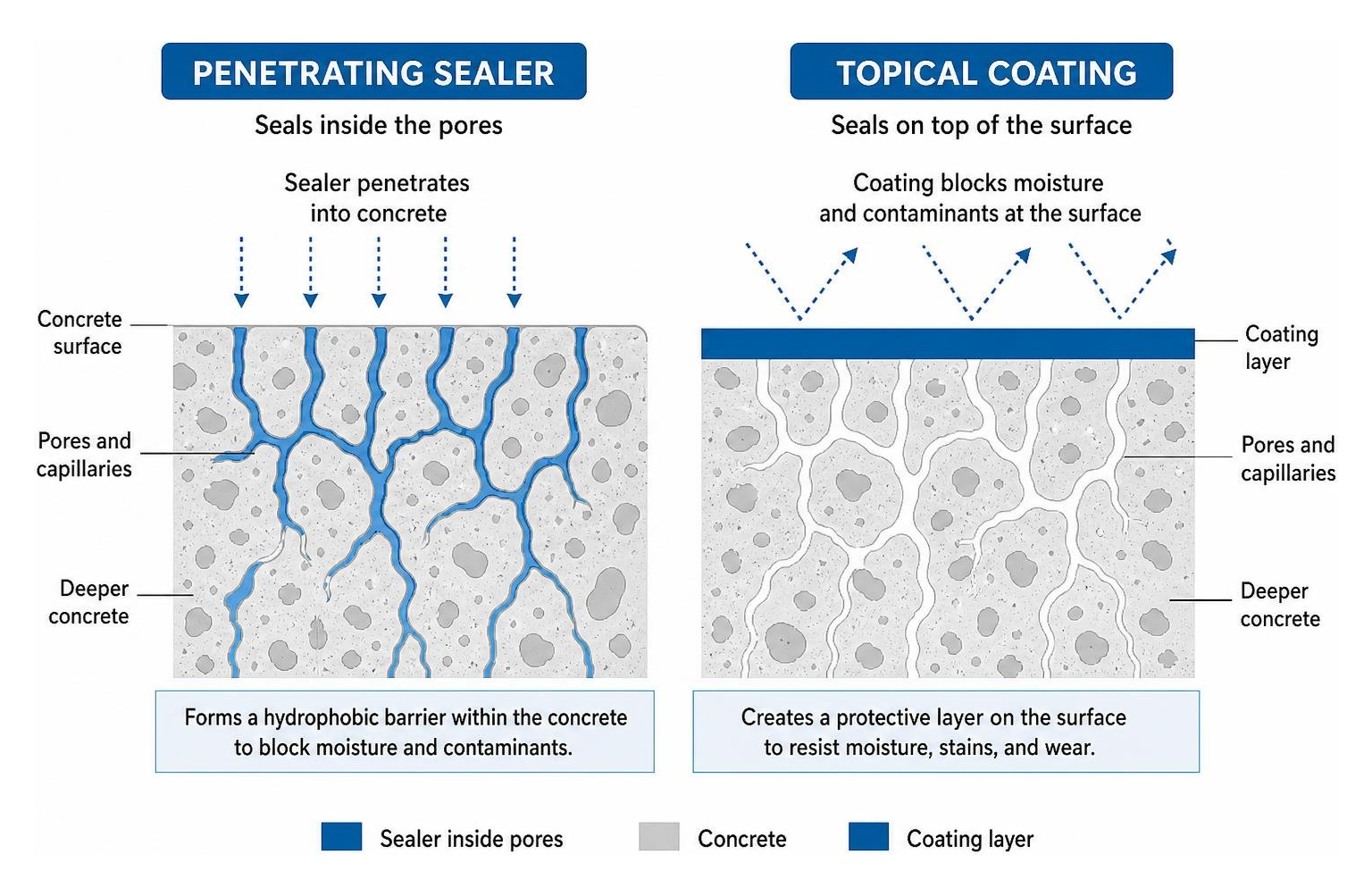
Not all concrete sealers are created equal. They generally fall into two primary categories: penetrating sealers, which work completely below the surface, and topical coatings, which form a protective wear layer on top of the concrete.
Penetrating Concrete Sealing Systems
Penetrating sealers are formulated with active ingredients like silanes, siloxanes, or silicates. When applied to clean concrete, they soak deep into the capillaries and chemically react with the calcium hydroxide within the cement paste. This reaction forms an insoluble hydrophobic gel that lines the pores.
Because they work entirely below the surface, penetrating sealers:
- Do not alter the physical appearance or sheen of the concrete.
- Keep the concrete breathable, allowing internal moisture vapor to escape.
- Provide protection against sub-surface water damage and salt intrusion.
- Are commonly used on exterior flatwork to help mitigate seasonal freeze-thaw damage.
While penetrating sealers are excellent for moisture management, they do not create a thick physical wear barrier to protect against heavy impact, scratches, or harsh industrial chemicals.
Topical Concrete Sealing and High-Performance Coatings
Topical sealers and high-performance coatings sit on top of the concrete surface, creating a continuous protective film. These range from basic retail acrylics to industrial-grade epoxy and polyaspartic systems.
- Acrylic Sealers: These are thin, film-forming sealers often used to provide a quick “wet look” or gloss finish. While popular for basic projects, acrylics can wear down quickly under vehicle traffic and are highly susceptible to “hot tire pickup,” where hot tires bond to the sealer and peel it off.
- Epoxy Coatings: Epoxy resins form a thick, incredibly hard, and chemical-resistant barrier. They are excellent for indoor environments but require proper formulation to prevent ambering or yellowing under UV exposure near windows and garage doors.
- Polyaspartic Coatings: This is an exceptional choice for high-performance garage and commercial floors. Polyaspartic coatings are highly flexible, incredibly resistant to impact and chemicals, completely UV-stable, and cure rapidly.
At Denver Floor Coatings, we specialize in transforming plain concrete into highly functional, beautiful spaces using these advanced polyaspartic and epoxy-based flake systems. If you are weighing your options between a basic sealer and a heavy-duty coating, our resource on concrete coating sealers provides an excellent breakdown of how to make the right choice.
| Feature | Penetrating Sealers | Topical High-Performance Coatings |
|---|---|---|
| Primary Mechanism | Penetrates and reacts inside pores | Forms a thick, protective surface film |
| Surface Appearance | Invisible, natural look | Glossy, satin, or decorative flake finish |
| Hot Tire Resistance | Excellent (nothing on surface to peel) | Outstanding (when professional polyaspartic is used) |
| Chemical Resistance | Moderate (resists water and salts) | High (resists oils, acids, solvents, and fuel) |
| Dust Prevention | Moderate | Virtually dust-free surface |
| Ideal Environments | Exterior driveways, sidewalks | Garages, warehouses, showrooms, factories |
The Importance of Professional Surface Preparation
If there is one universal truth in the concrete industry, it is this: a sealing or coating system is only as good as the surface preparation.
Standard cleaning methods often fail to open up the concrete pores uniformly and cannot remove deep-seated oil contaminants, old sealers, or curing compounds. To achieve a permanent bond, Denver Floor Coatings relies on professional mechanical preparation.
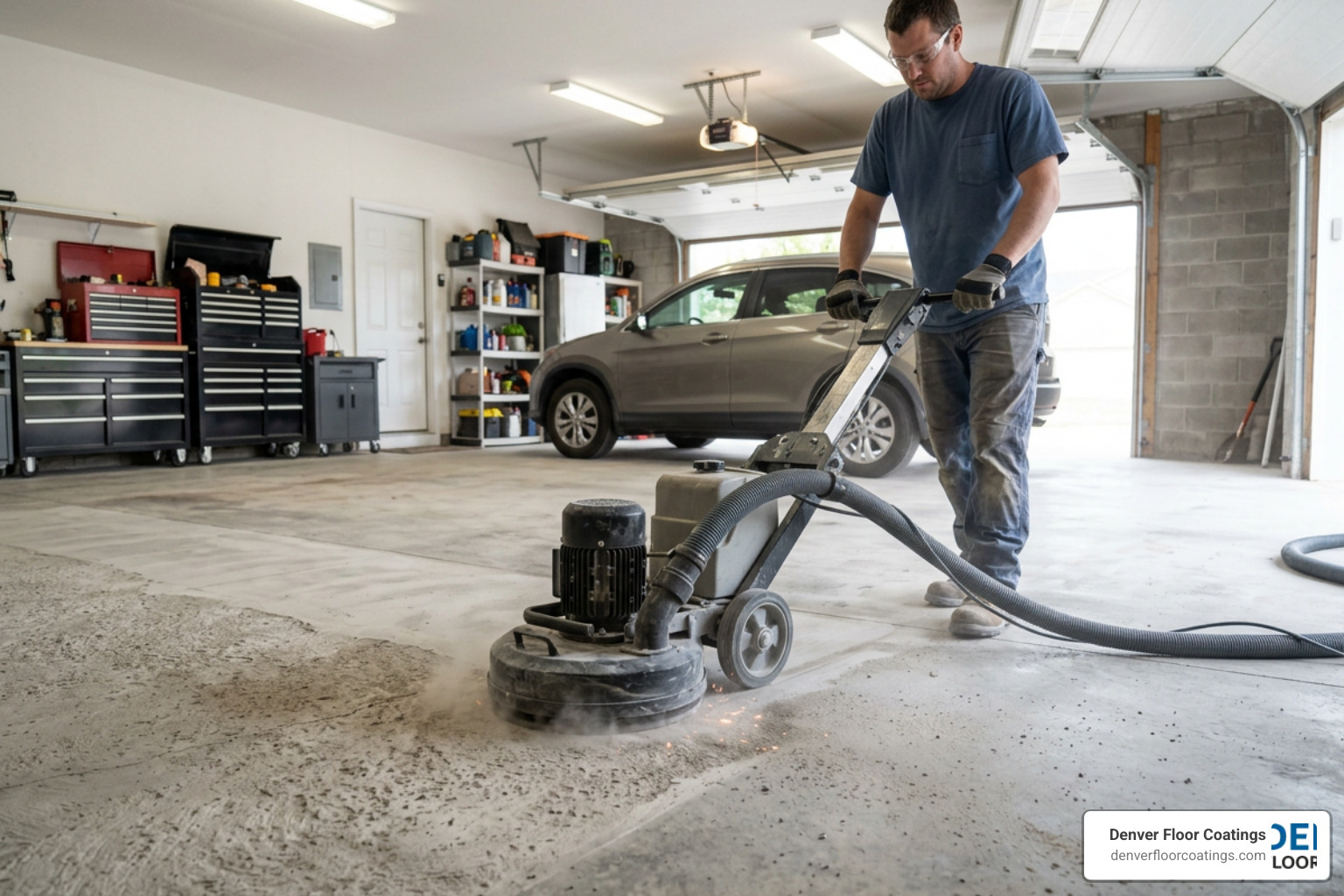
Using heavy-duty walk-behind diamond grinders, we profile the concrete surface. This process behaves like sanding wood before painting; it removes the weak top layer of concrete (laitance), strips away old contaminants, and creates a micro-textured profile. This profile gives the high-performance epoxy or polyaspartic coating the perfect texture to lock into.
Before we apply any coating, we also address moisture. Concrete slabs can act like giant straws, drawing moisture up from the earth beneath the building. If a floor is sealed while having active moisture vapor transmission issues, that vapor pressure can build up beneath the non-porous coating, leading to bubbling, blistering, and eventual peeling.
We conduct rigorous concrete moisture testing on every project to ensure the slab is dry enough to receive our industrial-grade systems safely.
Protecting Indoor Concrete from Colorado’s Harsh Seasons
Living and working along the Front Range — from Fort Collins down to Castle Rock — means dealing with dramatic weather shifts. Our winters bring heavy snow, ice, and freezing temperatures, while our summers deliver intense high-altitude UV radiation.
When you drive your car into your garage during a winter storm in Denver, Aurora, Arvada, or Westminster, your vehicle carries a heavy mixture of snow, ice, road salt, and liquid de-icers. As that slush melts on your garage floor, it accumulates.
If your concrete is unsealed, it absorbs this salty brine. The salt lowers the freezing point of water inside the pores, which accelerates internal pressure during freeze-thaw cycles. This leads to rapid surface scaling and spalling, leaving your garage floor looking pitted and worn. You can learn more about how to safeguard your slab from this seasonal chemical erosion in our guide on how to protect concrete from salt.
Our high-performance garage floor coatings are specifically engineered to withstand these harsh conditions. Because garage floors are our specialty (making up roughly 80% of our daily operations), we design our multi-layer polyaspartic and epoxy flake systems to be highly resistant to water, road salt, and automotive fluids.
Whether you need to protect a residential garage in Thornton, a commercial warehouse in Boulder, or an industrial facility in Longmont, our seamless, non-slip coatings ensure your concrete remains beautiful, hygienic, and easy to clean through every season.
Frequently Asked Questions About Sealing Concrete
How long does concrete sealer typically last?
The lifespan of a sealer depends on the type of product used, environmental factors, and the volume of traffic it experiences:
- Topical acrylic sealers may begin to wear thin, dull, or peel under vehicle tires within a few seasons.
- Penetrating sealers often provide protection for several years before requiring reapplication to maintain water repellency.
- Professional polyaspartic and epoxy systems are designed as long-term, highly durable flooring solutions. With basic cleaning and maintenance, these industrial-grade coatings are engineered to protect your indoor concrete for years to come.
Why is surface preparation so critical before sealing?
Sealers and coatings require a clean, open pore structure to adhere properly. If the concrete has dirt, oil, grease, or existing sealers trapped inside its pores, the new product cannot penetrate or bond. This lack of adhesion is a primary cause of bubbling, flaking, and premature coating failure. Professional diamond grinding is an exceptionally reliable way to ensure a clean, properly profiled surface.
Can you seal concrete that has moisture issues?
Applying a topical, non-porous sealer or coating over concrete with high moisture vapor transmission is generally not recommended. Doing so traps the moisture beneath the film, which can eventually cause the coating to bubble and peel. If moisture testing reveals high levels of vapor transmission, we must first address the root cause or apply a specialized moisture vapor barrier primer designed to withstand hydrostatic pressure. To learn more about managing these sub-slab moisture challenges, read our guide on how to get rid of concrete moisture.
Conclusion

Your concrete floors represent a significant investment in your home or commercial property. Leaving them bare exposes them to moisture, chemical discoloration, dusting, and the destructive freeze-thaw cycles of Colorado’s winters.
While basic penetrating sealers and standard topical sealers offer temporary relief, they require frequent maintenance and can struggle to stand up to hot tires, heavy impact, and chemical spills.
At Denver Floor Coatings, we help homeowners and commercial property owners across the entire Front Range upgrade their concrete with industrial-grade, high-performance epoxy and polyaspartic coating systems. Our seamless, decorative flake finishes are highly UV-stable, non-slip, chemical-resistant, and installed quickly—often in just a single day.
If you’re ready to transform your worn garage, warehouse, factory, or showroom floor into a beautiful, durable, and easy-to-clean space that stands up to heavy use, we are here to help. Contact Denver Floor Coatings for a free estimate today, and let’s discuss how we can protect your floor for the long haul.