

What Should You Look for in Denver Floor Coatings’ Professional Installation Standards?
Selecting a high-grade resinous flooring system requires evaluating rigorous technical standards, specialized preparation equipment, and field-tested resin chemistry. When evaluating concrete coating companies throughout the Front Range, understanding the engineering practices behind a seamless installation helps ensure you receive a resilient, beautifully finished floor designed for demanding residential and commercial conditions.
At Denver Floor Coatings, we maintain full general liability coverage, comprehensive state licensing, and advanced certifications for industrial-grade polyaspartic and epoxy polymers. Our operational philosophy centers on meticulous mechanical surface preparation. The concrete surface profile (CSP) standard established by the International Concrete Repair Institute (ICRI) indicates that concrete requires mechanical profiling—specifically a CSP 2 to CSP 3 profile—to establish an enduring mechanical interlock. Without this mechanical profile, liquid polymers cannot penetrate deeply into the open pore structure of the concrete matrix.
Moisture vapor evaluation represents an essential preliminary step on every project. Colorado slabs frequently encounter significant moisture vapor transmission due to local water tables, irrigation runoff, and winter snowmelt. Prior to resin placement, our technicians perform quantitative moisture tests to verify that vapor emission rates align with strict manufacturer tolerances. Denver Floor Coatings provides clear, documented warranty coverage that explicitly outlines protection against peeling and delamination under regional freeze-thaw cycles. As a dedicated concrete coating company and one of the best epoxy flooring contractors in Denver, we execute these precise technical controls on every commercial and residential application.
Essential Preparation Equipment and Field Standards
High-performance floor finishes demand heavy-duty mechanical equipment to properly open the concrete slab and create a consistent profile across the entire surface.
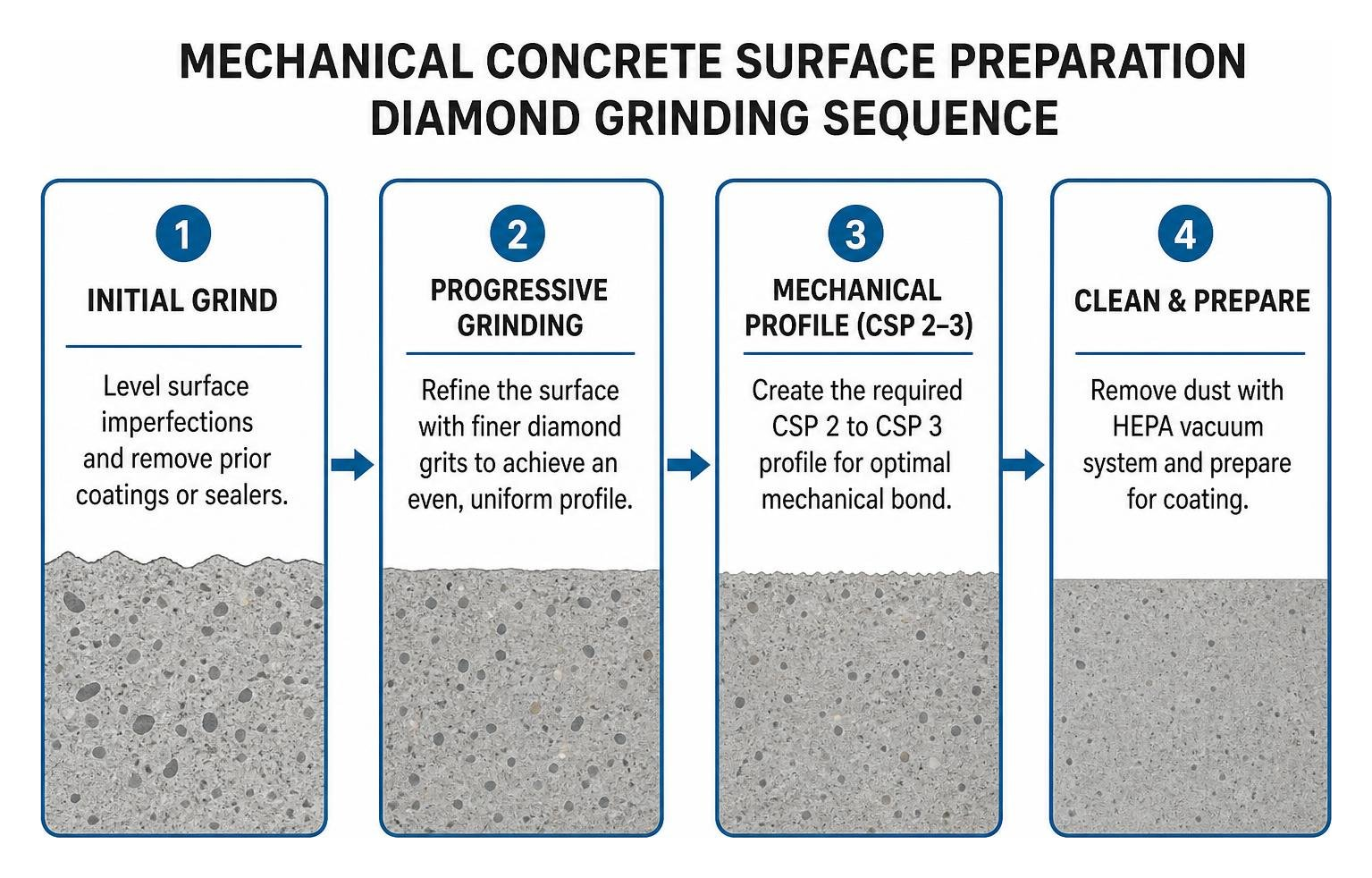
Key equipment and installation protocols utilized by Denver Floor Coatings include:
- Multi-Head Planetary Diamond Grinders: Heavy commercial equipment calibrated to generate a consistent CSP 2–3 mechanical profile across diverse concrete densities.
- Integrated Dust-Free HEPA Vacuums: Specialized extraction systems that capture up to 99.97% of airborne silica particulates down to 0.3 microns, protecting indoor air quality and ensuring clean substrate adhesion.
- Rapid-Curing Polyurea Repair Polymers: Low-viscosity elastomeric resins that penetrate and mend static fractures prior to prime coat application.
- Electronic Moisture Impedance Meters & Calcium Chloride Kits: Specialized diagnostic testing equipment used to accurately determine concrete vapor emission rates and relative internal humidity.
- Strict Jobsite Safety Standards: Comprehensive personal protective equipment (PPE) protocols, meticulous air monitoring, and disciplined material handling on all residential and commercial sites.
How Do One-Day Polyaspartic Garage Floor Coatings Compare to Commercial Epoxy?
Understanding resin chemistry helps property owners select the most suitable coating technology for their operational environment. Denver Floor Coatings specializes in high-performance epoxy and polyaspartic coating systems, including decorative flake finishes, rather than stained concrete services. While polyaspartic and epoxy formulations both deliver seamless, non-porous protection, their specific polymer structures serve distinct performance needs.
Polyaspartic coatings belong to the aliphatic polyurea family. Their primary operational advantage is an accelerated curing profile paired with complete ultraviolet (UV) stability. In residential garages and light commercial spaces, sunlight enters through open overhead bay doors or windows. Traditional aromatic polymers may amber, chalk, or discolor when exposed to natural light, whereas polyaspartic clear topcoats maintain clarity and color integrity. In addition, polyaspartics possess greater natural elongation, allowing the cured film to expand and contract slightly with seasonal thermal shifts in unheated garages. To explore these properties in detail, review our guide on Polyaspartic Flooring Services in Denver Terms Demystified.
Commercial epoxy systems serve as a premier standard for indoor manufacturing, commercial warehousing, logistics centers, and industrial facilities. Formulated for high build thickness, epoxy resin delivers exceptional compressive strength, impact resistance, and long-term barrier protection against aggressive chemicals, petroleum products, and heavy equipment traffic. Facility managers seeking comprehensive technical specifications can review our Commercial Epoxy Floor Complete Guide.
| Feature / Metric | One-Day Polyaspartic Flake System | Commercial Epoxy System |
|---|---|---|
| Primary Application Environment | Residential garages, light commercial, retail showrooms | Heavy industrial, manufacturing, distribution centers |
| Pedestrian Foot Traffic Cure | Typically 4 to 6 hours | Typically 24 to 48 hours |
| Full Vehicle Return-to-Service | Typically 24 to 48 hours | Typically 72 to 96 hours |
| Ultraviolet (UV) Stability | Inherent aliphatic UV stability | Requires an aliphatic topcoat for outdoor UV exposure |
| Hot-Tire Pickup Resistance | Superior cross-linked resistance | High resistance once fully cured |
| Compressive Load Capacity | High tensile flexibility and resilience | Exceptional high-build compressive strength |
| Standard Application Schedule | Rapid single-day multi-layer installation | Multi-day sequenced application process |
Polyaspartic Garage Floor Benefits
Polyaspartic systems installed by Denver Floor Coatings are particularly effective in residential settings. The rapid curing schedule allows homeowners to regain functional use of their garage space within a short timeframe. These systems effectively resist hot-tire pickup—a failure mechanism where heat transferred from vehicle tires softens low-grade surface treatments and pulls them away from the concrete. Because polyaspartic chemistry retains flexibility across a broad temperature range, it handles Front Range temperature fluctuations smoothly. Learn more about our approach to garage floor coating in Denver.
Commercial Epoxy System Strengths
For high-volume industrial environments, our commercial concrete coatings provide a continuous, high-build barrier that protects the underlying concrete slab against oil penetration, mechanical abrasion, and heavy dynamic loads. Epoxy systems can be layered with dedicated wear additives, quartz aggregate, or high-build slurries to accommodate continuous forklift traffic, pallet jacks, and rigorous cleaning procedures.
What Factors Influence the Investment for Floor Coating Installations in Denver?
Every concrete slab exhibits unique structural and environmental characteristics that determine overall project scope. Rather than applying a single uniform figure, Denver Floor Coatings evaluates residential and commercial projects through comprehensive on-site inspections covering square footage, substrate conditions, and operational wear requirements. Investing in professional-grade resin systems provides considerable lifecycle value, as seamless finishes significantly reduce routine maintenance labor, concrete dusting, and ongoing floor care expenses over an extended operational life.
Several core variables determine the overall estimate for commercial floor coatings and residential installations:
- Total Project Square Footage: Larger surface footprints often achieve beneficial material mobilization and installation efficiencies.
- Concrete Substrate Condition: Slabs displaying surface irregularities, laitance, or previous coatings require extended diamond grinding passes to achieve a clean CSP 2–3 profile.
- Substrate Preparation & Remediation: Concrete floor repair is only a small component of the company’s floor-coating preparation work, but properly treating static cracks, spalls, and joint edges is essential to support an even decorative build.
- Resin System Architecture: Multi-layer commercial specifications, high-build decorative broadcast systems, or chemical containment barriers require specific material volumes and layering stages.
- Decorative Enhancements & Performance Aggregates: Selection of custom color flake blends, metallic pigments, anti-microbial additives, or aluminum oxide traction aggregates tailored to the facility’s slip-resistance requirements.
- Facility Logistics & Scheduling: Commercial operations requiring overnight phases, weekend scheduling, or fast-track sequencing to maintain business continuity.
For homeowners evaluating garage upgrades, our garage epoxy floor coatings Denver guide explains how different resin chemistries and system thicknesses contribute to long-term performance.
What Is the Step-by-Step Process for a One-Day Polyaspartic Installation?
Executing a high-performance polyaspartic flake floor in a single day demands a disciplined, time-tested application sequence. Denver Floor Coatings follows a structured installation workflow designed to maximize resin penetration and mechanical adhesion while minimizing downtime. Discover more details in our Quick Start Guide to Polyaspartic Floor Coating Denver.
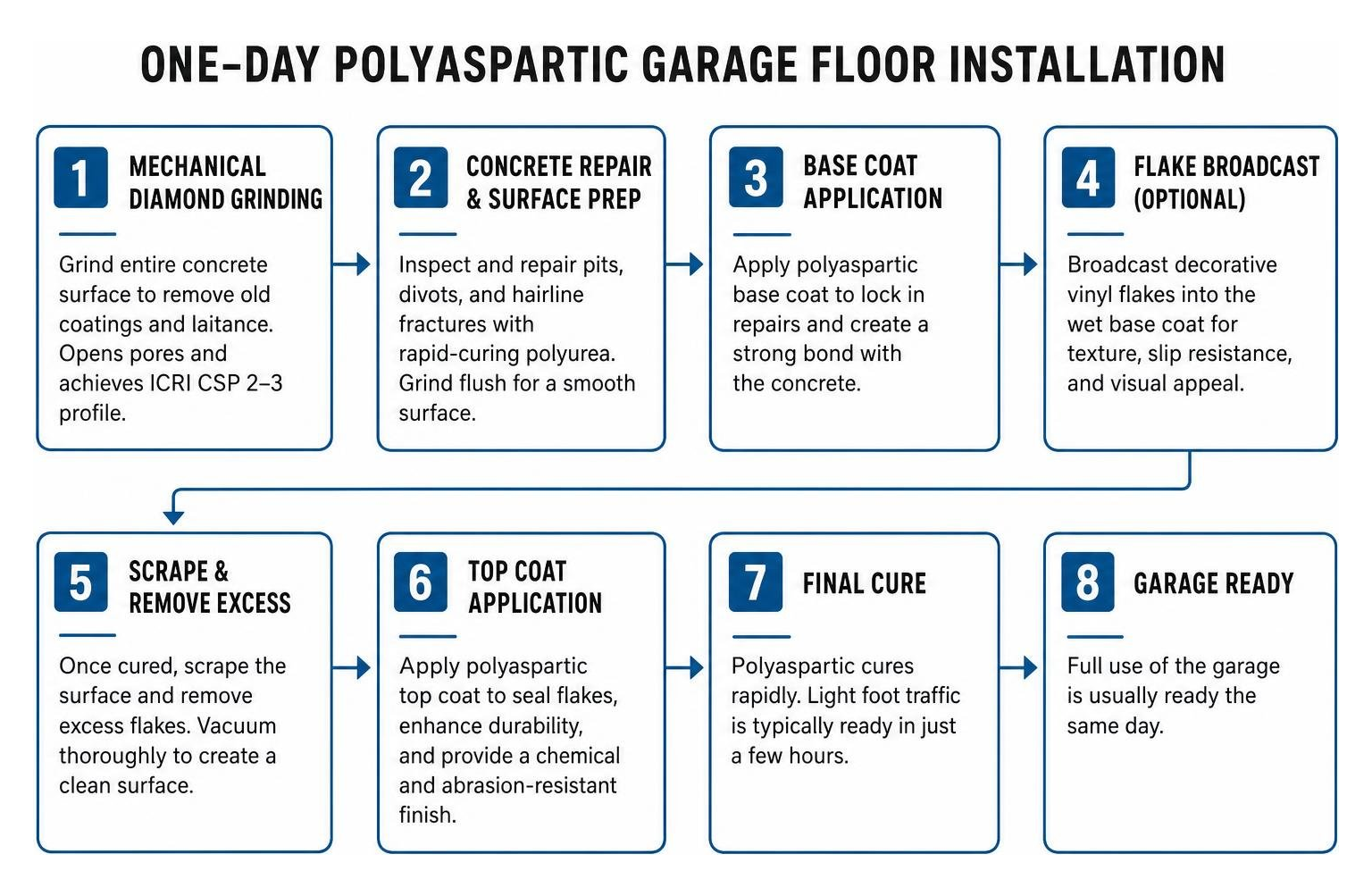
1. Mechanical Diamond Grinding (Morning Phase)
Our technicians start by mechanically grinding the entire concrete surface using industrial multi-head planetary grinders equipped with diamond tooling. Connected directly to continuous-pulse HEPA vacuum systems, this process removes surface contaminants, previous sealers, and weak laitance while profiling the concrete to an ICRI CSP 2–3 standard. Hand grinders with integrated dust shrouds profile the edges and vertical stem walls.
2. Concrete Repair and Joint Preparation
Once the profile is established, our team inspects the slab for hairline cracks, pits, and minor spalls. Concrete floor repair is only a small component of the company’s floor-coating preparation work, during which we fill minor surface fractures with rapid-setting polyurea repair compounds and grind them flush with the surrounding concrete.
3. Penetrating Base Coat Application
We mix and apply a pigmented, commercial-grade base coat. Our technicians use squeegees to distribute the resin evenly across the floor before back-rolling. The low-viscosity resin penetrates deeply into the concrete pores to form an integrated mechanical bond.
4. Full Decorative Flake Broadcast
While the base coat is wet, our team broadcasts decorative vinyl color flakes across the entire floor to complete refusal. This broadcast saturates the surface, providing rich color depth, impact shielding, and consistent aggregate texture across the floor.
5. Scraping and Flake Recovery (Afternoon Phase)
After the base coat reaches its initial cure, technicians scrape the floor multidirectionally with flat steel recovery blades. This step knocks down standing edges and removes loose, unbonded flakes. We thoroughly vacuum the floor to leave a uniform, clean flake bed.
6. Clear Polyaspartic Topcoat Application
Finally, we apply a high-solids, clear aliphatic polyaspartic topcoat across the entire flake system. This non-porous clear layer encapsulates the broadcast flakes, delivering chemical protection against road salt, automotive fluids, and everyday debris.
Foot traffic can typically resume within 4 to 6 hours after topcoat application, with vehicle parking generally accommodated within 24 to 48 hours depending on ambient temperature and humidity. Certain substrate conditions, such as deep structural repairs or elevated slab moisture requiring a dedicated moisture mitigation primer, may require an adjusted schedule to ensure long-term bonding integrity.
What Technical Pitfalls Does Denver Floor Coatings Prevent During Installation?

Achieving lasting adhesion on concrete substrates requires avoiding common technical pitfalls. When property owners research epoxy companies near me, understanding critical installation standards helps identify high-quality workmanship.
- Using Mechanical Profiling Over Chemical Etching: Denver Floor Coatings relies exclusively on diamond grinding rather than liquid chemical washes. Chemical washes often leave residual moisture and fail to open dense aggregate, while diamond grinding guarantees a uniform CSP 2–3 profile for maximum mechanical interlock.
- Selecting Appropriate UV Chemistry: Aromatic resin formulations yellow and degrade when exposed to natural light through garage bay doors. Denver Floor Coatings utilizes pure aliphatic polyaspartic topcoats to preserve clarity and color stability.
- Conducting Comprehensive Moisture Testing: Installing coatings over damp or high-vapor concrete can generate hydrostatic pressure and osmotic blistering. Our team tests moisture levels beforehand and applies specialized moisture-mitigation primers when necessary.
- Providing Written Warranty Documentation: We provide clearly defined, written warranty terms outlining system coverage and performance parameters under local climate conditions.
- Maintaining Dedicated Local Support: Denver Floor Coatings maintains established regional operations throughout our comprehensive service area, ensuring prompt communication and dependable service.
What Are the Most Frequently Asked Questions About Denver Floor Coatings?
How long do polyaspartic garage floor coatings typically last in Colorado?
When installed over an appropriately profiled concrete slab and maintained with routine cleaning, a high-performance polyaspartic flake system can provide many years of dependable service life. Because polyaspartic chemistry resists winter road grime, magnesium chloride, deicing salts, and Front Range temperature swings, it delivers enduring resilience over time. Cleaning the floor periodically with neutral-pH solutions supports its extended performance. Learn more about our polyaspartic floor coating services.
Which commercial facilities benefit most from epoxy and polyaspartic floor systems?
Our commercial flooring systems serve a wide variety of facilities throughout the Denver metro region, including:
- Automotive Dealerships & Service Centers: Providing high light reflectivity, fluid resistance, and protection against hot tires.
- Warehouses & Logistics Hubs: Offering high compressive load capacity for pallet staging, forklift aisles, and inventory movement.
- Food & Beverage Processing Facilities: Supplying seamless, non-porous surfaces that support sanitization and routine washdowns.
- Manufacturing & Assembly Plants: Creating durable chemical barriers that protect underlying concrete from production fluids.
Are on-site consultations and detailed proposals provided before installation?
Yes. Denver Floor Coatings provides comprehensive on-site evaluations to inspect the concrete substrate, measure moisture vapor transmission, record square footage, review custom color flake options, and deliver a clear, itemized proposal for your project.
Why Should You Contact Denver Floor Coatings for Your Concrete Coating Project?
Enhancing your concrete surfaces requires combining premium resin formulations with thorough mechanical preparation. Denver Floor Coatings specializes in high-performance epoxy and polyaspartic coating systems, including decorative flake finishes, rather than stained concrete services. Concrete floor repair is only a small component of the company’s floor-coating preparation work, ensuring your slab is properly profiled, patched, and stabilized prior to coating application.
Whether you require a rapid-curing decorative flake garage floor designed to withstand Colorado freeze-thaw cycles or a heavy-duty commercial epoxy floor engineered for industrial traffic, our team delivers reliable craftsmanship and lasting protection.
Ready to transform your concrete floors? Contact Denver Floor Coatings today to schedule your complimentary on-site evaluation and receive an estimate for your upcoming residential or commercial flooring project.