

Why Epoxy Basement Flooring Is the Smartest Upgrade for Your Home
Epoxy basement flooring represents one of the most durable, moisture-resistant, and visually impressive upgrades available for a home’s below-grade level. Basements present unique environmental challenges, particularly regarding temperature fluctuations and moisture migration through the concrete slab. Selecting a high-performance floor coating is an excellent way to transform these underutilized spaces into functional, beautiful, and highly resilient living areas.
When evaluating options for concrete surfaces, homeowners often seek a balance between aesthetic appeal and long-term structural protection. Denver Floor Coatings provides specialized systems designed to bond directly with the concrete substrate, creating a seamless barrier that outperforms traditional floor coverings. Unlike standard paints or basic sealers that merely sit on the surface, a professional-grade epoxy system chemically fuses with the concrete, offering exceptional resistance to wear, impact, and moisture infiltration.
Achieving a successful, long-lasting finish requires a deep understanding of concrete chemistry, meticulous surface preparation, and precise application techniques. A rushed or improper installation is the primary reason floor coatings fail, leading to issues like peeling, bubbling, or premature wear. This comprehensive guide explores the technical aspects of epoxy systems, the critical importance of moisture testing, design possibilities, and the professional installation process that ensures a beautiful, enduring finish.
I’m Mike Wislinsky, Founder and President of Denver Floor Coatings. With over 20 years of engineering and operations management experience and nearly a decade specializing in high-performance epoxy basement flooring and concrete coating systems, I built this guide to provide homeowners with clear, accurate, and highly detailed information. Our goal is to help you make an informed, confident decision for your home’s basement floor.
Terms related to epoxy basement flooring:
What is Epoxy Basement Flooring?
To appreciate the performance of high-end concrete coatings, it is helpful to examine the polymer chemistry that drives these systems. True epoxy is not a paint; rather, it is a two-part copolymer system consisting of an epoxy resin and a polyamine hardener. When these two components are mixed, they initiate a chemical reaction known as cross-linking. This exothermic reaction forms a tightly bound polymer network that is incredibly strong, rigid, and chemically resistant.
During the curing process, the mixture flows into the microscopic pores of the concrete slab. As the chemical reaction completes, the epoxy locks into the concrete structure, creating a powerful mechanical and chemical bond. This seamless integration prevents the coating from peeling or lifting under normal conditions. For a deeper dive into the science behind these advanced systems, you can read our detailed guide on epoxy floors explained.
How Epoxy Differs from Standard Paint and Sealers
It is common to confuse professional-grade epoxy coatings with standard floor paints. Traditional floor paints are typically single-part acrylic or latex formulas that rely on simple evaporation to dry. Because they do not undergo a chemical cure, they form a very thin, fragile film on top of the concrete. These paints lack the adhesion strength and abrasion resistance required to withstand foot traffic, heavy furniture, or moisture pressure, often leading to rapid flaking and wear.
Concrete sealers serve a different purpose altogether. While they can provide basic dust control and temporary water repellency, they do not build a protective, high-durability film over the concrete. Sealers are designed to penetrate the surface to reduce porosity but do not offer the impact resistance, chemical protection, or aesthetic enhancement of a multi-layer coating system. To understand these differences more clearly, explore our resource on concrete sealer 101 what it does and key benefits.
Water-Based vs. 100% Solids Epoxy Basement Flooring
The formulation of the epoxy system directly influences its thickness, durability, and overall lifespan:
- Water-Based Epoxy: These formulations use water as a carrier solvent. When applied, the water must evaporate for the coating to dry. This evaporation causes the wet film to shrink significantly, often leaving behind a dry layer that is only 1 to 2 mils thick. While they are easier to handle due to a longer working time, they lack the build quality and durability required for long-term protection in active basement environments.
- 100% Solids Epoxy: This professional-grade formulation contains no volatile solvents or water. The thickness of the wet film applied to the concrete is exactly the thickness of the cured coating, typically resulting in a robust layer of 9 to 10 mils or more. This high-build system is self-leveling, exceptionally tough, virtually odorless, and free of volatile organic compounds (VOCs), making it the ideal choice for demanding residential applications.
Key Benefits of Epoxy Basement Flooring Systems
Upgrading a basement floor with a high-performance coating system offers numerous advantages over leaving the concrete bare or installing traditional floor coverings. Homeowners can weigh the complete range of benefits and considerations in our comprehensive analysis of epoxy flooring pros and cons what you should know.
Durability Against Impacts, Stains, and Traffic
Basements are highly versatile spaces, often serving as family rooms, home gyms, workshops, or storage areas. Consequently, the flooring must endure a wide range of physical demands, from heavy foot traffic and sliding furniture to dropped tools and fitness equipment.
A professional 100% solids epoxy system provides outstanding impact and scratch resistance. Its dense, non-porous surface prevents automotive fluids, household chemicals, and common household spills from penetrating and staining the concrete. This ensures the floor remains clean, attractive, and easy to maintain over years of active use. To learn more about the expected performance and longevity of these systems, read our article on how long does epoxy floor last premium solutions for lasting floors.
Moisture Mitigation and Vapor Barriers
Because basements are situated below ground level, they are inherently susceptible to moisture issues. Soil surrounding the foundation contains water that constantly exerts pressure on the concrete walls and floor. This process, known as moisture vapor transmission (MVT), occurs as water vapor migrates upward through the porous concrete slab.
If a low-quality, non-breathable paint is applied to a damp slab, the rising vapor pressure will eventually force the coating off the concrete, resulting in unsightly bubbles, blisters, and peeling. Denver Floor Coatings utilizes advanced moisture-mitigating primers engineered to withstand significant hydrostatic pressure. These specialized base coats lock out moisture vapor, helping to keep your basement dry, comfortable, and free from the musty odors often associated with below-grade spaces. For more information on managing damp concrete, refer to our best wet basement flooring guide.
Why Concrete Coatings Outperform Alternative Basement Flooring
Traditional basement flooring options such as carpet, laminate, and luxury vinyl tile (LVT) frequently struggle to cope with the unique environmental conditions of below-grade concrete. If a basement experiences even a minor plumbing leak, high humidity, or seasonal dampness, these conventional materials can fail rapidly. Carpet fibers trap moisture and organic matter, creating an ideal breeding ground for mold and mildew. Laminate and LVT can warp, buckle, or lose their adhesive bond when exposed to moisture from below.
In contrast, a seamless concrete coating completely eliminates these vulnerabilities by sealing the concrete at a molecular level. There are no seams, grout lines, or fibers to trap water, dirt, or allergens.
| Flooring Type | Moisture Resistance | Durability | Maintenance | Expected Performance |
|---|---|---|---|---|
| High-Performance Epoxy | Outstanding (Waterproof Barrier) | High (Impact & Scratch Resistant) | Very Easy (Sweep & Damp Mop) | Excellent long-term durability |
| Carpet | Poor (Absorbs Moisture & Promotes Mold) | Low (Prone to Staining & Wear) | High (Requires Vacuuming & Shampooing) | Limited in damp environments |
| Luxury Vinyl Tile (LVT) | Moderate (Moisture Can Trap Underneath) | Moderate (Can Scratch or Delaminate) | Easy (Sweep & Mop) | Moderate, risk of adhesive failure |
| Standard Floor Paint | Poor (Peels Under Vapor Pressure) | Very Low (Flakes & Scuffs Easily) | Moderate | Short-lived, requires frequent recoating |
Selecting the appropriate material is essential for creating a comfortable, healthy, and low-maintenance below-grade living space. To explore your options in greater detail, read our overview of the best basement flooring options.
Seamless and Hygienic Surfaces
A seamless, non-porous floor coating is exceptionally hygienic. Because there are no cracks, joints, or fibers, dust mites, pet dander, and pollen have nowhere to accumulate. Cleaning is remarkably simple, requiring only a quick sweep and an occasional damp mop with a mild, pH-neutral cleaner. To see how these systems can elevate both the utility and style of your home, check out transformative epoxy floors elevate your living space.
Professional Surface Preparation and Moisture Testing
The key to a successful, long-lasting floor coating lies almost entirely in the preparation of the concrete substrate. In fact, the vast majority of coating failures are directly attributable to inadequate or improper surface preparation. Simply washing or acid-etching the concrete is rarely sufficient to guarantee a permanent bond.
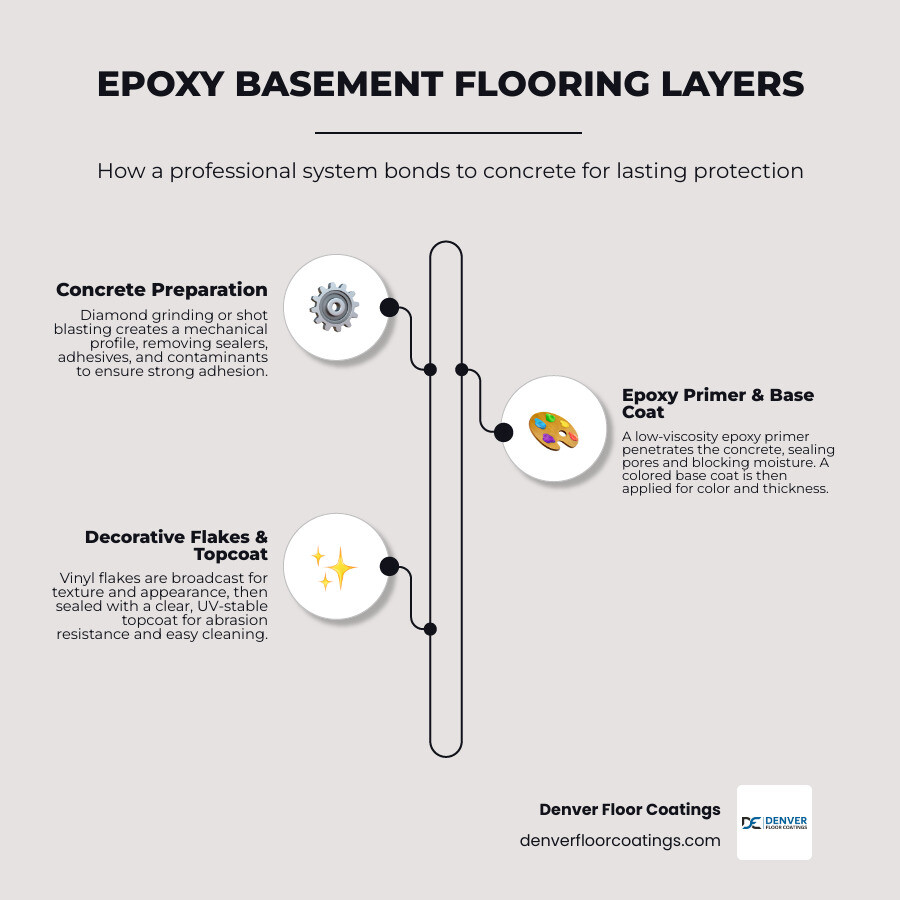
At Denver Floor Coatings, we utilize heavy-duty diamond grinding equipment to mechanically profile the concrete slab. This process removes curing compounds, old sealers, paint, and surface contaminants while opening up the concrete’s pore structure. This mechanical profiling creates a rough, clean surface texture (similar to medium-grit sandpaper) that allows the epoxy primer to penetrate deeply and establish an unbreakable mechanical bond. To learn more about our meticulous preparation standards, read our guide on professional epoxy floor installation.
How to Test Basement Concrete for Moisture
Before any coating system is applied, it is essential to evaluate the moisture levels within the concrete slab. Applying a non-breathable coating over a slab with excessive moisture emission will almost certainly lead to failure.
- The Plastic Sheet Test (ASTM D4263): This basic diagnostic test involves taping a 4′ x 4′ sheet of heavy, clear plastic tightly to the concrete floor, sealing all edges with high-quality duct tape. After 24 to 48 hours, the plastic is inspected. If condensation has formed on the underside of the plastic, or if the concrete beneath has darkened, it indicates that active moisture vapor is migrating through the slab.
- Relative Humidity (RH) Testing (ASTM F2170): For a precise, scientific measurement, in-situ relative humidity probes are placed into drilled holes within the concrete. This test measures the moisture levels deep within the slab, providing accurate data to determine if a specialized moisture-mitigating primer is required.
Understanding these moisture levels allows our team to select the precise primer formulation needed to safeguard your investment. For a deeper look at these diagnostic procedures, refer to our article on concrete moisture testing.
Preparing Challenging Concrete Substrates
Older basements often present unique challenges, such as existing vinyl composition tile (VCT) or residual black mastic adhesive. These materials can be difficult to remove and may contain hazardous substances like asbestos, making mechanical removal complicated and costly.
Using advanced, specialized bonding primers, Denver Floor Coatings can safely encapsulate stable residues and tiles, creating a perfectly smooth, clean, and secure substrate for the new coating system without generating dangerous airborne dust. Discover how we restore and prepare challenging concrete surfaces in our guide on how to restore your concrete floor.
Design, Colors, and Finishes for Basement Epoxy Floors
A basement floor does not have to look cold or industrial. Modern concrete coatings offer incredible design flexibility, allowing homeowners to customize the look to complement any interior design style. For inspiration on how to design your space, explore our resource on transformative epoxy floors elevate your living space.
Popular Aesthetics for Epoxy Basement Flooring
- Decorative Flake Finishes: This is one of our most popular options. Multi-colored vinyl chips are broadcast into a colored base coat and sealed with a durable, clear topcoat. This system mimics the elegant look of granite or terrazzo, effectively conceals minor concrete imperfections, and provides a subtle texture that enhances slip resistance.
- Solid Colors: Ideal for clean, minimalist, or modern industrial aesthetics. These finishes are available in a wide range of colors, with options for high-gloss or contemporary satin topcoats.
- Metallic and Marble Effects: By blending metallic pigments into clear resins, we can create stunning, three-dimensional designs that resemble natural stone, marble, or flowing liquid metal. Each metallic floor is completely unique, offering a high-end, custom look.
Environmental Considerations: Temperature and Humidity
Applying high-performance coatings in below-grade environments requires careful climate control. Most professional epoxy systems require the ambient and concrete slab temperatures to be at least 60°F (ideally 70°F) to cure properly. High relative humidity can also interfere with the chemical reaction, potentially leading to a cloudy surface finish known as amine blush.
Our professional installation teams carefully monitor the dew point, relative humidity, and concrete temperature throughout the process to ensure optimal curing conditions and a flawless finish.
Installation Timeline, Safety, and Maintenance
Our professional installation process is designed to be highly efficient, minimizing disruption to your home and daily routine. While complex metallic systems may require two to three days to complete, many decorative flake installations can be completed in a shorter timeframe.
- Light Foot Traffic: Typically permitted 24 hours after the final topcoat is applied.
- Heavy Use and Furniture Placement: Generally safe after 48 to 72 hours.
- Full Chemical Cure: The system achieves its maximum hardness and chemical resistance within 7 days, depending on the specific resin chemistry and environmental conditions.
Throughout the installation, Denver Floor Coatings prioritizes the safety of your household. We utilize low-VOC, solvent-free, and low-odor formulations to ensure your home remains safe and comfortable to occupy during and after the project.
Maintenance and Cleaning for Longevity
Maintaining your new floor is remarkably simple. Because the surface is completely seamless and non-porous, dirt, dust, and spills have nowhere to hide.
- Routine Cleaning: Regularly sweep or dust-mop the floor to remove loose dirt and abrasive grit.
- Deep Cleaning: Mop the surface with warm water and a pH-neutral cleaner. Avoid using harsh acids, ammonia, or vinegar, as these substances can dull the finish over time.
For detailed, step-by-step maintenance instructions, read our expert guide on how to clean epoxy floors.
Frequently Asked Questions about Basement Epoxy
Can epoxy be applied in cold basements?
Yes, but specific precautions must be taken. Standard epoxy systems will not cure correctly if the concrete slab temperature falls below 55°F. For cooler environments, Denver Floor Coatings utilizes specialized low-temperature curing agents or temporarily adjusts the climate of the space during the installation and curing phases to ensure a successful application.
How long does a professional basement epoxy floor last?
When installed over a properly prepared, dry concrete slab by an experienced professional team, a high-performance epoxy or polyaspartic system can provide many years of reliable service. The exact lifespan depends on factors such as foot traffic, UV exposure, and maintenance practices, but these systems are designed for exceptional long-term durability.
Is epoxy flooring safe for indoor residential spaces?
Absolutely. Denver Floor Coatings uses premium, solvent-free, and low-VOC formulations. This ensures that there are no harsh chemical fumes or hazardous off-gassing during or after the installation process, making the completed floor entirely safe for families, children, and pets.
Conclusion
Upgrading your basement with a high-performance concrete coating is an excellent investment in your home’s value, comfort, and utility. By choosing a seamless, moisture-resistant system, you can avoid the common headaches associated with damp carpets, warped laminate, or peeling paint, replacing them with a beautiful, low-maintenance surface.
At Denver Floor Coatings, we specialize in transforming residential concrete into durable, elegant spaces across the entire Denver metro area—including Aurora, Lakewood, Arvada, Westminster, and surrounding communities. Our experienced team is dedicated to delivering exceptional craftsmanship, using only the highest quality materials and advanced preparation techniques to ensure your floor performs beautifully for years to come.
Ready to transform your basement concrete? More info about residential services is available on our website. Contact us for an estimate today, and let our experienced team help you design a floor that stands up to Colorado’s seasons and heavy use.