

What Is Epoxy Concrete — And Is It Right for Your Garage Floor?
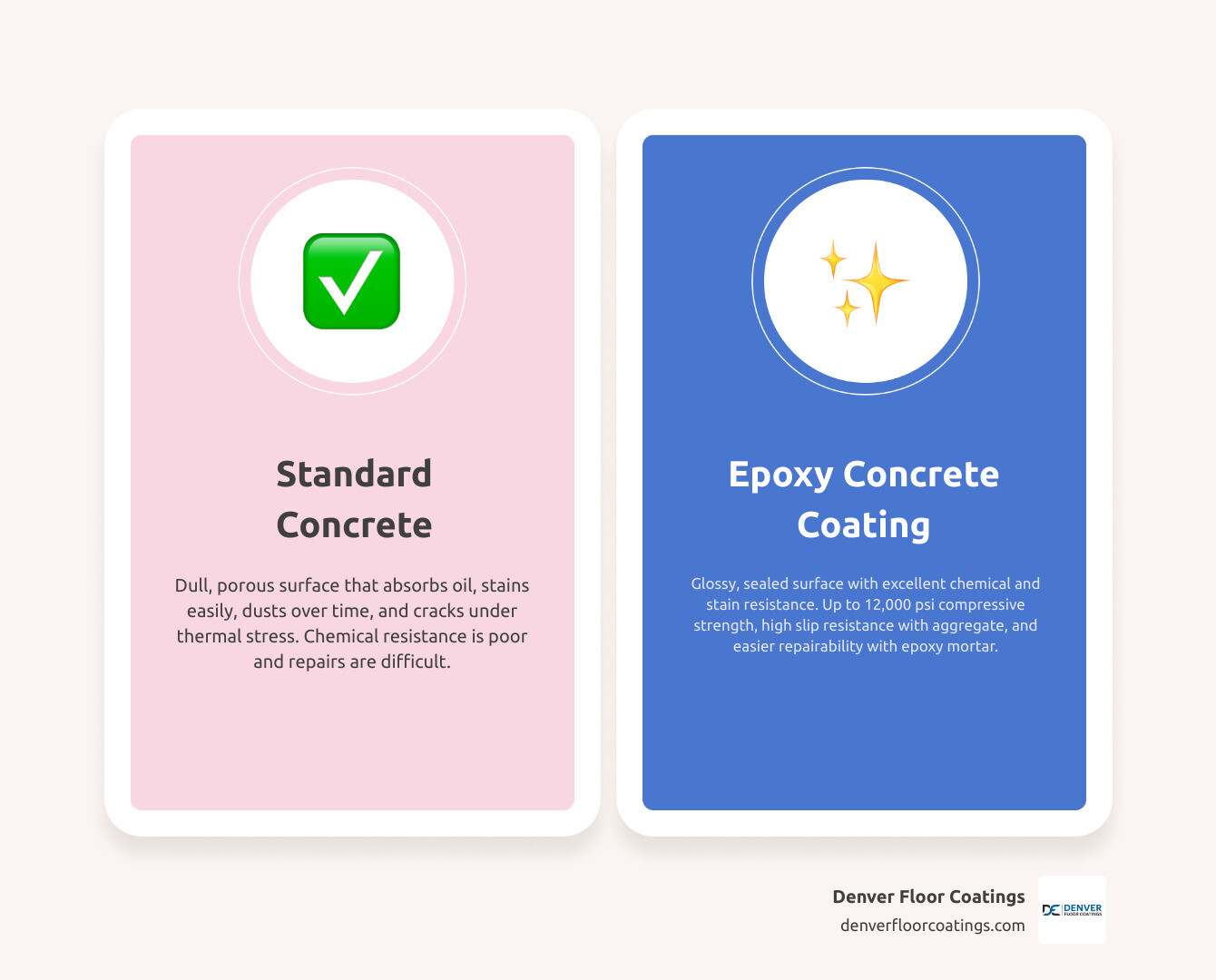
Epoxy concrete is a highly durable protective coating system that bonds directly to a concrete slab, creating a surface that is significantly harder, smoother, and far more resistant to wear than bare concrete alone. Here is a quick breakdown of how epoxy-coated concrete compares to a standard slab:
| Feature | Standard Concrete | Epoxy Concrete Coating |
|---|---|---|
| Surface hardness | Moderate | Very high (up to 12,000 psi compressive strength) |
| Chemical resistance | Poor | Excellent |
| Stain resistance | Poor | Excellent |
| Slip resistance | Moderate | High (with aggregate broadcast) |
| UV stability | N/A | Limited — topcoat recommended |
| Appearance | Dull, porous, grey | Glossy, clean, professional |
| Repairability | Difficult | Easier with epoxy mortar |
Bare concrete is strong in compression, but it has real structural weaknesses. It naturally absorbs oil, it can crack under thermal stress, and it tends to dust and degrade over time under heavy traffic. An epoxy coating seals those pores, adds a chemically bonded wear layer, and transforms a rough, stained slab into a surface that is genuinely easier to maintain and keep clean.
If your garage floor looks tired, stained, or cracked, you are not alone. Many Denver homeowners are surprised to learn that a proper epoxy coating system does not just look better — it actually helps the concrete perform better under wheel loads, temperature swings, and everyday use. Along the Front Range, our floors endure intense freeze-thaw cycles, road salts, and magnesium chloride, all of which can slowly destroy unprotected concrete.
My name is Mike Wislinsky, founder of Denver Floor Coatings, and with over 20 years of engineering and operations experience — plus nearly a decade specializing in high-performance epoxy concrete systems across the Denver metro — I have seen what separates a coating that lasts from one that peels within a season. In the sections below, we will walk through everything you need to know to make a confident, informed decision for your property.
What is Epoxy Concrete and How Does It Compare to Standard Slabs?
When people talk about epoxy concrete, they are usually referring to polymer-based floor coatings applied over an existing concrete slab, or an epoxy polymer concrete overlay used for structural repairs. Unlike traditional concrete, which relies on a water-and-cement mixture, these systems use high-performance resins to create an incredibly strong, seamless barrier.
For homeowners and business owners alike, understanding the physical limits of these materials is the first step toward securing a floor that withstands daily abuse. Traditional concrete is inherently porous, meaning it acts like a hard sponge, absorbing moisture, automotive fluids, and road salts that can lead to internal degradation over time.
The Structural Differences: Traditional Concrete vs. Epoxy-Coated Concrete
The primary difference lies in the binder. Traditional concrete uses a cementitious binder that is naturally porous and brittle under tension. An epoxy concrete system, on the other hand, utilizes a two-part epoxy resin binder. This chemical cross-linking gives the surface exceptional tensile strength and flexibility.
For instance, while a standard concrete slab might crack under minor structural shifts, high-performance epoxy-urethane co-polymers like EPX50-RC feature a tensile elongation of 50% to 60%. This elasticity allows the coating to bridge tiny hairline cracks and handle the subtle movements of Colorado’s expansive soils. To learn more about how these layers bond, check out our guide on Epoxy Floors Explained.
Key Advantages of Epoxy Concrete Coating Systems
When we install professional concrete coatings, we are looking for maximum adhesion. A key metric here is the slant shear bond strength. High-quality epoxy systems regularly achieve a slant shear bond strength of 1,395 psi or more, meaning the coating chemically welds itself to the concrete. In fact, under stress testing, the concrete substrate itself will typically fail before the epoxy bond breaks.
Additionally, our systems provide:
- Superior Chemical Resistance: Safeguards your floor from road salts, mag-chloride, and automotive fluids.
- Thermal Movement Accommodation: Low-modulus formulas expand and contract alongside the slab during rapid temperature drops along the Front Range.
- Hygienic, Seamless Finish: Eliminates joints and pores where dirt and grime collect.
Comparing Epoxy Formulations: 100% Solids vs. Solvent and Water-Based Systems
Not all epoxies are created equal. The product formulation determines the final thickness, durability, and safety during installation.
| Feature | 100% Solids Epoxy | Solvent-Based Epoxy | Water-Based Epoxy |
|---|---|---|---|
| VOC Content | 0 g/L (Zero VOC) | High | Low |
| Shrinkage | 0% (Cures as thick as applied) | 30% to 50% loss | 40% to 60% loss |
| Dry Film Thickness | Excellent (High build) | Thin | Very thin |
| Durability | Industrial-grade | Moderate | Light duty |
We exclusively recommend 100% solids epoxy systems for heavy-use spaces. Because they contain no solvents or water to evaporate, they do not shrink during the curing process. What we roll out onto your floor is exactly what remains once cured, providing a thick, durable shield that is designed to withstand heavy vehicular traffic and impact.
Epoxy Concrete Coatings vs. Standard Concrete Paint
It is common to see retail stores selling “epoxy paint,” but we must distinguish a true chemical cure from simple evaporation drying. Standard concrete paint relies on water or solvent evaporation to dry. It leaves behind a paper-thin film that is highly susceptible to hot-tire pickup, peeling, and scratching.
A true two-part epoxy concrete coating undergoes a chemical reaction that transforms the liquid into a hard, dense plastic. While cheap paint might seem tempting, it often leads to premature failure, requiring extensive grinding and surface preparation to correct. For a deeper look at these differences, see our article on Epoxy Flooring Pros and Cons: What You Should Know.
Concrete Surface Preparation and Repair Applications
The secret to a lifetime coating is not the topcoat — it is the preparation. If you do not prepare the concrete to professional adhesion standards, even the strongest epoxy will peel. At Denver Floor Coatings, we dedicate the vast majority of our installation time to preparing the concrete substrate, ensuring a mechanical bond that is built to last.
Repairing Cracks, Spalls, and Potholes Before Coating
Before we apply any decorative coatings, we must address structural deficiencies. For deep spalls and damaged joints, we use high-strength epoxy mortar systems. Products like the E1000 Epoxy Concrete Repair Kit | Up to 1″ Deep Repairs | 100% Solids can achieve a compressive strength of 11,000 to 12,000 psi, making the repaired areas significantly stronger than the original concrete.
For smaller cracks, using specialized cartridge-based systems like Epoxy Concrete Repair 05-22-19 8640-29 ensures deep penetration. The key is to avoid feather-edging; repairs must be square-cut to a minimum depth (often 1/2 inch) to prevent the edges from chipping under traffic.
Achieving the Ideal Concrete Surface Profile
To ensure a permanent mechanical bond, we must roughen the concrete. This is measured by the Concrete Surface Profile (CSP) rating.
- For thin-to-medium residential coatings, we aim for a CSP #2 to #3 using professional diamond grinding.
- For thick overlays or commercial repairs, a CSP #5 via shot-blasting may be required.
Once ground, we use industrial vacuum systems to remove every speck of dust. If you want to dive deeper into how we evaluate slabs, read our Beginner’s Guide to Best Floor Coating for Concrete. Managing moisture vapor transmission (MVT) is also critical, which is why we offer specialized solutions for Concrete Floor Coatings Denver to prevent bubbling and delamination caused by hydrostatic pressure.
The Step-by-Step Application and Curing Process
Applying epoxy concrete requires precision, speed, and deep technical knowledge. Once Part A (resin) and Part B (hardener) are combined, an exothermic reaction begins. This chemical reaction generates heat, meaning the material has a limited “pot life” (usually 20 to 35 minutes) before it hardens in the bucket. Our experienced crews work efficiently to ensure the material is applied within its optimal working window.
Mixing, Priming, and Broadcasting Aggregates
- Mixing: We use a low-speed Jiffy mixer at 300 to 450 RPM to blend the parts thoroughly without whipping air bubbles into the resin, which could cause pinholes in the finished floor.
- Priming: An initial prime coat seals the porous concrete to prevent outgassing bubbles in the final finish. For bonding fresh concrete overlays to existing slabs, a specialized Epoxy Bonding Agent is applied while still tacky.
- Base Coat & Broadcast: We apply the main build coat and immediately broadcast decorative vinyl flakes or slip-resistant aggregates (such as quartz or bauxite) to refusal, which is highly recommended for safety. You can read more about these overlay steps on the Epoxy Concrete | Epoxy Resin for Concrete Repair | EPODEX | EPODEX page.
Understanding Cure Times and Environmental Factors
Epoxy systems are highly temperature-sensitive. At a comfortable 75°F, a rapid-set crack filler can handle heavy forklift traffic in 30 minutes, while a standard coating allows light foot traffic in 4 to 6 hours and vehicular traffic in 24 to 36 hours. However, if temperatures drop to 50°F, those cure times can easily double. We always monitor regional weather patterns and adjust our curing schedules accordingly to ensure a successful installation.
Performance in Extreme Environments and Outdoor Limitations

In commercial warehouses, food processing facilities, and manufacturing plants, floors face extreme challenges. High-performance epoxy concrete overlays are engineered to handle constant impact, heavy forklift traffic, and harsh chemical sanitizers.
UV Exposure and Outdoor Limitations of Epoxy
While epoxy is incredibly tough indoors, it has one major weakness: ultraviolet (UV) light. Direct sunlight causes standard epoxy to undergo “ambering” (yellowing) and “chalking” (a powdery degradation of the surface).
Because of these limitations, we do not coat exterior surfaces like driveways or patios exposed to direct Colorado sunlight. However, we ensure that the indoor areas near your garage doors remain protected. For details on where coatings perform best, see our page on Coated Concrete.
Recommended Topcoats for UV Protection and Aesthetics
To provide the ultimate protection, we topcoat our epoxy systems with a polyaspartic finish. Polyaspartic coatings are completely UV-stable, meaning they will not yellow or fade when exposed to sunlight through open garage doors. They also offer superior scratch resistance and a beautiful, glossy shine. Learn more about our high-performance Concrete Epoxy options.
Frequently Asked Questions
Can epoxy concrete coatings be applied over damp concrete?
While some specialized moisture-tolerant primers can handle damp concrete, standard epoxies will fail if moisture is trapped beneath the film. We always perform moisture tests prior to installation to prevent adhesion failure. If moisture levels are high, we utilize specialized moisture-mitigating primers to ensure a secure bond.
How thick can an epoxy concrete coating be applied?
Standard coatings are applied at 8 to 20 mils thickness. However, structural epoxy polymer concrete systems, like those detailed in the EPC-OVERLAY TDS, can be placed in single-pass cross-sections from 3/4 inch up to 6 inches deep for structural grade correction.
How long before you can drive on a newly coated epoxy floor?
For most residential garage installations, we recommend waiting 24 to 36 hours for light vehicular traffic and up to 5 days for a full chemical cure, depending on the temperature. This ensures the coating has reached its full design strength before being subjected to heavy loads.
Conclusion
Upgrading your garage or commercial facility with a professional epoxy concrete system is an investment in the longevity and value of your property. At Denver Floor Coatings, we specialize in transforming worn, dusty slabs into beautiful, showroom-quality spaces.
Whether you are looking to protect your home garage from Colorado’s harsh winter road salts or need an OSHA-compliant, slip-resistant floor for a commercial warehouse, we have the engineering expertise to get the job done right — often in just one day. Our team is dedicated to providing high-performance solutions tailored to the unique demands of the Denver climate.
Ready to take your concrete to the next level? Contact Denver Floor Coatings today to schedule a consultation and receive a professional estimate for your project.