

How Garage Floors in a Day Work
Garage floors in a day are possible when the concrete is ready for coating and the system is designed for a fast turnaround. A typical professional installation begins with thorough mechanical diamond grinding and cleaning of the concrete slab. Our technicians then apply a high-adhesion base coat, broadcast decorative color flakes across the surface to full rejection, and seal everything beneath a protective polyaspartic topcoat. The entire hands-on application finishes within a single working shift, although the newly coated floor still requires dedicated curing time before walking or parking heavy vehicles on the surface.
For busy homeowners throughout the Denver metropolitan area, this rapid turnaround delivers a clean, bright, and durable space while minimizing disruption to household routines. The critical factor is never rushing the underlying technical preparation or assuming that single-day installation means parking a heavy truck that very evening. Careful project planning ensures you achieve long-term performance without compromising substrate adhesion.
I am Mike Wislinsky, founder of Denver Floor Coatings, where garage floor coatings are our primary specialty. My professional background in engineering and operations drives our company focus on disciplined surface preparation, precise polymer chemistry, and strict timing protocols. These standards make garage floors in a day achievable without skipping essential mechanical or chemical steps.
Homeowners often evaluate multiple factors when considering a floor upgrade, from stain resistance and maintenance convenience to aesthetic enhancements that complement their home. Choosing an engineered system helps prevent long-term degradation caused by road salts, automotive fluids, and moisture vapor transmission typical in Colorado. To explore resin options in greater detail, review our guides on maintaining a cleanable garage epoxy finish, evaluating premium coatings for garage floor projects, and understanding how proper surface prep prevents epoxy garage floor peeling.
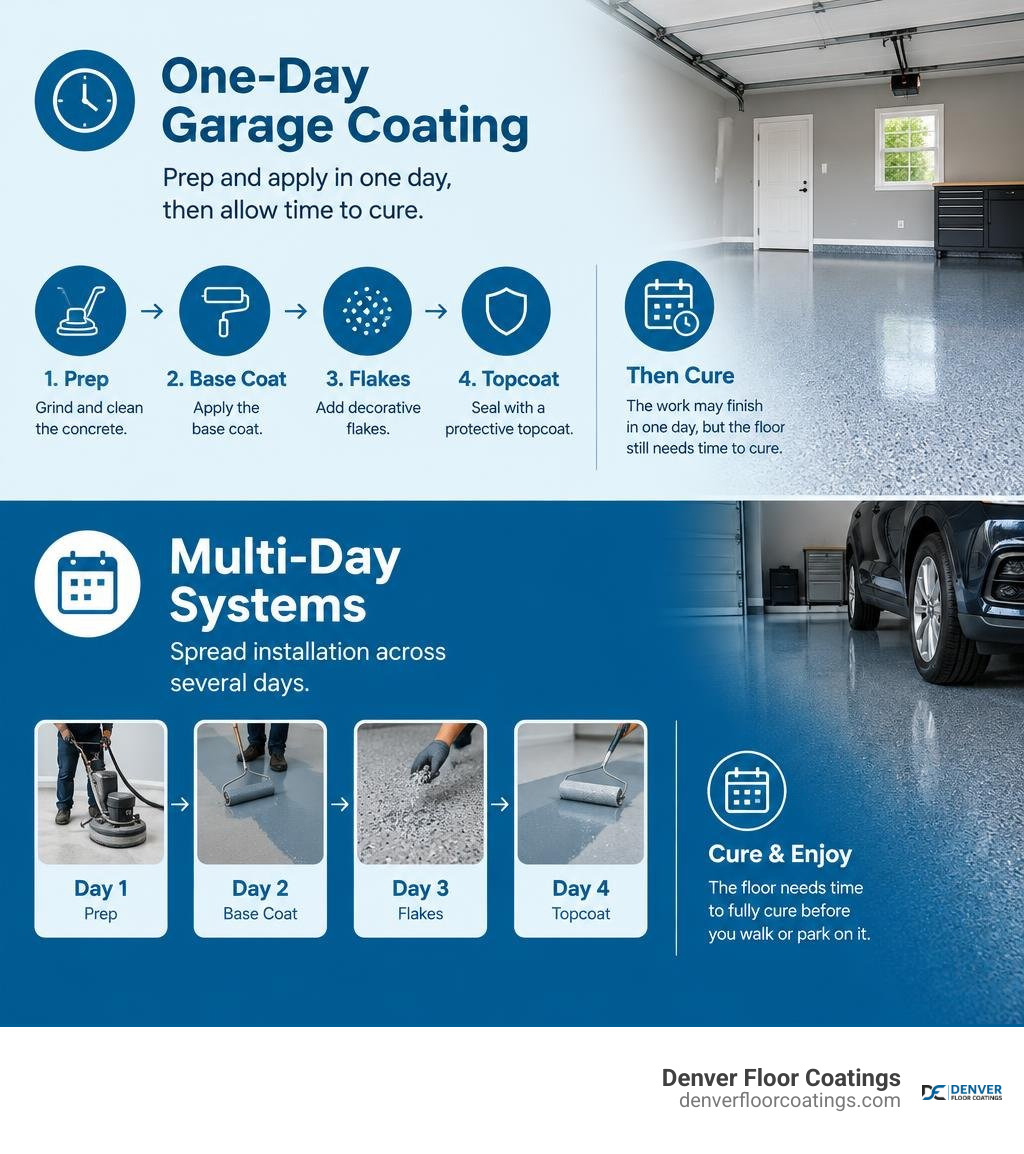
The Science and Chemistry Behind Garage Floors in a Day
Transforming an untreated concrete slab within a single working shift requires advanced polymer chemistry engineered for rapid reaction kinetics. The professional coatings we utilize rely on rapid polymer cross-linking, which forms dense, three-dimensional molecular networks significantly faster than conventional materials.
In traditional resin formulations, chemical bonds develop slowly as carrier solvents evaporate or as standard polyamines react with base epoxy resins over several days. In contrast, fast-cure systems, particularly aliphatic polyaspartic polyurea technologies, utilize specialized aliphatic polyisocyanates that cross-link within hours rather than days. This tight molecular lattice delivers outstanding chemical resistance, high tensile strength, and remarkable elongation properties that flex naturally with concrete expansion and contraction during seasonal weather changes.
| Feature | Standard 100% Solids Epoxy | Industrial Polyaspartic System |
|---|---|---|
| Typical Installation Window | 2 to 3 days | 1 day |
| Time to Foot Traffic | 24 to 48 hours | 8 to 10 hours |
| Time to Vehicle Traffic | 72 to 120 hours | 24 hours |
| UV Stability | Vulnerable to ambering | 100% UV-stable |
| Flexibility / Elongation | Low to moderate | High |
How Polyaspartic Technology Delivers Garage Floors in a Day
Polyaspartic polyurea is an industrial-grade aliphatic ester coating specifically developed to cure rapidly while retaining exceptional film integrity and impact durability. When our team applies these formulations, the cross-linking reaction occurs efficiently across a broad temperature spectrum, making them dependable throughout variable Front Range weather conditions. To understand this versatile chemistry in detail, consult our quick start guide to polyaspartic floor coating denver.
Because polyaspartic materials are inherently aliphatic, they resist yellowing and chalking when exposed to natural ultraviolet radiation entering through open garage doors. Their natural flexibility also enables the cured film to accommodate subtle slab movement without developing micro-fractures, delaminating, or losing bond strength over time.
The Risks of Using Accelerators in Traditional Epoxy
Attempting to force a single-day installation by adding chemical accelerators to standard epoxy introduces substantial technical risks. While an accelerator shortens the initial gel time, it frequently triggers amine blush, a waxy surface byproduct that interferes with mechanical and chemical bonding between subsequent coats.
Accelerated epoxy formulations also tend to become excessively brittle, which can noticeably reduce impact resistance when heavy tools or equipment contact the floor. Furthermore, rapid forced curing frequently causes uneven gloss levels, premature ambering, and compromised film thickness, reducing the expected service life of the finished garage floor.
Essential Preparation and Installation Stages
Speed should never come at the expense of proper substrate preparation. The long-term bond between your concrete foundation and the resin system depends entirely on precise mechanical profiling and comprehensive contaminant removal.

Surface Profiling and Minor Concrete Repair
Our installation process begins with industrial planetary diamond grinding equipment connected directly to high-cfm HEPA dust extractors. Grinding removes surface contaminants, previous failing sealers, and weak surface laitance while opening the concrete capillaries to create a distinct concrete surface profile. This mechanical profile allows our penetrating primers to lock deeply into the underlying substrate pores.
Concrete floor repair is only a small component of our floor-coating preparation work, but addressing minor surface imperfections is crucial before laying base resins. When preparing damaged slabs, you can explore our detailed approach in our guide to garage floor crack repair. We patch minor cracks, spalls, and divots using fast-curing polyurea mender compounds so that the foundation remains smooth, stable, and ready for coating.
Step-by-Step Timeline for Garage Floors in a Day
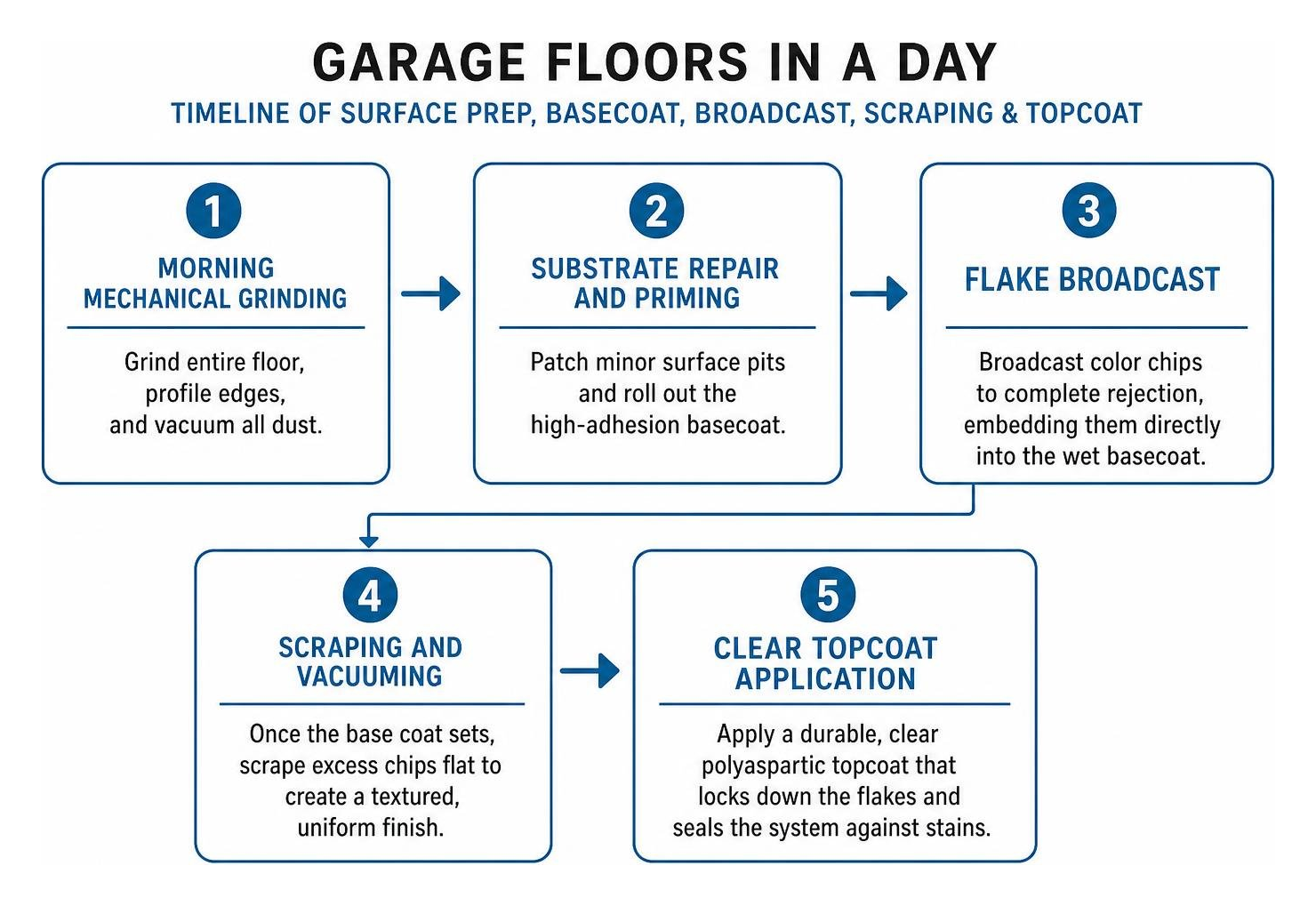
A successful single-day coating relies on a disciplined, synchronized workflow executed by our trained team:
- Morning Mechanical Grinding: We grind the entire concrete surface, profile perimeter edges with hand grinders, and vacuum all fine dust particles.
- Substrate Repair and Priming: We mend minor pits and roll out the high-adhesion basecoat to wet out the concrete pores thoroughly.
- Flake Broadcast: We broadcast decorative vinyl color chips to complete rejection, embedding them directly into the wet basecoat. You can discover the functional and visual benefits in our article on how flake floor coatings turn plain concrete into a showroom surface.
- Scraping and Vacuuming: Once the base layer cures, we scrape excess chips flat and vacuum thoroughly to create a textured, uniform profile.
- Clear Topcoat Application: We apply a heavy-duty, clear polyaspartic topcoat that locks down the color flakes and seals the floor against automotive fluids and moisture intrusion.
Curing, Return-to-Service, and Durability Expectations
Once our team applies the protective topcoat, the chemical cure begins immediately. While rapid-cure coatings solidify quickly to the touch, curing is an ongoing chemical reaction that establishes full cross-linking density and maximum durability over the initial 24 to 48 hours.
Walking and Driving Timelines
Understanding when to resume regular household activities protects your new surface from accidental scuffs, early imprint marks, or chemical stains. Detailed technical guides such as the Polyset Polyaspartic Tech Sheet outline strict curing intervals for high-solids fast-cure systems:
- Foot Traffic: The surface is typically safe for socks and light foot traffic after 8 to 10 hours under normal ambient conditions.
- Storage and Light Items: Storage bins, patio furniture, and lightweight shelving units can generally be returned after 12 to 18 hours.
- Vehicle Parking: Cars, trucks, and heavy motorcycles can safely drive and park on the floor after 24 full hours of cure time.
For more detailed guidelines on returning vehicles and heavy machinery to your space, review our recommendations on when you can park your car on your new floor.
Environmental Factors Influencing Rapid Curing
Environmental variables within your garage influence how quickly polyaspartic chemistry cures:
- Temperature: Cooler concrete slabs and cold ambient air moderately extend reaction times, whereas warmer temperatures accelerate cross-linking.
- Relative Humidity: Polyaspartic coatings cure partly through ambient humidity, meaning dry mountain air can slightly lengthen working times.
- Airflow and Ventilation: Good airflow assists in stabilizing cross-linking compounds evenly across the entire surface area.
Frequently Asked Questions About One-Day Garage Coatings
Can a one-day floor coating withstand heavy tool drops and vehicle chemicals?
Yes. Professional polyaspartic systems provide exceptional tensile strength, impact absorption, and chemical resistance. Once fully cured, they reliably resist road salts, motor oil, hot tire pickup, transmission fluid, and gasoline, while standing up to regular impacts from toolboxes and household equipment under normal operating conditions.
How does a professional fast-cure system differ from multi-day epoxy?
While multi-day epoxy systems cure gradually through traditional amine reactions that require extended periods between coats, professional one-day systems use polyaspartic polyurea polymers that achieve full molecular bond strength and hardness in hours. You can compare different resin formulations further in our residential garage coatings guide.
What temperature range is required to install rapid floor systems?
Polyaspartic materials offer superior thermal versatility compared to traditional epoxies. They can often be successfully applied in ambient temperatures ranging from below freezing up to 90 degrees Fahrenheit, allowing Denver Floor Coatings to deliver consistent installations throughout changing Colorado seasons.
Conclusion
Upgrading your garage with a premium coating does not require turning your home into a construction zone for a full week. With advanced polyaspartic chemistry, meticulous mechanical diamond grinding, and seasoned installation specialists, Denver Floor Coatings delivers durable, showroom-quality surfaces within a single day.
Whether you reside in Denver, Aurora, Lakewood, Arvada, Boulder, Broomfield, Littleton, or Castle Rock, we install heavy-duty flake and polyaspartic systems engineered to handle tough Colorado conditions. Discover our full selection of epoxy garage floor coatings and contact our team today to schedule your on-site consultation and get a free estimate.