

Is a Concrete Floor Resurfacer Right for Your Interior Floors?
Utilizing a high-performance concrete floor resurfacer is often considered one of the most effective strategies for restoring a worn, cracked, or otherwise compromised interior concrete surface. This process allows property owners to revitalize their space without the extensive costs and logistical challenges associated with a full slab replacement. When an interior floor begins to show signs of age, such as surface spalling or deep-seated staining, a professional resurfacing system provides a renewed structural and aesthetic foundation. At Denver Floor Coatings, we view resurfacing not merely as a cosmetic fix, but as a comprehensive engineering solution designed to extend the functional life of your concrete substrate.
Quick Overview: High-Performance Concrete Floor Resurfacing
| Feature | Details |
|---|---|
| Composition | Advanced polymer-modified cement or industrial-grade epoxy systems |
| Primary Applications | Surface cracks, spalling, pitting, and aesthetic restoration |
| Ideal Environments | Residential garages, basements, and commercial interior slabs |
| Standard Thickness | Typically 1/8″ to 1/4″ depending on the specific system requirements |
| Traffic Readiness | Foot traffic often possible within 4–6 hours post-application |
| Expected Lifespan | Often ranges from 8 to 15+ years with professional installation and care |
In the Denver metropolitan area, garage floors and interior slabs are subjected to unique environmental stressors. From the significant temperature fluctuations of the Front Range to the introduction of corrosive road salts during the winter months, concrete surfaces can deteriorate rapidly. This deterioration often manifests as rough textures, unsightly oil stains, or structural pitting that compromises the integrity of the surface. Fortunately, a high-performance resurfacing system can provide a fresh, durable finish that significantly enhances both the visual appeal and the functional utility of the space. The goal is to create a surface that is not only resilient against mechanical wear but also resistant to the chemical penetration that often leads to long-term degradation.
It is important to recognize that not all resurfacing products or methodologies offer the same level of protection. The selection of a specific system should be based on the current condition of the substrate, the intended use of the area, and the desired final aesthetic. This guide is designed to provide a comprehensive understanding of the professional resurfacing process, ensuring that your investment results in a long-lasting and resilient floor. We focus on systems that are engineered to handle the specific expansion and contraction cycles common in Colorado’s climate, which is a critical factor in preventing premature delamination.
I’m Mike Wislinsky, founder of Denver Floor Coatings. With over two decades of experience in engineering and operations, combined with extensive hands-on expertise in applying high-performance concrete systems throughout Colorado, I have observed the critical factors that distinguish a successful concrete floor resurfacer project. Our approach focuses on precision, high-quality materials, and a deep understanding of the chemical bonds required for a long-term surface transformation. By applying engineering principles to every project, we ensure that the materials selected are perfectly matched to the specific needs of the environment, whether it is a high-traffic commercial warehouse or a residential garage.
Understanding Denver Floor Coatings’ Resurfacing Solutions
When discussing a professional concrete floor resurfacer, the focus is on high-performance polymer systems that are engineered to bond at a molecular level with the existing concrete substrate. At Denver Floor Coatings, our solutions go far beyond simple surface treatments. We utilize advanced modifiers and industrial-grade resins that allow the material to maintain the necessary flexibility for thermal expansion while providing the hardness required to support heavy vehicles and industrial equipment. This balance of flexibility and strength is what allows our systems to withstand the rigors of daily use without cracking or peeling.
Our resurfacing process is designed to address the underlying causes of surface degradation. Whether a floor is experiencing spalling—where the top layer of the concrete begins to flake away—or deep pitting caused by chemical exposure, our systems are applied to fill these imperfections and create a seamless, monolithic surface. Many traditional cement-based products are prone to shrinkage, which can lead to the formation of new cracks shortly after application. In contrast, our advanced formulas are shrinkage-compensated, ensuring a stable and flat result that can achieve a compressive strength often exceeding 5,000 PSI. This high compressive strength is vital for maintaining the integrity of the floor under the weight of heavy machinery or vehicles.

Choosing the Right High-Performance System for Your Space
Selecting the appropriate resurfacing system requires a detailed analysis of the specific environment. For interior floors with significant height variations or low spots where fluids tend to pool, we often employ self-leveling technologies. These products are engineered to flow into depressions and level out via gravity, resulting in an exceptionally level subfloor that is ready for a final decorative finish. This process is particularly beneficial in older structures where the original concrete may have settled unevenly over time.
In many residential and commercial applications, the foundation of a successful project is a high-quality concrete epoxy. Epoxy is highly regarded for its exceptional adhesive properties, allowing it to penetrate the pores of the concrete more effectively than standard coatings. To enhance the system’s performance, we frequently pair this epoxy base with polyaspartic topcoats. While the epoxy provides the necessary build and bond, the polyaspartic layer offers superior UV stability and resistance to chemical staining. This multi-layered approach ensures that the floor is protected from both physical impact and environmental factors like sunlight and chemical spills.
Before any material is applied, we conduct a comprehensive moisture vapor transmission assessment. In the Colorado climate, moisture migrating upward through a concrete slab can lead to delamination or bubbling in inferior systems. By identifying these moisture levels early, we can utilize specialized primers that function as a vapor barrier, protecting the integrity of the resurfaced floor from the ground up. This proactive approach is a hallmark of the Denver Floor Coatings methodology, ensuring that the bond between the resurfacer and the substrate remains secure for years to come.
Benefits of High-Performance Overlays
Choosing a high-performance overlay provides numerous advantages that extend well beyond simple aesthetics. These systems are designed to provide a comprehensive upgrade to the concrete’s physical properties, making the surface more durable and easier to maintain.
- Superior Abrasion Resistance: Our systems are engineered to withstand the friction and heat generated by vehicle tires, preventing the peeling and lifting often seen in lower-quality applications. This is especially important in high-traffic areas where constant movement can wear down standard surfaces.
- Robust Chemical Protection: From automotive fluids to harsh de-icing salts, our high performance concrete coatings create a non-porous shield that prevents contaminants from penetrating and damaging the concrete. This protection is essential for maintaining the structural integrity of the slab over the long term.
- Significant Dust Reduction: Untreated concrete is prone to “chalking,” a process that creates fine dust. A professionally resurfaced floor seals the surface entirely, making the environment significantly easier to maintain and clean. This leads to a healthier indoor environment by reducing airborne particulates.
- Enhanced Slip Resistance: We can integrate decorative flakes or specialized anti-slip additives to ensure the floor remains safe for foot traffic, even in conditions where moisture may be present. This customization allows us to tailor the safety profile of the floor to the specific needs of the client.
Professional Surface Preparation and Application
The longevity of a resurfaced floor is almost entirely dependent on the quality of the surface preparation. Even the most advanced concrete floor resurfacer may experience adhesion issues if it is applied to a substrate that has not been properly cleaned and profiled. At Denver Floor Coatings, we dedicate the majority of our project timeline to preparing the concrete “canvas” to ensure a long-term bond. We understand that the chemical reaction of the resins requires a clean, open-pored surface to achieve maximum penetration.
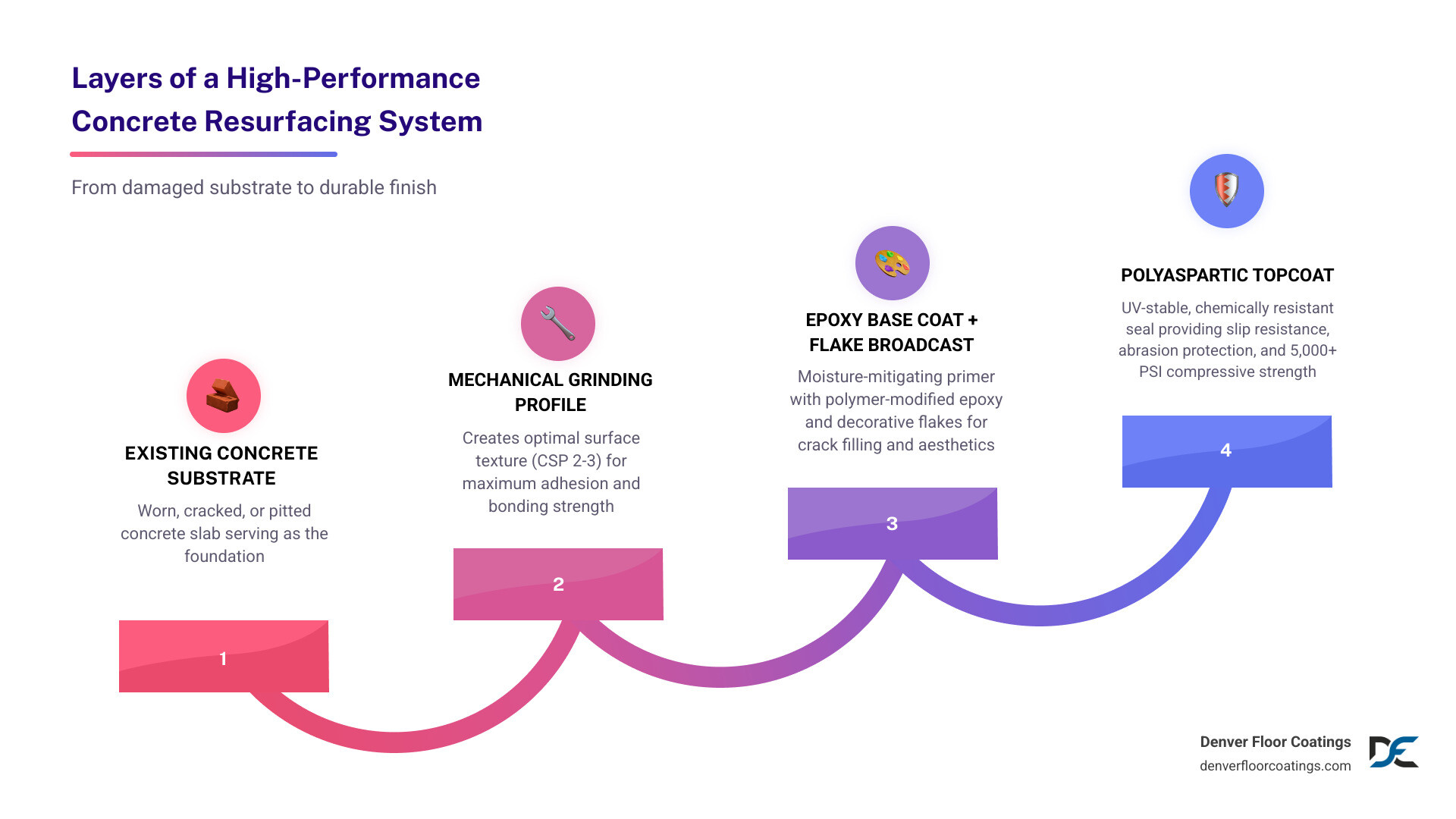
Our preparation process involves the use of heavy-duty mechanical grinding equipment fitted with diamond-segmented blades. This mechanical action removes the “laitance”—the weak, dusty top layer of the concrete—and opens the pores of the slab. In certain industrial settings, we may also utilize shot blasting to achieve a more aggressive profile. This meticulous preparation ensures that our industrial floor coatings concrete can penetrate deeply into the surface, creating a mechanical lock that is far superior to simple surface adhesion. By creating the correct Concrete Surface Profile (CSP), we ensure the system is anchored into the slab itself.
Critical Steps for Optimal Adhesion
Following the grinding process, we perform a thorough removal of all contaminants. This includes the use of industrial vacuum systems equipped with HEPA filtration to ensure that no residual dust remains within the concrete pores. We also inspect the slab for oil saturation; if deep-seated oils are present, we utilize specialized degreasing agents or heat treatments to extract the contaminants and ensure a clean bonding surface. Any remaining oil can act as a bond-breaker, which is why this step is never overlooked in our process.
Furthermore, we conduct pH testing and substrate moisture assessments. Concrete is naturally alkaline, but extreme pH levels can interfere with the chemical reaction of the resurfacing agents. By creating the ideal environment for the resins to cure, we ensure that the coated concrete becomes an integral part of the slab itself, rather than a superficial layer that could eventually delaminate. Our team monitors these variables closely throughout the preparation phase to ensure the substrate is perfectly primed for the application.
Professional Application of Denver Floor Coatings’ Systems
When the application phase begins, precision is paramount. We utilize professional-grade tools to maintain a consistent thickness across the entire floor area. This typically involves a squeegee technique for rapid material distribution, followed by the use of specialized notched trowels or gauge rakes. These rakes feature adjustable settings that allow our technicians to maintain a precise thickness—usually between 1/8″ and 1/4″—regardless of any underlying irregularities in the slab. This attention to detail ensures a uniform finish that is both aesthetically pleasing and structurally sound.
For our signature garage finishes, we implement multi-coat systems designed for maximum durability. This process generally begins with a moisture-mitigating primer, followed by a high-build epoxy base coat. During this stage, decorative flakes are broadcast to the point of rejection, providing both aesthetic depth and added texture. Finally, a high-solids polyaspartic topcoat is applied to seal the system. This layered methodology is why our commercial concrete coatings are the preferred choice for businesses throughout the Front Range, providing a finish that is as tough as it is attractive.
Performance Standards for Interior Environments
When resurfacing interior floors in communities like Aurora, Lakewood, or Arvada, our objective is to achieve industrial-grade performance standards. Our systems are engineered to meet rigorous specifications, often reaching a compressive strength that exceeds 5,000 PSI within a 28-day curing period. This level of strength is significantly higher than the standard residential concrete typically found in most Colorado homes, which generally ranges between 2,500 and 3,000 PSI. These standards are often measured against ASTM International guidelines to ensure consistency and reliability across every project we undertake.
However, structural integrity involves more than just compressive strength; it also requires enhanced tensile and impact resistance. Our high-performance systems are designed to resist cracking even when the underlying ground undergoes minor shifts. Impact resistance is equally critical; in a garage or warehouse environment, the floor must be able to withstand the impact of dropped tools or heavy equipment without chipping or fracturing. For commercial facilities, we also consider thermal shock protection, which is essential for spaces that undergo rapid temperature changes or frequent hot-water washdowns. This comprehensive approach to performance ensures that the floor can handle whatever challenges the environment presents.
Ideal Conditions for Installation
The climate in the Denver region presents specific challenges for the installation of floor coatings. To ensure an optimal cure and long-term performance, we carefully monitor the environmental conditions within the workspace. Ideally, we look for ambient temperatures between 50°F and 90°F. However, the temperature of the concrete slab itself is the most critical factor, as it directly influences the chemical reaction of the resins. If the slab is too cold, the resins may not cure properly; if it is too hot, they may cure too quickly, leading to potential application issues.
We also track the dew point and relative humidity levels. High humidity can negatively impact the gloss levels and curing times of certain polyaspartic coatings. Whether we are performing concrete coatings castle rock or a project in Fort Collins, we adjust our chemical formulations to account for the specific environmental variables of the day, ensuring the material performs exactly as engineered. This level of environmental monitoring is a key part of our commitment to quality and ensures that every floor we install meets our high standards for durability and appearance.
Curing Timelines and Traffic Readiness
A common concern for property owners is the timeline for returning the floor to service. While traditional concrete can require several weeks to reach full maturity, our advanced systems are designed for a rapid return to service. As a professional concrete coating company, we utilize fast-cure technologies that minimize downtime without compromising the quality of the final result.
- Initial Set: The surface typically achieves an initial set within 2–4 hours, depending on the specific formulation used.
- Foot Traffic: The floor is generally safe for light foot traffic after approximately 6 hours, allowing for minimal disruption to your daily routine.
- Vehicle Traffic: We typically recommend a waiting period of 24 to 48 hours before subjecting the new surface to heavy vehicle traffic to ensure the bond is fully established.
- Full Chemical Cure: Although the floor is functional quickly, it generally takes about 7 days to reach its maximum chemical resistance. We advise avoiding the use of harsh cleaning agents during this initial week to allow the cross-linking process to complete fully.
Longevity and Maintenance of Resurfaced Concrete
The expected lifespan of a professionally installed concrete floor resurfacer from Denver Floor Coatings is designed for long-term durability. Depending on the specific volume of traffic and the adherence to recommended maintenance protocols, these systems can often provide a service life ranging from 8 to 15+ years. In residential garage environments with typical use, it is not uncommon for these floors to maintain their original appearance and integrity for well over a decade. The key to this longevity is the combination of high-quality materials and the meticulous preparation of the substrate.
The foundation of this longevity is the mechanical bond established during the preparation phase. Because our coatings are engineered to fuse with the concrete substrate, they are highly resistant to the delamination and peeling that often plague lower-quality applications. Instead, the surface is designed to wear very gradually over time, maintaining its protective qualities throughout its lifespan. This gradual wear pattern ensures that the concrete remains shielded from environmental damage even as the topcoat ages.
Protecting Your Investment
Maintaining a resurfaced floor is a straightforward process, which is one of the primary reasons for the popularity of these systems. There is no requirement for waxing, buffing, or the use of aggressive acidic cleaners. In fact, we strongly recommend avoiding acidic or highly alkaline cleaning agents, as they can eventually dull the finish of the topcoat. A simple, consistent cleaning routine is all that is needed to keep the floor looking its best.
For routine maintenance, a simple microfiber mop and a solution of warm water with a pH-neutral cleaner is typically all that is required. In larger commercial or warehouse spaces, the use of an automatic scrubber equipped with soft pads is an effective way to maintain the surface. We also suggest the use of protective pads under heavy stationary machinery or jack stands to prevent localized surface scratches. As one of the leading concrete coating companies in the region, we also offer professional inspections to ensure your floor continues to perform at its peak and to address any minor issues before they become significant problems.
Frequently Asked Questions about Concrete Resurfacing
How long does a concrete floor resurfacer typically last when professionally installed by DFC?
When our team manages the installation, the system is designed to last between 8 and 15 years, and often longer depending on the specific environment and maintenance habits. The professional advantage lies in our use of industrial-grade resins and precision mechanical grinding. These systems are engineered to become a long-term part of the concrete slab. While the topcoat may eventually show signs of wear in high-traffic areas after many years, the structural integrity of the resurfacing system typically remains intact, providing continued protection for the underlying concrete.
Can Denver Floor Coatings’ resurfacing products be used to level uneven interior slabs?
Our high-build epoxy systems and self-leveling underlayments are highly effective for smoothing out surface imperfections such as spalling, pitting, and minor height variations. If a floor has a slight slope or localized low spots, these can often be addressed during the application process to create a much more level and functional surface. However, it is important to note that we do not provide structural remediation; if a slab is experiencing significant sinking or heaving due to soil issues, those structural concerns should be resolved prior to the application of a decorative coating to ensure the best possible outcome.
Why choose Denver Floor Coatings’ advanced resurfacing systems over traditional methods?
Traditional cementitious resurfacing products are often porous and prone to staining and cracking over time, especially in the harsh Colorado climate. Our advanced polymer-modified systems are non-porous, highly resistant to chemicals, and offer significantly greater strength. Furthermore, we provide a high degree of aesthetic customization, including various flake colors and gloss levels, resulting in a showroom-quality finish that is both resilient and visually striking. Our engineering-based approach ensures that every project is handled with the technical expertise required for a successful, long-lasting result.
Conclusion
Interior concrete floors do not have to remain a source of aesthetic or functional concern. Whether you are looking to revitalize a dusty garage in Littleton or a high-traffic warehouse floor in Thornton, a high-performance concrete floor resurfacer provides a comprehensive solution for surface restoration. At Denver Floor Coatings, we specialize in transforming compromised concrete into durable, industrial-grade surfaces that are specifically designed to withstand the unique environmental demands of the Colorado climate. Our commitment to quality and precision ensures that your new floor will provide value and performance for years to come.
We take great pride in our engineering-based approach, our meticulous attention to surface preparation, and our commitment to utilizing only the highest quality polyaspartic and epoxy systems. From residential garages—which represent the core of our business—to complex commercial and industrial environments, we possess the expertise required to provide your floors with a fresh, lasting start. We understand that your property is a significant investment, and our goal is to provide a flooring solution that enhances both its beauty and its utility.
Avoid the frustration of temporary fixes and invest in a professional system that is built to last. Trust the experts who understand how to make concrete both beautiful and resilient for years to come. Our team is ready to help you achieve the perfect finish for your interior space.