

Why High Solids Epoxy Matters for Protective Floors
High solids epoxy is a protective coating formulated with a elevated concentration of polymer resin and pigment relative to carrier solvent. Because a significantly smaller fraction of the applied liquid evaporates into the atmosphere as the system crosslinks, it leaves behind a substantially denser, thicker dry film in fewer application passes. This high-build behavior makes high solids formulations a dependable choice for residential, commercial, and industrial concrete slabs exposed to relentless mechanical traffic, aggressive chemical spills, repetitive cleaning cycles, and substrate moisture.
For an active garage, automotive shop, or manufacturing floor, installing a high solids system typically results in a seamless, non-porous finish that resists fluid penetration, hot-tire pickup, and surface abrasion far more effectively than low-solids options. However, realizing these performance attributes requires a systematic approach. Long-term coating adhesion depends heavily on comprehensive substrate evaluation, accurate moisture vapor testing, precise mechanical surface profiling, and meticulous adherence to ambient temperature, substrate dew point, and recoat schedules.
Not all industrial resin systems perform identically. Formulations range from moderate solvent-borne coatings to high solids blends (generally 65% to 85% solids by volume) up to 100% solids or solventless formulations that release virtually zero volatile organic compounds during crosslinking. High solids products feature increased uncured viscosity and condensed working times compared to diluted architectural paints, which makes experienced handling essential for uniform leveling and film consistency.
At Denver Floor Coatings, our team specializes in high-performance epoxy and polyaspartic coating systems, including decorative flake finishes, rather than stained concrete services. Concrete floor repair is only a small component of our floor-coating preparation work; our primary focus centers on mechanically preparing, profiling, and cleaning the concrete slab so the resin forms a deep mechanical bond. When working with an experienced epoxy flooring specialist, property owners gain access to tailored systems engineered for specific traffic demands, whether applying resilient solid-color protective systems, textured flake blends, or distinctive metallic epoxy coatings.
I am Mike Wislinsky, founder and president of Denver Floor Coatings, bringing more than 20 years of engineering and operations-management experience at 3M alongside years of hands-on floor-coating leadership. That industrial engineering background allows our team to evaluate high solids epoxy chemistry and structural concrete prep with rigorous technical discipline, ensuring every installation across the Denver metropolitan area provides reliable aesthetic appeal and durable protection.
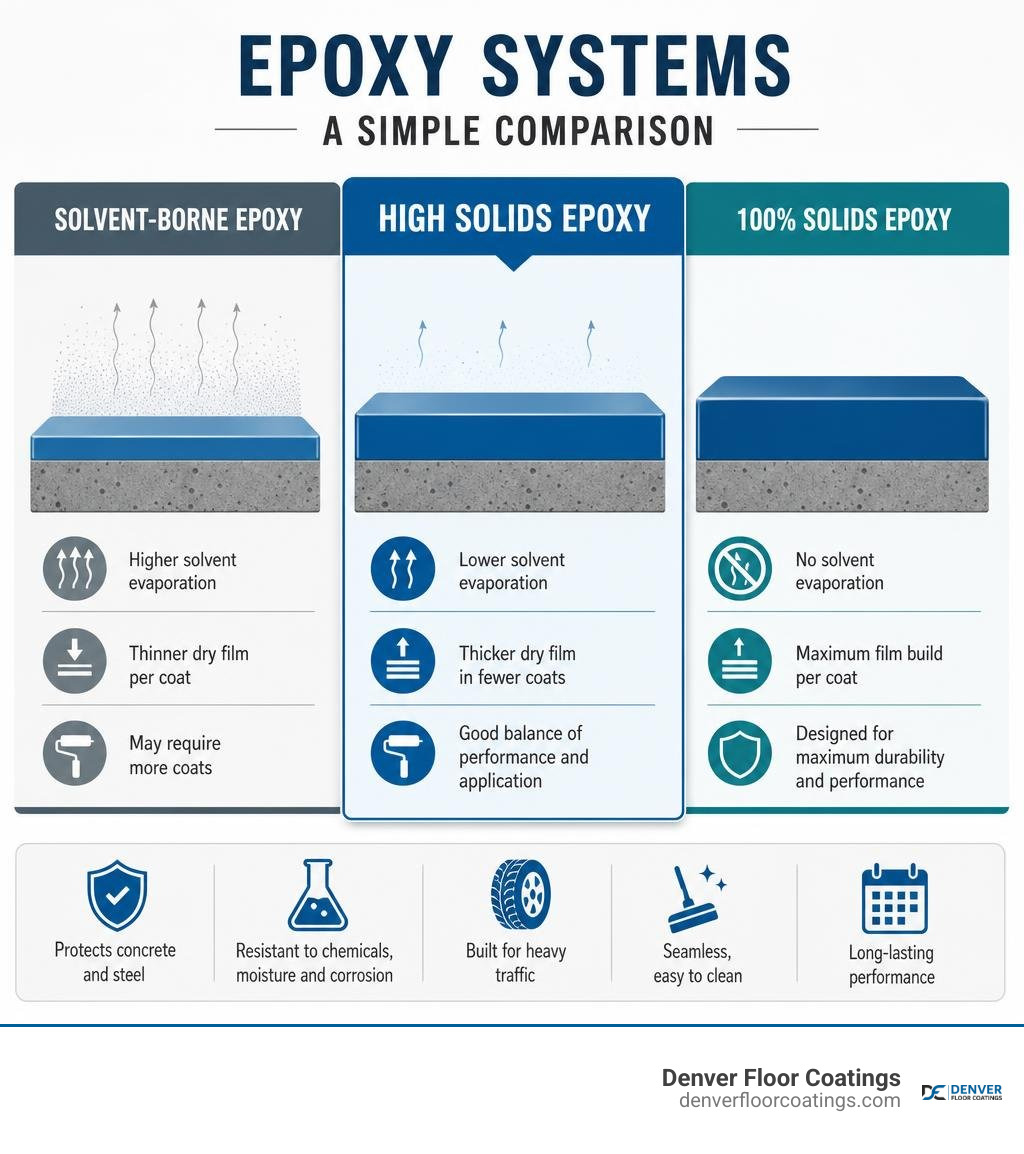
Understanding how advanced epoxy floors behave starts with examining the underlying resin chemistry, solids ratios, and the direct relationship between wet application thickness and dry film retention.
What Is High Solids Epoxy and How Does It Work?
A high solids epoxy is generally classified within the protective coatings industry as an industrial-grade formulation containing between 65% and 85% non-volatile solids by volume. Unlike standard architectural wall or floor paints that rely on the physical evaporation of water or heavy mineral solvents to leave behind a thin binder film, high solids epoxies cure primarily through an exothermic chemical crosslinking process. When the base resin (Part A) is combined with the polyamine or polyamidoamine hardener (Part B), the reactive groups form tight, three-dimensional covalent bonds. This thermosetting polymer network locks tenaciously into the micro-pores of properly prepared concrete substrates.
Evolving volatile organic compound (VOC) environmental standards have accelerated the commercial demand for high solids and solvent-free resin platforms. Traditional low-solids coatings release substantial quantities of volatile organic solvents into the atmosphere during cure, producing harsh odors and shrinking noticeably as they dry. High solids products dramatically minimize solvent off-gassing, making them suitable for compliance with regional air quality regulations while maximizing dry film thickness (DFT). Technical product data, such as that detailed in the Hi-Solids Catalyzed Epoxy documentation, demonstrates how high-solids catalyzed formulations provide dense chemical and moisture barrier properties over concrete and structural steel without emitting massive volumes of hazardous air pollutants into the surrounding facility.
Understanding High Solids Epoxy Formulations
The fundamental resin architecture of a high-solids system relies on base bisphenol-A or bisphenol-F epoxy prepolymers combined with catalyzed aliphatic amines, cycloaliphatic amines, or polyamides. Because the proportion of volatile organic solvent is significantly reduced, the uncured mixture exhibits higher viscosity and heavier body. Formulators achieve workable viscosity and smooth flow leveling by incorporating specialized reactive diluents—such as monofunctional or difunctional glycidyl ethers—that participate directly in the crosslinking reaction and become an integral part of the hardened cured matrix rather than evaporating into the surrounding air.
This optimized molecular structure yields exceptionally high crosslink density, impressive compressive and tensile strength, and minimal internal cure shrinkage. Specifying premium industrial-grade epoxy materials ensures the resulting polymer film resists heavy wheel loads, point impact, gouging, and surface wear in busy residential garages, commercial workshops, and heavy industrial facilities alike.
Dry Film Thickness and Solids by Volume
The relationship between Wet Film Thickness (WFT) and Dry Film Thickness (DFT) is governed by a fundamental mathematical formula based on the percentage of solids by volume:
$$text{DFT} = text{WFT} times left( frac{text{% Solids by Volume}}{100} right)$$
In practical field application, this dynamic determines how much protective material remains on the slab after cure:
- A high solids epoxy featuring 80% solids by volume applied at a wet thickness of 10 mils ($0.010$ inches) cures to a robust 8.0 mils of dry film thickness, losing only 2.0 mils to evaporation.
- A standard solvent-borne paint featuring only 40% solids by volume applied at that same 10-mil wet thickness cures to a mere 4.0 mils of dry film thickness, losing 6.0 mils (60% of its total wet volume) to solvent flashing.
Reviewing different types of poured epoxy flooring demonstrates how high-build capabilities streamline installation timelines. By maximizing dry film thickness in a single application pass, high solids systems reduce the total number of intermediate coats required to achieve strict engineering specifications, minimizing turnaround time while establishing a dense protective barrier.
Comparing Industrial Epoxy Formulations
Selecting the optimal resin system requires balancing volatile solvent content, ease of application, pot life, film build capabilities, chemical exposure thresholds, and ambient ventilation requirements.
| Feature | Standard Solvent-Borne Epoxy | High Solids Epoxy (65%–85%) | 100% Solids Epoxy (Solvent-Free) |
|---|---|---|---|
| Solids by Volume | 30% – 50% | 65% – 85% | 99% – 100% |
| VOC Content | High (>350 g/L) | Low (<250 g/L) | Near Zero / Zero (<50 g/L) |
| Dry Film Build per Coat | 2 – 4 mils | 5 – 10 mils | 10 – 30+ mils (multi-millimeter) |
| Working Pot Life | Extended (2 – 4 hours) | Moderate (30 – 60 min) | Short to Moderate (15 – 30 min) |
| Chemical Resistance | Moderate | High | Superior |
| Shrinkage During Cure | High (50% – 70% volume loss) | Low (15% – 35% volume loss) | Negligible (0% – 1% volume loss) |
| Primary Odor Profile | Strong, lingering solvent odor | Mild solvent odor | Low to negligible odor |
Traditional thin-film epoxy paint products simply lack the polymer density and build thickness required to withstand continuous mechanical loading and harsh chemical exposure over extended service periods.
High Solids vs Solvent-Borne Coatings
Solvent-borne epoxies rely on rapid solvent evaporation to form their final film. As large volumes of volatile solvent flash off into the surrounding atmosphere, microscopic capillary pathways, pinholes, and microscopic voids can form throughout the curing layer. These microscopic imperfections can create direct migration channels for moisture, road salts, automotive fluids, and corrosive industrial chemicals to reach the underlying concrete slab.
High-solids formulations dramatically restrict solvent migration, forming a continuous, tightly crosslinked matrix with minimal internal void space. The lower solvent content also minimizes unpleasant fumes, making these materials far more practical for occupied buildings and facilities with sensitive air handling systems. Reviewing the principles in our epoxy floors explained resource clarifies why higher polymer density consistently translates into superior long-term floor performance.
High Solids vs 100% Solvent-Free Systems

While high solids epoxies retain a modest percentage of solvent to moderate application viscosity and assist with roller leveling, 100% solids epoxy contains zero volatile carrier solvents.
Solvent-free systems, such as the ULTRA HIGH BUILD EPOXY epigen 1311 ULTRA , can be placed at substantial film builds—from 15 mils up to several millimeters in heavy slurry or broadcast configurations—without any risk of solvent entrapment, blistering, or pinholing. In standard commercial, warehouse, and residential garage spaces, high solids epoxies provide an exceptional balance: they offer slightly extended pot life and manageable roller application compared to ultra-thick solventless resins, while delivering the heavy film build and durability required for demanding environments.
Performance Advantages and Common Applications

High solids epoxy systems are engineered to withstand rigorous industrial operating conditions. Across Denver, Aurora, Lakewood, Centennial, and Arvada, high-performance industrial floor coatings provide the structural concrete protection needed to resist persistent mechanical impact, abrasive traffic, and aggressive liquid contact.
Chemical Resistance and Heavy Traffic Durability
Flooring across distribution centers, aircraft hangars, automotive service facilities, and manufacturing plants experiences continuous compressive loading and shear stress from heavy forklifts, steel-wheeled carts, vehicle traffic, and pallet jacks. High solids epoxies routinely provide cured compressive strengths exceeding 9,000 to 12,000 psi—far surpassing the compressive strength of standard 3,000 to 4,000 psi concrete slabs—protecting the structural concrete against impact spalling, rutting, and wheel wear.
In addition to physical durability, high solids epoxies offer substantial resistance to petroleum hydrocarbons, motor oils, brake fluid, hydraulic fluids, battery acids, deicing salts, and alkaline cleaning detergents. Referring to a comprehensive epoxy floor chemical resistance guide allows facility managers and property owners to align specific chemical splash and spill risks with appropriate protective topcoat configurations.
Immersion Service and Specialized Containment
Due to their impermeable molecular density and continuous barrier properties, high solids and ultra-high-build epoxy resins are frequently utilized in continuous immersion environments, secondary chemical containment dikes, wastewater treatment plants, clarifier tanks, and wash bays. These coatings prevent liquid infiltration and safeguard concrete infrastructure against aggressive chemical attack and acidic degradation.
Selected high-build formulations also comply with strict international regulatory standards, including NSF/ANSI 61 and AS/NZS 4020 for potable water storage structures and food processing spaces. As detailed in our commercial epoxy coatings complete guide, installing thick-film protective barriers prevents liquid seepage, eliminates concrete dusting, and supports sanitary facility maintenance across demanding commercial operations.
Surface Preparation and Application Methods
A protective coating system relies entirely on the quality and sound structural condition of the concrete beneath it. Applying high solids epoxy over contaminated, unprofiled, or excessively moist concrete can lead to bond failure and premature delamination.
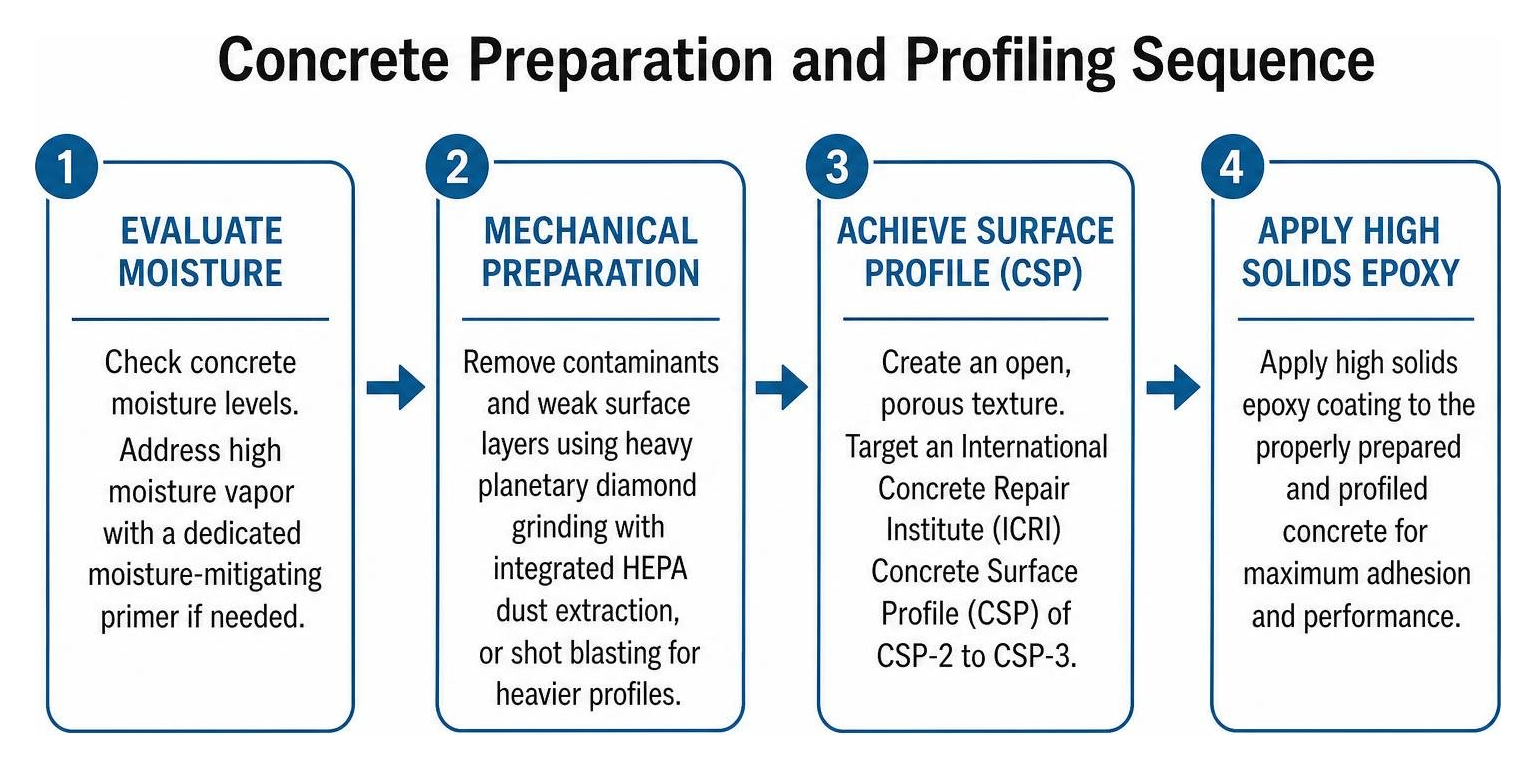
Before mechanical preparation begins, substrate moisture must be thoroughly evaluated. Conducting professional concrete moisture testing using in situ relative humidity probes (ASTM F2170) or calcium chloride tests (ASTM F1869) determines whether high moisture vapor emission rates (MVER) are present. If elevated moisture vapor is detected, a dedicated moisture-mitigating epoxy primer is installed prior to placing the high solids intermediate and top layers.
Substrate Profiling and Mechanical Preparation
Concrete must be mechanically profiled to remove weak surface laitance, open the concrete pores, and create a uniform anchor profile corresponding to International Concrete Repair Institute (ICRI) Concrete Surface Profile (CSP) standards, typically CSP-2 to CSP-3 for high solids epoxies. We achieve this texture using heavy commercial planetary diamond grinders equipped with industrial HEPA dust extraction systems, or through targeted shot blasting on high-capacity industrial slabs.
Concrete floor repair is only a small component of our floor-coating preparation work; our primary focus is thoroughly cleaning, degreasing, profiling, and vacuuming the substrate so the high solids resin can achieve deep mechanical penetration. Following a systematic epoxy floor installation process ensures the concrete is structurally sound, clean, dry, and free of curing compounds, sealers, oils, and bond-breakers before coating application begins.
Applying High Solids Epoxy Coatings Effectively
Because high solids epoxies have elevated viscosity and shorter pot life than low-solids paints, application requires precise technical execution:
- Precise Proportioning and Mixing: Measure Parts A and B according to the manufacturer’s exact volumetric ratio. Blend with a low-speed mechanical spiral mixer (300–450 RPM) for 3 minutes to achieve thorough chemical homogenization without entraining air bubbles.
- Managing Exothermic Heat: When mixed in the bucket, the chemical reaction accelerates rapidly, generating significant exothermic heat that quickly shortens workable pot life. The mixture should immediately be poured out across the concrete slab in long ribbons to dissipate heat and maximize working time.
- Even Placement and Gauge Control: Distribute the material uniformly using calibrated notched squeegees or high-grade rollers, followed immediately by back-rolling with a lint-free, solvent-resistant woven roller core to release surface tension and ensure consistent mil thickness.
- Environmental Monitoring: Measure slab temperature, ambient temperature, relative humidity, and dew point. The concrete temperature must remain at least 5°F above the ambient dew point to prevent condensation. As outlined in our epoxy flooring dry time guide, lower temperatures extend working pot life but lengthen recoat windows and overall cure times.
System Limitations and Industrial Maintenance Considerations
While high solids epoxies provide outstanding mechanical strength and chemical barrier capabilities, understanding their material boundaries ensures long-term operational success. Standard aromatic epoxy polymers are naturally susceptible to ultraviolet (UV) radiation from sunlight. When subjected to direct exterior exposure, unshielded epoxies can undergo photolytic chalking, surface discoloration, and ambering over time. For this reason, we install these formulations exclusively on interior concrete slabs—such as residential garages, commercial warehouses, workshops, and production floors—and shield them with UV-stable aliphatic polyaspartic or polyurethane protective topcoats wherever natural daylight enters through garage bay doors or windows.
Key operational considerations include:
- Recoat Windows and Intercoat Adhesion: High solids epoxies feature defined recoat intervals, typically between 12 and 24 hours depending on slab temperature. If the critical recoat window lapses, the cured film must be mechanically abraded with sanding screens to create a secondary physical anchor profile before applying subsequent coats.
- Thermal Shock and Expansion: Rigid epoxy coatings exhibit a different coefficient of thermal expansion than concrete slabs. In spaces exposed to extreme thermal cycling—such as industrial steam cleaning or commercial kitchen washdowns—specialized heavy-duty hybrid urethane concrete systems may be required.
- Routine Surface Maintenance: Consulting the top 10 disadvantages of epoxy flooring to consider gives facility owners realistic insights into routine upkeep, dust mopping, neutral-pH detergent washing, and spill management to preserve floor appearance over its operational lifespan.
Frequently Asked Questions About Heavy-Duty Coatings
What is the primary difference between high solids epoxy and 100% solids epoxy?
High solids epoxies contain a small volume of solvent (typically 15% to 35%), which lowers mixture viscosity, aids flow leveling, and provides slightly longer working pot life. In contrast, 100% solids epoxies contain zero evaporative solvents, yielding zero cure shrinkage and allowing for ultra-thick, single-pass build layers without risk of solvent entrapment.
How long does a high solids coating take to cure for traffic?
Under standard conditions (70°F / 21°C and 50% relative humidity), a high solids epoxy is generally tack-free within 8 to 12 hours. It typically accepts light foot traffic after 24 hours of cure, while achieving full chemical resistance and mechanical load-bearing cure within 5 to 7 days before supporting heavy vehicular or forklift movement.
Can high solids epoxy be installed outdoors?
Standard aromatic epoxy chemistries are designed for interior applications because direct sunlight UV exposure causes chalking, color fading, and loss of surface gloss. For areas exposed to direct outdoor sunlight, our team pairs protective high solids base layers with advanced UV-stable aliphatic polyaspartic topcoats to ensure stable color retention.
Conclusion
High solids epoxy systems deliver a dependable, high-build protective solution for facilities and homeowners seeking durable floor protection, robust chemical resistance, and compliant low-VOC emissions. Understanding how solids content dictates dry film thickness, working time, and crosslinking dynamics ensures you choose the ideal system for your facility’s operational demands.
At Denver Floor Coatings, our team specializes in high-performance epoxy and polyaspartic coating systems, including decorative flake finishes, rather than stained concrete services. Whether you are outfitting a high-traffic manufacturing plant, an automotive facility, a commercial warehouse, or a residential garage along the Colorado Front Range, our experienced professionals deliver engineered surface solutions tailored to withstand local temperature fluctuations and heavy daily use.
Explore our diverse array of commercial floor coatings or contact us today to request a free estimate and schedule an on-site consultation with our floor coating specialists.