

Why Concrete Repair Is the First Step to a Great-Looking Floor
Professional concrete repair is a highly systematic and technical process that involves identifying and resolving structural or surface-level deficiencies in a concrete slab before the application of high-performance coatings. This critical phase addresses cracks, spalls, and uneven transitions that, if left unmanaged, could potentially compromise the long-term integrity of the finished floor. At Denver Floor Coatings, we view the repair stage as perhaps the most vital component of any flooring project, as the performance of a polyaspartic or epoxy system is fundamentally tied to the quality and stability of the substrate beneath it. Without a sound foundation, even the most advanced coating systems may face challenges regarding adhesion and durability.
The professional workflow at Denver Floor Coatings begins with a comprehensive damage assessment, where our team systematically identifies cracks, spalling, delamination, or surface crazing through both visual and physical inspection. Following this, we move into substrate preparation, utilizing industrial diamond grinding to remove loose material, clean the substrate, and establish a proper profile for bonding. Material selection is the next phase, where we choose engineered resins, such as epoxy mortars or polyaspartic fillers, based on the specific nature of the damage and the environmental conditions of the site. The application and integration phase involves executing precise mixing and placement techniques to ensure the repair becomes a seamless part of the slab. Finally, the protective coating application seals the stabilized surface with industrial-grade systems designed for enhanced durability and aesthetic appeal.
Concrete is often perceived as a nearly indestructible material, yet even the most robust slabs are susceptible to environmental and mechanical stress over time. In the Denver metro area, factors such as extreme freeze-thaw cycles, the introduction of road salts, and the weight of heavy vehicles can lead to gradual surface degradation. While hairline cracks or minor surface flaking might appear to be purely cosmetic issues, they often serve as conduits for moisture and contaminants. If these areas are not professionally addressed, they can interfere with the chemical bond of a floor coating, potentially leading to premature failure or delamination.
I am Mike Wislinsky, the founder of Denver Floor Coatings. My background includes over 20 years of engineering and operations leadership at 3M, an experience that heavily influences our technical approach to concrete repair. We apply engineering-led precision to every project, ensuring that the foundation of your floor is prepared to withstand the unique challenges of the Colorado climate. Skipping or rushing this phase is a common pitfall in the industry, but our team prioritizes substrate health to deliver results that are designed for long-term performance and reliability. We believe that a floor is only as good as the preparation that goes into it, which is why we never compromise on the repair process.
Understanding Common Concrete Damage Affecting Floor Coatings
Before a high-performance coating can be applied, it is essential to understand the specific types of damage that can affect a concrete slab. In the Front Range, from the industrial zones of Aurora to the residential neighborhoods of Highlands Ranch, concrete is subjected to a variety of stressors that require specialized repair strategies. Understanding these stressors allows Denver Floor Coatings to tailor our approach to the specific needs of each individual slab.
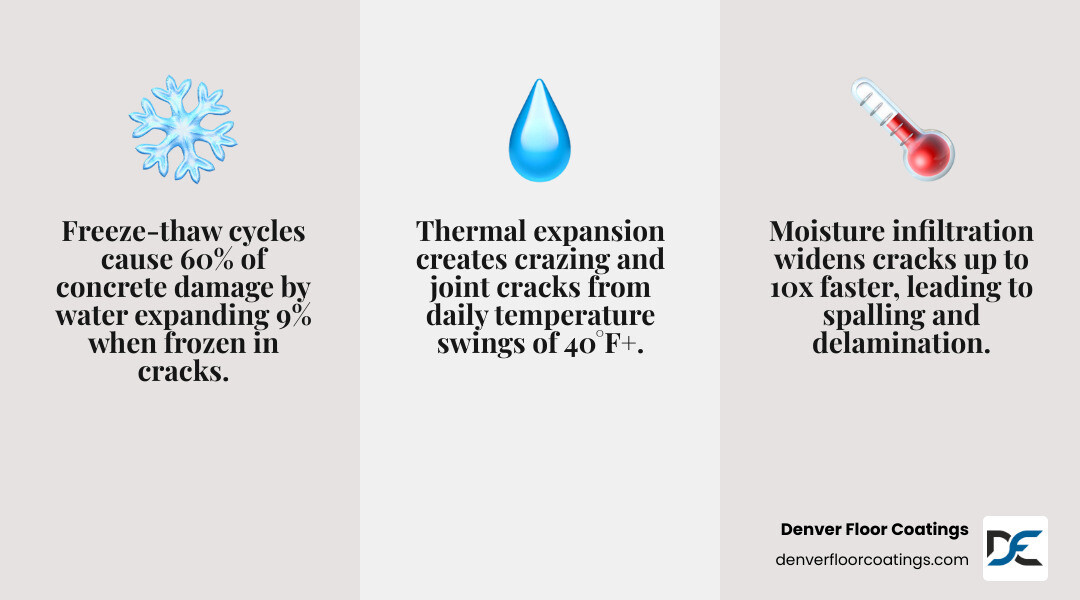
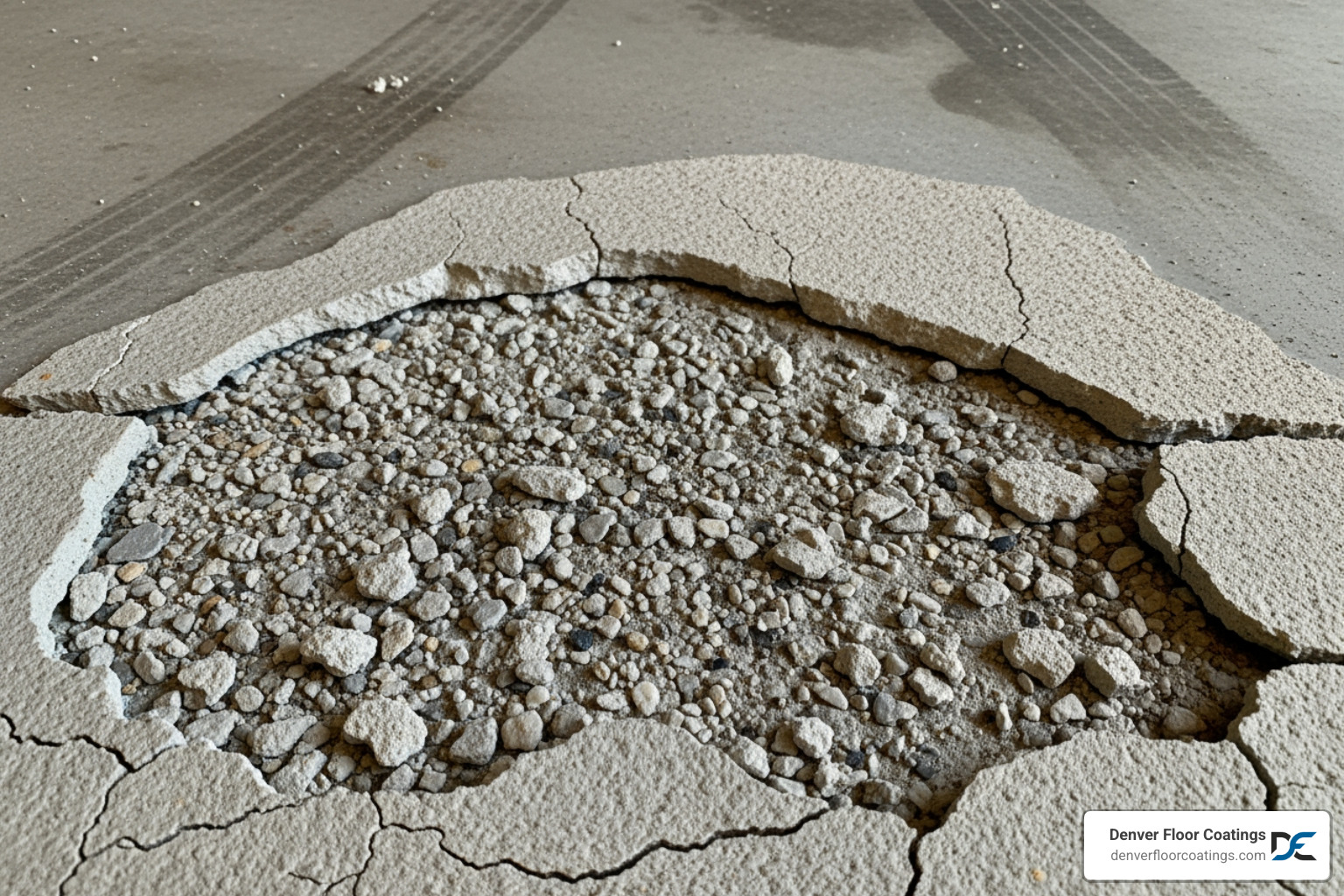
Colorado’s climate is characterized by rapid temperature fluctuations, which contribute significantly to freeze-thaw cycles and spalling. Because concrete is a naturally porous material, it can absorb moisture from the environment. When this moisture freezes, it expands by approximately 9%, creating significant internal pressure within the concrete matrix. Over time, this pressure can cause the surface of the concrete to flake or pop off, a condition known as spalling. If a coating is applied over spalled concrete without proper concrete repair, the weakened surface may eventually detach, potentially taking the coating with it. Our team focuses on removing this compromised material to reach the sound concrete underneath.
Moisture infiltration and efflorescence are also common concerns for ground-level slabs in the Denver area. As moisture moves upward through the concrete, it can carry dissolved minerals to the surface. When the water evaporates, it leaves behind a white, powdery substance called efflorescence. This process indicates that moisture is actively moving through the substrate, which can potentially disrupt the adhesion of epoxy or polyaspartic systems if not managed with moisture-mitigating primers. Denver Floor Coatings evaluates these signs to determine if additional moisture barriers are necessary for the project’s success.
In garage and commercial environments, concrete is often exposed to corrosive substances such as battery acid, de-icing salts, and automotive fluids. These chemicals can react with the cement paste, leading to pitting—the formation of small craters in the surface. These pits not only detract from the floor’s appearance but also create weak points where contaminants can further degrade the slab. Furthermore, structural cracks often result from the settling of the soil beneath the slab or from the application of loads exceeding the concrete’s design capacity. While minor shrinkage cracks are common, cracks wider than 1/4 inch may suggest underlying stability issues. Our team evaluates these cracks to determine if they are static or moving, which dictates the type of repair material required to stabilize the area before coating.
Surface crazing and scaling are additional forms of degradation that we frequently encounter. Crazing is characterized by a network of fine, shallow cracks that resemble a spiderweb, typically occurring during the curing process if the concrete surface dries too quickly. Scaling is a more severe form of surface failure where the top layer of the slab peels away in thin sheets, often due to the use of non-air-entrained concrete or excessive exposure to de-icing chemicals. Both conditions must be mechanically removed by Denver Floor Coatings to reach the sound concrete underneath, ensuring that the subsequent coating has a reliable surface to bond with.
Essential Preparation for Successful Concrete Repair and Coating Adhesion
At Denver Floor Coatings, we emphasize that the success of a floor project is largely determined by the quality of the preparation. For clients in Boulder, Castle Rock, and throughout the Denver area, we follow rigorous standards to ensure that every repair and coating application has the best possible foundation. This preparation is not merely a cleaning step; it is a mechanical transformation of the concrete surface designed to optimize chemical and physical bonding.
For a repair material or coating to achieve a permanent bond, the concrete surface must be mechanically textured to create “anchor points.” We adhere to the International Concrete Repair Institute (ICRI) standards for Concrete Surface Profile (CSP). For most residential and commercial applications, we aim for a CSP of 2 or 3. This profile, which feels similar to medium-grit sandpaper, is achieved through the use of industrial diamond grinding equipment. This mechanical process is far superior to chemical methods, as it provides a consistent and predictable texture across the entire slab.
While some may suggest chemical methods like acid etching, Denver Floor Coatings utilizes mechanical diamond grinding for superior results. Grinding effectively removes “laitance”—the weak, milky layer of cement paste that rises to the surface during pouring—and opens the pores of the concrete. This process also levels minor irregularities and ensures that the substrate is chemically and physically ready to accept the repair resins. By opening the pores, we allow the resins to penetrate deeply into the concrete, creating a mechanical lock that is difficult to achieve through other means.
Identifying delaminated concrete is another critical step in our preparation process. We use sounding techniques, such as tapping the surface with a hammer or using a chain drag, to locate hollow areas where the top layer has separated from the main slab. These unsound sections are mechanically removed until we reach solid, competent concrete. We often use vertical saw cuts to create clean perimeters for repair areas, avoiding “feather edges” that are prone to chipping or premature wear. This attention to detail ensures that the repair is as structurally sound as the surrounding concrete.
Cleaning and contaminant removal are also paramount. Oil, grease, and old sealers are significant barriers to adhesion. Even after grinding, deep-seated contaminants can sometimes remain within the concrete’s pores. We utilize specialized degreasers and industrial vacuums to ensure the bond site is clean. In cases of severe oil saturation, we may apply specialized oil-blocking primers to prevent future wicking that could compromise the coating. Additionally, before proceeding with any repair or coating, we perform moisture vapor emission rate (MVER) testing. High moisture levels can lead to osmotic blistering or delamination of the coating. If the slab exceeds safe moisture limits, we integrate moisture-mitigating resins into our repair and coating process to manage the vapor pressure effectively.
Selecting High-Performance Materials for Concrete Repair Prior to Coating
Selecting the appropriate repair material is a technical decision based on the depth of the damage, the expected load, and the required cure time. Denver Floor Coatings utilizes industrial-grade resins that are engineered to bond tenaciously to the concrete substrate without the shrinkage often associated with standard cementitious patches. Our selection process is guided by the specific physical properties required for each unique repair scenario.
For significant spalls and deep holes, we typically utilize high-strength epoxy mortars. These are created by blending specialized epoxy resins with graded silica sand. These mortars are designed to have a higher compressive strength than the concrete itself, often ranging between 8,000 and 12,000 PSI, providing a durable and stable repair that does not shrink as it cures. This lack of shrinkage is vital for maintaining the integrity of the repair over time, as it prevents the formation of new gaps between the patch and the original slab.
In scenarios where a rapid turnaround is required, such as our one-day garage transformations in Littleton or Parker, we utilize polyaspartic-based fillers. These materials cure very quickly, often allowing us to grind the repair flat and apply the base coat within 20 to 45 minutes of application. This efficiency is achieved without sacrificing bond strength or durability, making it an ideal choice for projects with tight timelines. These fillers typically offer a compressive strength of 6,000 to 9,000 PSI, which is more than sufficient for most residential and commercial applications.
Control joints and expansion joints are designed to accommodate the natural movement of a building. Filling these with rigid materials can lead to new cracks as the building shifts. Instead, we use semi-rigid polyureas that are designed to protect the edges of the joint from heavy traffic while remaining flexible enough to handle microscopic thermal expansion and contraction. These materials generally have a lower compressive strength, around 2,000 to 4,000 PSI, but offer the necessary flexibility to prevent structural stress.
Our material selection is further tailored to the specific environmental conditions of the Rockies. This includes the use of low-viscosity resins designed to penetrate deep into hairline cracks through gravity or injection, stabilizing the crack from the inside out. We also utilize moisture-insensitive epoxies capable of bonding to concrete that may have a higher moisture content, ensuring a reliable bond in various conditions. We select materials that cure to a hard, impact-resistant finish, typically ranging from 70 to 80 on the Shore D scale.
For more detailed information on how we handle smaller surface imperfections, you can read about epoxy floor repair for minor damage to see our approach to stabilizing the substrate. We constantly monitor substrate temperature and the dew point during the repair process. If the concrete is too cold, the chemical reaction in the resins can slow significantly. Conversely, high humidity can affect the surface finish of certain materials. We manage these variables to ensure that every repair achieves its intended physical properties and provides a lasting foundation for the final coating.
Professional Application Techniques for Durable Concrete Repair
Applying repair materials is a precise task that requires both technical knowledge and specialized tools. Our goal at Denver Floor Coatings is to ensure that every repair is fully integrated into the slab, creating a monolithic surface ready for coating. This requires a deep understanding of how different materials interact with the concrete substrate under various conditions.
We do not simply apply resin over the top of a crack. Instead, we “chase” the crack using a V-blade grinder to open it into a clean, manageable channel. This process removes weakened edges and increases the surface area for the repair material to bond. For static cracks, we use rigid resins to lock the slab together; for moving cracks, we utilize flexible fillers designed to accommodate movement. This distinction is critical, as using the wrong material can lead to the repair failing as the concrete naturally expands and contracts with temperature changes.
When addressing deep voids or significant depressions, we may apply the repair material in multiple layers, or “lifts.” This technique is used to manage the heat generated by the chemical reaction, known as exotherm, of the resin. By applying the material in controlled layers, we reduce the risk of internal stresses that could lead to cracking within the repair itself. This layered approach ensures that the entire volume of the repair cures evenly and maintains its structural integrity.
To maximize adhesion, we often “wet out” the repair area by scrubbing a neat coat of resin into the concrete pores with a stiff brush before adding the bulk of the repair mortar. This ensures that the resin is deeply embedded in the substrate, eliminating air pockets and creating a superior mechanical bond. This attention to the microscopic level of the bond is what sets Denver Floor Coatings apart in terms of the longevity of our repairs.
In larger commercial facilities, such as warehouses in Commerce City or Thornton, we often encounter “birdbaths” or low spots. We utilize self-leveling epoxy underlayments to bring these areas up to the proper grade. This creates a level surface that improves safety and makes the floor easier to maintain. If you have an existing coated floor that has sustained minor impact damage, there are specific protocols to follow. You can learn more about how we fix minor damage on your epoxy floor to maintain the integrity of the system without a full replacement. Our techniques are designed to be as non-invasive as possible while providing a robust solution to surface irregularities.
Quality Control and Long-Term Maintenance for Coated Floors
Once the concrete repair phase is complete, our team performs a series of quality control checks to verify that the substrate is ready for the final coating system. We do not proceed until we are confident in the stability of the repairs. This verification process is a hallmark of the Denver Floor Coatings approach, ensuring that every project meets our high standards for excellence.
Every repaired area is meticulously inspected through both visual and sounding techniques. We use these methods to ensure that the repair material has bonded fully to the substrate. Any area that produces a hollow sound is re-evaluated and addressed to prevent future delamination. For specialized commercial projects, we can perform pull-off adhesion testing. This involves bonding a metal disc to the repaired surface and using a hydraulic pull-off tester to measure the force required to break the bond. In a successful test, the concrete substrate itself should fail before the bond between the repair material and the concrete does, confirming that the repair is stronger than the original slab.
While our polyaspartic and epoxy systems are designed for extreme durability, proper maintenance will help preserve their appearance and performance over time. Regular cleaning is essential, as removing sand and grit prevents these particles from acting as abrasives under vehicle tires. We recommend regular sweeping and the use of a soft-bristle mop with a pH-neutral cleaner. This simple routine can significantly extend the life of the floor’s aesthetic finish.
Our coatings are highly resistant to most automotive and household chemicals. However, we recommend cleaning up spills, such as battery acid or harsh solvents, promptly to prevent potential surface staining. We also suggest inspecting the expansion joints every few years. If the building experiences significant movement that causes the joint filler to pull away, a simple touch-up can prevent moisture from migrating beneath the coating. By following these maintenance guidelines, you can help ensure that your Denver Floor Coatings installation remains in peak condition for many years to come.
Frequently Asked Questions about Concrete Repair for Floor Coatings
Professional assessment is recommended if your concrete floor exhibits extensive spalling, cracks wider than a nickel, or a surface that is constantly “dusting.” These are signs that the concrete is degrading and requires stabilization. Denver Floor Coatings specializes in preparing these surfaces for high-performance coatings in both residential garages and commercial facilities. If you are planning a floor upgrade, our team can evaluate the condition of your slab and provide a comprehensive repair and coating plan tailored to your specific environment.
The timeline for curing is dependent on the materials used and the environmental conditions. Our rapid-setting polyurea and polyaspartic repair materials can often be ground flat in as little as 20 to 45 minutes. A complete high-performance coating system typically allows for foot traffic within 24 hours, while heavy vehicle traffic is generally recommended after 48 to 72 hours. During colder months in Fort Collins or Greeley, these timelines may be slightly extended to ensure a full chemical cure. We always provide a specific timeline for each project based on the current conditions.
One of the most frequent errors in the industry is “feather-edging,” where repair material is thinned out to nothing at the edges. These thin areas lack structural integrity and are prone to flaking. Another common issue is ignoring “outgassing,” which occurs when air trapped in the concrete expands as the temperature rises, creating bubbles in the curing resin. At Denver Floor Coatings, we utilize techniques such as vertical saw-cutting and applying materials during stable or cooling temperature cycles to mitigate these risks. Our engineering-led approach ensures that these common pitfalls are avoided through careful planning and execution.
Many property owners wonder if every crack needs to be repaired. While minor hairline cracks may not always pose a structural threat, they can still affect the visual finish and provide a path for moisture. We generally recommend repairing all visible cracks to ensure a uniform and protected surface. Our team will help you prioritize repairs based on the intended use of the floor and the specific coating system being applied. This ensures that your investment is protected and that the final result meets your expectations for both form and function.
Conclusion
At Denver Floor Coatings, we understand that a high-performance floor is only as reliable as the concrete beneath it. Whether we are transforming a residential garage in Parker or protecting a large-scale industrial facility in Thornton, we treat concrete repair as a critical engineering task. By utilizing industrial-grade resins, advanced diamond grinding, and meticulous application techniques, we ensure that your new floor is a durable, long-term investment rather than a temporary fix. We specialize in turning damaged, unappealing concrete into showroom-quality spaces that are designed to withstand the rigors of the Colorado climate. If you are ready to address your concrete issues and upgrade to a high-performance flooring system, our team is ready to assist. Contact us for a professional estimate today, and let us provide a custom solution for your home or business.