

Choosing Industrial Resin Flooring for Real-World Demands
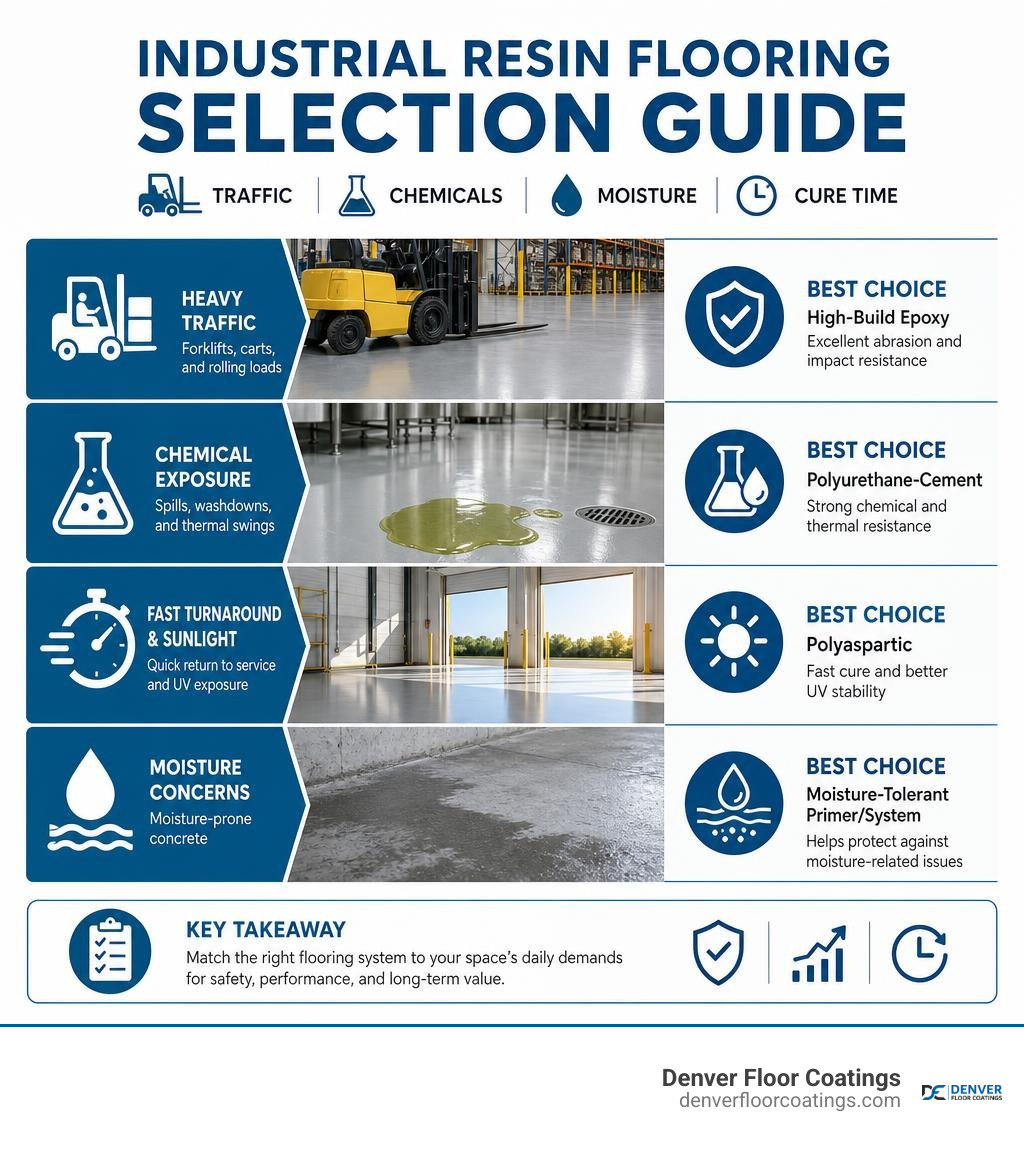
The right industrial resin flooring system depends on the specific chemical, physical, and thermal forces a concrete slab encounters every day. Selecting a floor protection system requires evaluating operational demands against polymer performance characteristics to ensure long-term durability:
- Heavy forklifts, carts, and rolling loads: Selecting a high-build epoxy or polyurethane system engineered for substantial abrasion and compressive resistance helps withstand constant rolling shear.
- Chemical spills, hot washdowns, or thermal swings: Polyurethane-cement mortar systems generally provide dependable performance by buffering against thermal shock and aggressive corrosive reagents.
- Fast turnaround or areas with sunlight: Polyaspartic coatings offer practical advantages because they cure rapidly and provide reliable ultraviolet stability near exterior-facing openings.
- Moisture-prone concrete: Diagnostic slab testing should precede application so that moisture-mitigating primers or breathable resin matrices can be specified appropriately.
Industrial environments rarely succeed with a generic, one-size-fits-all coating approach. A formulation that performs admirably across a dry packaging staging zone may quickly degrade when exposed to the hot sanitizing washes of a food-processing line or the concentrated solvents found in a manufacturing battery room. Facility planners must evaluate the existing slab profile, daily traffic density, chemical exposure profiles, workplace safety protocols, and realistic downtime constraints before settling on a specific polymer architecture. Exploring proven warehouse floor coating options or specialized anti slip epoxy systems can significantly enhance overall workplace safety and operational throughput, while selecting proper epoxy flooring establishes an impervious barrier across structural concrete.
Substrate preparation remains the critical foundation for any long-lasting resin application. Mechanical diamond grinding and shot blasting remove degraded concrete paste, opening the pore structure to establish strong mechanical interlock. Concrete floor repair is only a small component of Denver Floor Coatings’ floor-coating preparation work; deep cleaning, mechanical profiling, relative humidity evaluation, and specialized priming are all essential phases of our installation process.
I am Mike Wislinsky, Founder and President of Denver Floor Coatings, bringing more than 20 years of engineering and operations-management experience focused on process quality, material science, and field performance. Denver Floor Coatings specializes in high-performance epoxy and polyaspartic industrial resin flooring systems, including decorative flake finishes, rather than stained concrete services.
Core Types of Industrial Resin Flooring Systems
Selecting the right chemistry transforms bare, porous concrete into a resilient, high-productivity work surface. Industrial facilities subject their flooring to complex combinations of compressive stress, point-load impacts, rolling-wheel abrasion, and aggressive chemical exposure. Understanding how different polymer matrices behave under these operational stresses ensures that your investment aligns with day-to-day facility requirements. Our advanced industrial floor coatings utilize precision-engineered formulations designed specifically for challenging commercial and manufacturing environments.
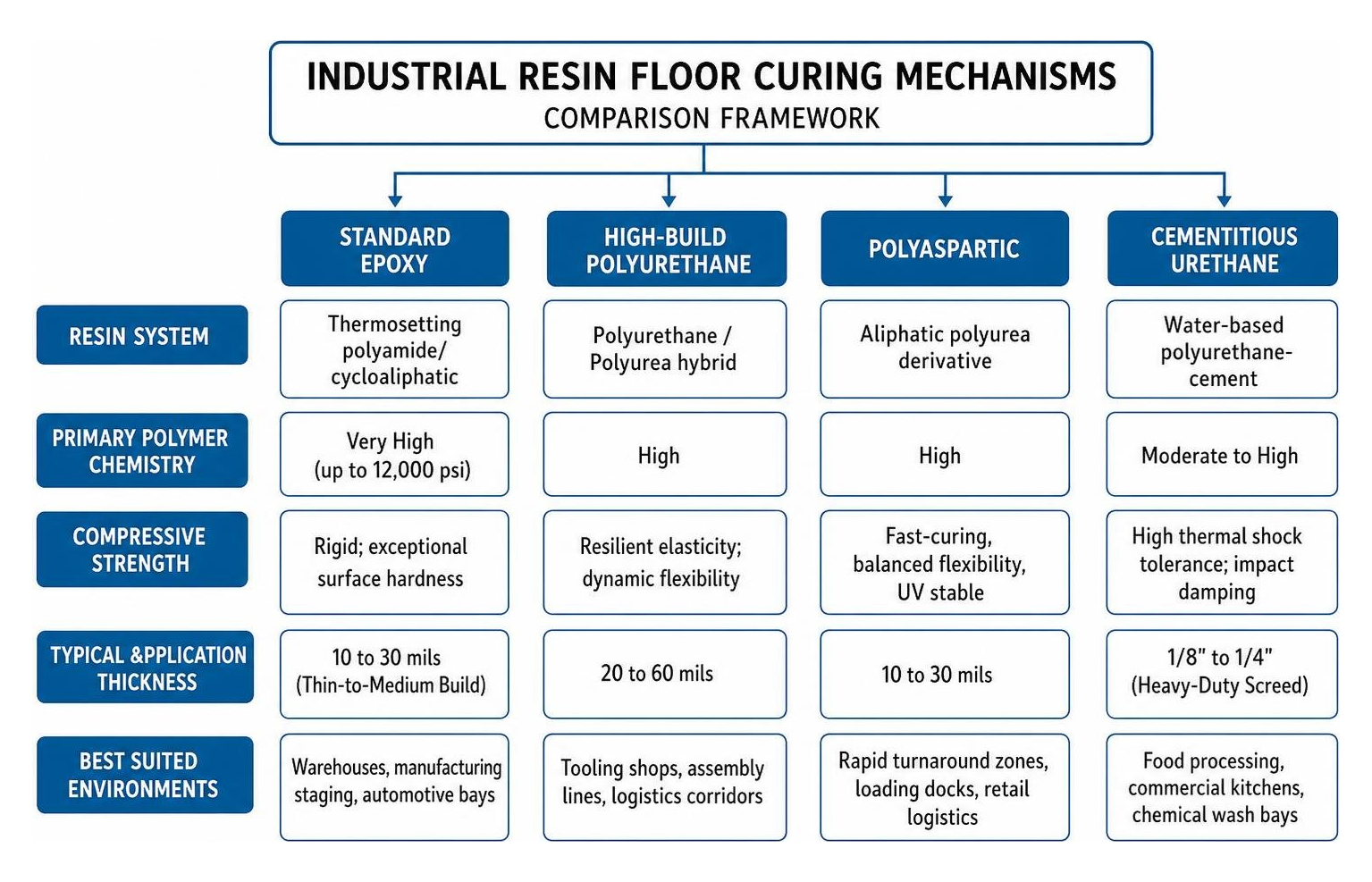
| Resin System | Primary Polymer Chemistry | Compressive Strength | Impact & Flexural Profile | Typical Application Thickness | Best Suited Environments |
|---|---|---|---|---|---|
| Standard Epoxy | Thermosetting polyamide/cycloaliphatic amine | Very High (up to 12,000 psi) | Rigid; exceptional surface hardness | 10 to 30 mils (Thin-to-Medium Build) | Warehouses, manufacturing staging, automotive bays |
| High-Build Polyurethane | Polyurethane / Polyurea hybrid | High | Resilient elasticity; dynamic flexibility | 20 to 60 mils | Tooling shops, assembly lines, logistics corridors |
| Polyaspartic | Aliphatic polyurea derivative | High | Fast-curing, balanced flexibility, UV stable | 10 to 30 mils | Rapid turnaround zones, loading docks, retail logistics |
| Cementitious Urethane | Water-based polyurethane-cement | Moderate to High | High thermal shock tolerance; impact damping | 1/8″ to 1/4″ (Heavy-Duty Screed) | Food processing, commercial kitchens, chemical wash bays |
Epoxy vs Polyurethane Formulations
Epoxy and polyurethane represent two fundamental pillars in resin flooring chemistry, each offering distinct mechanical properties. An industrial epoxy floor coating relies on a tightly cross-linked thermosetting reaction between an epoxide resin and an amine hardener. This dense molecular network generates immense surface hardness and compressive strength, making epoxy an outstanding base for bridging substrate micro-imperfections, supporting stationary heavy machinery, and resisting heavy static loads without deformation.
In contrast, an industrial polyurethane coating features an elastomeric polymer backbone that imparts dynamic flexibility and impact dampening. Where epoxy handles crushing forces through rigid load distribution, polyurethane absorbs mechanical vibration, direct point drops, and moderate substrate deflection without micro-fracturing. Polyurethane also tends to provide excellent scratch resistance against dragging pallets and maintains steady gloss retention when exposed to continuous physical abrasion.
Specialized Polyurethane-Cement and Polyaspartic Coatings
When standard coatings cannot match rigorous operating conditions or demanding return-to-service schedules, specialized high performance concrete coatings deliver tailored performance advantages:
- Polyurethane-Cement (Urethane Mortar): Engineered with a thermal expansion coefficient closely matching natural concrete. When subjected to sudden thermal shocks—such as steam sanitizing, boiling washdowns, or rapid freeze-thaw cycles in cold-storage rooms—the coating expands and contracts alongside the underlying concrete, reducing the likelihood of shear delamination.
- Polyaspartic Systems: Utilizing aliphatic polyurea chemistry, polyaspartics deliver rapid curing capabilities across diverse temperature ranges. These formulations allow multi-coat systems to be completed in tight project windows, minimizing facility downtime while offering long-term ultraviolet stability in areas near exterior overhead doors and sunlit staging bays.
Evaluating Performance Demands Across Industrial Facilities
Every industrial facility features distinct functional zones with specific physical demands. A high-turnover shipping dock experiences relentless wheel shear and sudden temperature fluctuations, whereas a processing line encounters continuous chemical washdowns, moisture migration, and sanitizing compounds. Achieving reliable performance requires facility managers to specify resin flooring systems tailored to each distinct operational zone rather than relying on a single uniform specification throughout the building.

Chemical, Thermal, and Impact Resistance Requirements
Corrosive substances can deteriorate unprotected concrete rapidly, leading to aggregate loosening and structural degradation. Facilities handling acids, alkalis, hydraulic fluids, or industrial solvents require dedicated chemical resistant floor coatings designed to block corrosive chemical penetration. Seamless resin matrices eliminate porous grout lines and seams where hazardous liquids might otherwise collect.
In wet processing and packaging facilities, maintaining hygiene and regulatory compliance is paramount. Installing a non-porous resin barrier prevents liquids from migrating beneath the slab and harboring bacteria. For facilities operating under strict health regulations, our detailed overview of everything you need to know about food and beverage processing floors outlines how seamless coved bases and antimicrobial resin formulations protect concrete integrity while simplifying daily washdown sanitation.
Selecting Industrial Resin Flooring for Heavy Forklift Traffic
Continuous forklift, reach-truck, and motorized pallet-jack traffic produces intense dynamic wheel friction, lateral shear, and severe point loading. If a floor coating lacks sufficient tensile strength and substrate adhesion, continuous rolling friction can lead to gouging, tire marking, and eventual bond failure.
When evaluating the best commercial floors for heavy traffic, high-build epoxy base coats broadcast with dense graded quartz or ceramic aggregates provide the structural reinforcement needed to support hard-rubber and polyurethane wheels shifting heavy inventory. The resulting composite build distributes point loads across a broader concrete area, helping to preserve the underlying slab under demanding operational cycles.
Moisture Tolerance and Breathable Resin Solutions
Concrete slabs resting on grade naturally draw moisture from the underlying soil through capillary action. When moisture vapor transmission (MVT) rates exceed the breathability of an impermeable surface coating, hydrostatic pressure accumulates beneath the polymer film. Over time, this pressure can cause osmotic blistering, pinholing, and localized delamination of the resin system.
Conducting relative humidity and calcium chloride testing prior to installation identifies whether moisture mitigation is necessary. Where high moisture vapor emissions are detected, applying moisture-tolerant epoxy primers or breathable water-based slurry systems allows moisture vapor to disperse without compromising the mechanical bond of the topcoat.
Operational Safety, Installation, and Substrate Preparation
A high-performance resin floor relies entirely on the quality and mechanical profile of the concrete substrate beneath it. Without thorough mechanical preparation, even the highest-grade polymer system risks premature failure through adhesive delamination.

Slip Resistance and Regulatory Compliance
Workplace safety requires dependable, predictable traction, especially in operational zones subject to liquid spills, oils, or fine process dust. Installing non slip industrial flooring involves broadcasting graded silica sand, aluminum oxide, or polymer granules directly into the wet intermediate resin layer before locking the aggregate in place with a durable topcoat.
These customized textures help facility managers support their housekeeping objectives and align with OSHA walking-working surfaces requirements. By tailoring aggregate particle sizes to specific zones, facilities can achieve the ideal balance between traction for workers and cleanability for sanitation crews.
Installing Industrial Resin Flooring Over Existing Concrete Substrates
Removing and repouring a sound concrete slab is costly and causes extensive operational disruption. Fortunately, existing structurally sound concrete can be effectively restored and upgraded with industrial resin systems through systematic mechanical preparation:
- Surface Decontamination: Industrial degreasers and mechanical cleaners remove deeply embedded oils, hydraulic fluids, and old curing compounds that could inhibit adhesion.
- Mechanical Profiling: Heavy-duty diamond grinding or shot blasting removes the weak surface laitance to produce an open Concrete Surface Profile (typically CSP 2 to 4), ensuring deep polymer penetration.
- Substrate Preparation: Concrete floor repair is only a small component of our floor-coating preparation work, focusing on routing dynamic cracks, filling control joints with semi-rigid polyurea, and rebuilding spalled joint shoulders.
- Adhesion Priming: Low-viscosity, high-penetration primers are applied to penetrate concrete pores, eliminate outgassing pinholes, and establish a tenacious chemical and mechanical bond with subsequent build coats.
Water-Based vs Solvent-Based and 100% Solids Formulations
Understanding carrier solvents and solid contents helps ensure environmental compliance and worker safety during installation:
- 100% Solids Formulations: Containing zero volatile organic solvents, these formulations convert entirely into the cured dry film thickness without evaporation shrinkage, producing minimal odor and making them suitable for occupied facilities.
- Water-Based Systems: Utilizing water as the carrying agent, these systems feature low-odor profiles and breathable qualities that perform reliably in low-impact areas or over moisture-sensitive slabs.
- Solvent-Based Coatings: These offer deep substrate penetration and excellent flow characteristics on dense surfaces, though they require strict air-exchange controls and active ventilation during the curing stage.
Application Guide: Coverage Rates, Curing Times, and Maintenance
Achieving consistent, dependable results from an industrial resin floor requires disciplined environmental monitoring and precise chemical mixing. Environmental factors such as ambient temperature, slab moisture, and relative humidity directly influence resin viscosity, pot life, and cure kinetics.
Coverage Rates and Chemical Mixing
Industrial resin systems are supplied as multi-component kits that must be blended at exact stoichiometric ratios. Deviations in mixing proportions can lead to tacky uncured spots, reduced chemical resistance, or compromised compressive strength.
- Working Pot Life: Most two-component epoxy and polyurethane formulations provide a workable pot life of roughly 30 to 45 minutes at 70°F (21°C). Once blended, the material must be promptly spread across the slab to prevent rapid exotherm in the mixing container.
- Coverage Rates: High-build resins typically yield coverage rates between 160 to 215 square feet per standard unit kit, depending on concrete porosity, surface profile depth, and specified build thickness.
Curing Stages and Return to Service
Curing is a progressive polymer cross-linking reaction that proceeds through distinct functional phases:
- Light Foot Traffic: Under standard ambient conditions of 70°F (21°C) and 50% relative humidity, floors can generally support light foot traffic within 12 to 24 hours.
- Mechanical Return to Service: Heavy machinery, rolling carts, and forklift operations can typically resume after 48 to 72 hours, depending on system formulation.
- Full Chemical Cure: Complete cross-linking typically requires up to 7 full days. Exposure to harsh cleaning detergents, standing chemicals, or extreme washdowns should be avoided until this chemical cure is fully established.
Routine Maintenance and Longevity Care
Non-porous resin finishes resist dirt penetration and eliminate the ongoing need for waxing, stripping, or buffing. Regular mechanical sweeping combined with automated scrubbing using pH-neutral cleaning detergents effectively preserves surface gloss and traction over years of continuous facility use.
Frequently Asked Questions About Industrial Resin Floors
Can industrial resin floors be applied directly over cracked concrete?
Minor non-structural hairline cracks can often be bridged by high-build base coats, but active structural fractures and moving control joints require targeted pre-treatment. Denver Floor Coatings cleans, mechanically preps, and fills active cracks with semi-rigid epoxy or structural polyurea joint fillers before applying base coats. This pre-treatment helps prevent underlying slab movements from mirroring through to the finished surface.
How long before an industrial resin floor can handle heavy traffic?
Return-to-service schedules depend on the specific resin chemistry chosen. Standard high-solids epoxy and polyurethane floors generally accommodate pedestrian traffic within 24 hours and heavy equipment or forklift traffic within 48 to 72 hours. For operations requiring minimal disruption, fast-curing polyaspartic systems can often support full operational loading in as little as 24 hours after application.
What is the expected service life of a heavy-duty resin system?
Service life varies based on daily traffic intensity, the frequency of chemical contact, thermal fluctuations, and routine maintenance practices. When properly specified, installed over a correctly prepared substrate, and maintained with appropriate cleaning methods, a professionally installed industrial resin floor can provide many years of dependable service before requiring a mechanical abrade and topcoat renewal.
What is the primary difference between epoxy and polyaspartic coatings?
Epoxy systems offer exceptional compressive strength and bond strength, making them ideal for heavy build applications and static load support. Polyaspartics cure considerably faster, feature greater elongation to absorb dynamic impacts, and provide superior UV resistance, preventing surface ambering in areas exposed to sunlight through open bay doors.
Conclusion
Investing in a tailored industrial resin flooring system safeguards your concrete substrate against structural degradation while creating a cleaner, safer, and more productive operating environment. Matching polymer chemistry to your facility’s daily traffic volume, chemical exposure profile, and operational temperatures helps prevent unexpected surface failures and costly downtime.
Denver Floor Coatings specializes in high-performance epoxy and polyaspartic coating systems, including decorative flake finishes, rather than stained concrete services. Whether managing a bustling manufacturing plant, packaging facility, commercial warehouse, or automotive service center, our team provides durable, low-maintenance resin floors engineered for real-world reliability.
Explore our complete range of commercial floor coatings or contact us today to schedule an on-site consultation and receive a comprehensive estimate for your next flooring project.