

What Is an Epoxy Floor Marble Look — and Can You Get It in Your Home?
An epoxy floor marble look is a sophisticated architectural finish created by integrating specialized metallic pigments into a high-solids liquid epoxy resin system. These pigments are meticulously manipulated while the resin is in its fluid state to replicate the organic swirling, intricate veining, and visual depth characteristic of natural quarried marble. This process is not a simple application but a multi-layered technical installation designed to provide a high-end aesthetic for residential and commercial interiors. At Denver Floor Coatings, we view this as a fusion of chemical engineering and fine art, where the goal is to transform a standard concrete substrate into a seamless, three-dimensional landscape that captures the elegance of stone without its inherent structural limitations.
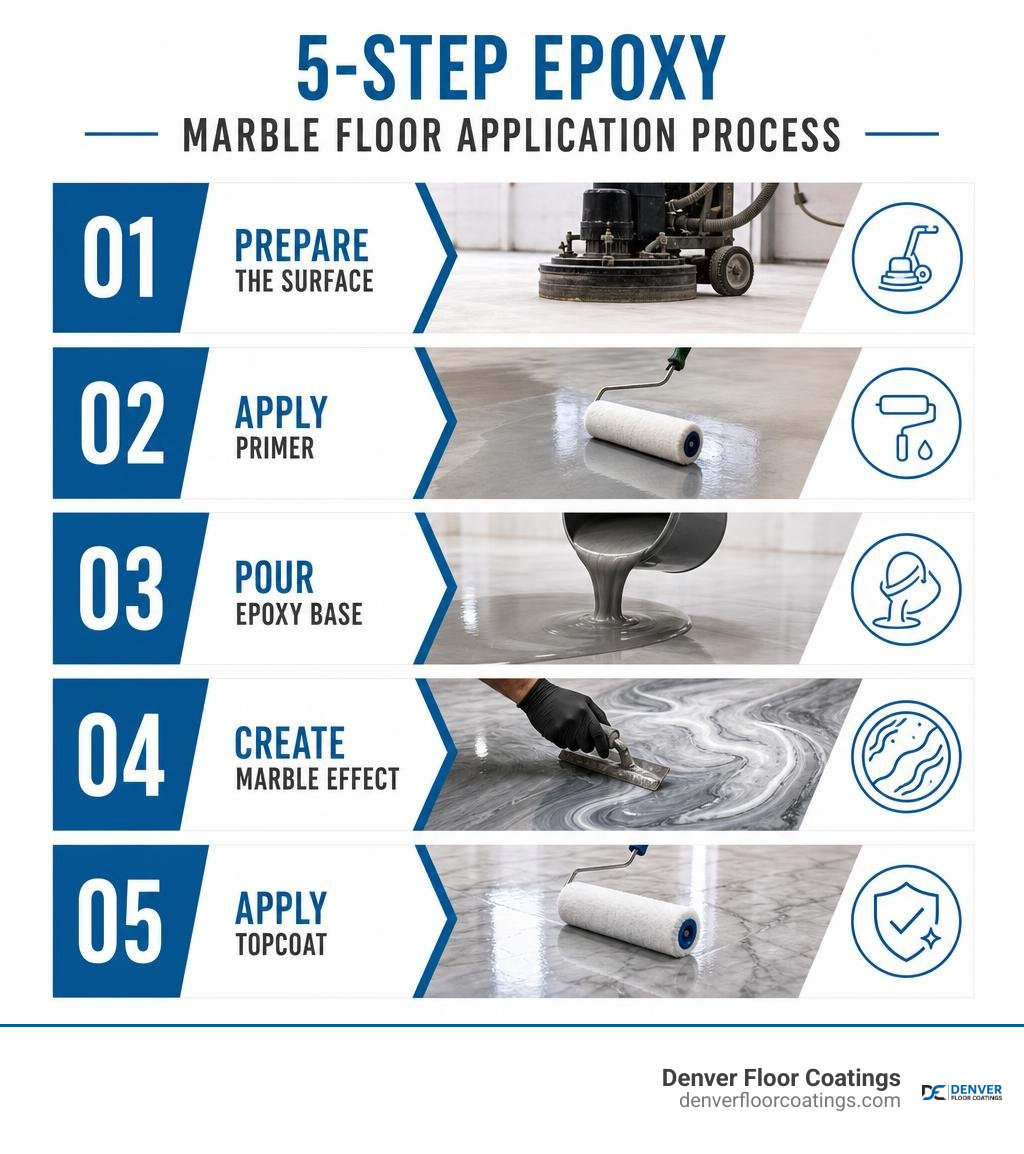
The installation sequence is a rigorous professional undertaking. It begins with mechanical surface preparation, utilizing industrial diamond grinding to open the concrete pores and ensure a permanent mechanical bond. This is followed by the application of a moisture-mitigating primer, establishing a non-porous, chemically bonded base layer that prevents outgassing and moisture-related failures. The core of the aesthetic is the installation of the metallic epoxy body coat, where pigment-loaded resin is spread with precision tools to achieve the necessary thickness for visual depth. Artistic pigment manipulation then follows, employing specialized techniques to create the characteristic veins and transitions found in natural stone. Finally, a high-performance topcoat is applied, adding a protective layer of polyaspartic or urethane to ensure UV resistance, abrasion protection, and long-term gloss retention.
The resulting surface is a seamless, high-gloss floor that can be nearly indistinguishable from real marble, offering a luxurious finish that is often more durable and easier to maintain than natural stone. Homeowners throughout the Denver metropolitan area, from the modern estates in Cherry Hills Village to the expansive basements in Highlands Ranch, are increasingly selecting the epoxy floor marble look to elevate their living spaces. This flooring solution provides a high-end architectural finish for garages, basements, and showrooms without the structural weight, inherent fragility, or extreme maintenance requirements of natural stone slabs. The appeal lies in its ability to transform a standard concrete slab into a bespoke design element that is both visually stunning and functionally superior.
Achieving a flawless result requires a deep understanding of resin chemistry, environmental variables, and advanced application techniques. The difference between a professional-grade installation and a substandard finish often comes down to the quality of the materials used and the rigor of the surface preparation. I’m Mike Wislinsky, Founder and President of Denver Floor Coatings. With over 20 years of engineering and operations experience, I have dedicated my career to perfecting the science of resinous flooring. Since establishing Denver Floor Coatings in 2017, I have seen how a properly executed epoxy floor marble look can completely redefine a space. In this guide, I will detail the professional standards and technical steps required to achieve a high-performance marble aesthetic.
The Art of the Epoxy Floor Marble Look
Creating a high-end epoxy floor marble look is a complex process that blends chemical engineering with artistic technique. We are not merely coating a surface; we are engineering a three-dimensional visual landscape within a high-build resinous system. Metallic epoxy systems utilize mica-based pigments that remain suspended in clear or tinted resin. Because these pigments are pearlescent and light-reflective, they interact with ambient and architectural lighting at various angles, creating a sense of movement and depth that echoes the natural variation people love in stone. This interaction with light is what gives the floor its “living” quality, as the appearance can shift slightly depending on the time of day or the specific lighting temperature used in the room.
At Denver Floor Coatings, we focus on designing these floors as part of the overall feel of a space—not as an afterthought. In the Denver metro area, clients often want a surface that reads as refined and intentional while still being practical in day-to-day life. A metallic marble look offers a seamless finish, a sense of visual depth, and a highly customizable palette. Just as importantly, it creates a surface without grout lines, which can make routine upkeep feel more straightforward in busy households. The absence of grout not only enhances the visual continuity of the space but also eliminates the common maintenance headache of cleaning porous grout lines that tend to trap dirt and moisture over time.
This finish is also popular because it can be tailored to the architecture of the room. The scale of the veining, the contrast between base and accent pigments, and the amount of movement in the pattern can be adjusted so the floor complements—rather than overwhelms—the surrounding design. Some rooms call for soft, cloud-like transitions that feel calm and minimal, perfect for a modern master suite or a quiet home office. Others look best with bolder veining that introduces drama and a sense of direction, which is often preferred in high-traffic entryways or expansive basement entertainment areas. The versatility of the medium allows us to mimic specific types of stone, from the classic white and grey of Carrara to the deep, moody tones of Nero Marquina.
Natural marble is undeniably striking, but many homeowners weigh aesthetics against everyday realities. Stone can be heavy, and certain installations may require additional structural considerations to support the weight of thick slabs. It can also be porous, and that porosity can make it more sensitive to staining or etching in real-world settings, particularly when exposed to acidic substances or heavy foot traffic. A properly installed resinous system from Denver Floor Coatings provides a different kind of practicality: it is seamless, non-porous, and built as a single integrated surface that is designed to withstand the rigors of a modern home. Another important difference is control. With natural slabs, you are limited to the quarry pattern you select. With a metallic system, we can shape the final appearance during installation—guiding pigment movement and veining to match the mood you want the space to carry. The result can feel curated and bespoke without relying on grout patterns or stone lot availability.
At Denver Floor Coatings, we work closely with clients to develop a custom “marble” palette that aligns with lighting, wall color, and the overall design intention of the space. Many of the most requested marble looks start with a neutral base—white, light grey, soft taupe, or cream—then build visual structure with metallic accents such as silver, charcoal, bronze, or copper. Small pigment choices can have outsized effects. Cooler metallics tend to feel crisp and contemporary, especially in basements with modern lighting. Warmer metallics can add depth and richness that pairs well with natural wood, warm-toned walls, or softer ambient light. We also discuss sheen expectations early, because the perceived depth of a metallic system often changes depending on how light moves across the floor. We utilize premium epoxy materials so the pigments maintain clarity and separation during cure. That matters for a marble look, where definition is part of the appeal: a floor can be beautifully subtle, but it should still look intentional, not muddied or flat. Because metallic floors are inherently artistic, we also help clients set realistic expectations. The goal isn’t to produce a repeated printed pattern; it’s to create a one-of-one floor with organic variation that feels convincingly high-end.
Professional Surface Preparation for Metallic Systems
The success of a metallic marble system is almost entirely dependent on the quality of the surface preparation. At Denver Floor Coatings, we emphasize that a floor is only as durable as its bond to the substrate. We frequently encounter concrete surfaces in Arvada, Westminster, and Thornton that require extensive mechanical preparation to ensure a long-lasting finish. For a metallic system to bond effectively, the concrete must be more than just clean; its pores must be fully opened to allow the resin to penetrate and anchor itself deep within the slab. This is not a step that can be rushed or bypassed, as the entire integrity of the multi-layer system rests on this initial bond.
We utilize industrial-grade diamond grinders to remove the “laitance”—the weak, brittle top layer of the concrete—and achieve a specific Concrete Surface Profile (CSP). This mechanical process creates a textured surface that allows the epoxy to “root” into the concrete, preventing issues like peeling or delamination, even under the stress of hot vehicle tires or heavy equipment. Proper preparation is the foundation of every high-performance floor we install. In the Colorado climate, where temperature fluctuations can cause concrete to expand and contract, this mechanical bond is vital for ensuring the coating moves in unison with the slab, reducing the risk of stress-related failures over time.
Before the application of the resin, the concrete slab must be meticulously repaired. Any existing cracks, divots, or spalled areas will be magnified by the high-gloss finish of a marble epoxy floor. We utilize specialized crack injection resins and high-strength leveling compounds to create a perfectly smooth, non-porous canvas. When handling these industrial materials, we strictly adhere to the safety and application protocols outlined in the Safety Data Sheet – Resin, Gray. A level floor is particularly critical for metallic systems because the pigments are fluid during the initial curing phase. If the floor has significant slopes or low spots, the metallic “veins” may migrate toward the lowest point, which can disrupt the intended aesthetic. You can learn more about our professional epoxy floor installation process here.
In many Colorado basements and older garages, moisture vapor transmission is a significant concern. Moisture rising through the concrete slab can create hydrostatic pressure, which may lead to “amine blush”—a cloudy white film on the surface—or the formation of bubbles and blisters in the epoxy coating. To mitigate this risk, we typically apply a specialized moisture-seal primer. This layer acts as a sophisticated vapor barrier, locking out moisture and ensuring that the subsequent metallic layers remain clear and well-bonded. The precise mixing of these components is essential, and our team follows the Safety Data Sheet – Hardener guidelines to ensure the chemical reaction is complete and the barrier is structurally sound. This technical approach is vital for maintaining the integrity of the floor in the varied climate of the Front Range, where soil moisture levels can change rapidly with the seasons.
Step-by-Step: Achieving a High-End Marble Aesthetic
Once the preparation is complete and the primer has cured, the installation of the metallic body coat begins. This is the stage where the epoxy floor marble look truly takes shape. We typically utilize a 100% solids epoxy because it supports the necessary thickness, or “mil build,” to give pigments room to move and settle into layered, natural-looking transitions. The process starts with mixing resin and hardener at a precise ratio. Once combined, the “pot life”—the window of time the material remains workable—is limited. In Colorado—where humidity, temperature, and slab conditions can vary throughout the year—managing working time and flow is central to achieving a refined result. We distribute the epoxy in controlled ribbons across the slab and then spread it evenly with professional tools to keep thickness consistent.
While there are many types of poured epoxy flooring, the metallic marble technique tends to be among the more labor-intensive because the finish is created in real time. The floor must be placed, shaped, and visually balanced before the material begins to set. That blend of timing, chemistry, and design is why the marble look is often viewed as both technical and artistic. The installer must anticipate how the pigments will settle as the resin begins its exothermic reaction, ensuring that the movement remains fluid and organic rather than static or forced. This requires a high degree of situational awareness and experience with the specific behavior of high-solids resins.
The veining is formed while the epoxy remains fluid. We establish the base field first, then introduce accent pigments that will become the veins and highlights. To achieve a realistic marble impression, we may use a ribboning approach—pouring thin lines of contrasting pigment and then gently manipulating them so they soften, taper, and branch in a way that feels organic. Tools and technique matter here. Subtle changes in roller pressure, squeegee angle, or how quickly an accent is dispersed can shift the final look dramatically. For some designs, we aim for the quiet sophistication of light veining that appears to sit beneath the surface. For others, we craft higher contrast movement that reads more dramatic and architectural. This is where the expertise of Denver Floor Coatings becomes most apparent, as our installers use their understanding of fluid dynamics to guide the pigments into patterns that mimic the geological processes of natural stone formation.
A controlled mist of high-percentage isopropyl alcohol may be used to influence pigment dispersion and create delicate cellular effects. This is done carefully and intentionally, because too much disruption can make the pattern feel busy. The goal is balance: veins that look natural, transitions that feel fluid, and enough depth that the floor holds interest from multiple viewpoints. The final step is applying a protective topcoat, which plays a major role in long-term appearance. Epoxy provides the visual body and depth, but many spaces benefit from an additional layer engineered to better handle abrasion and UV exposure. For that reason, Denver Floor Coatings commonly finishes marble-look systems with a high-performance polyaspartic topcoat. Polyaspartic coatings are valued for their clarity, UV stability, and wear resistance, and they allow us to tune the final sheen. While high gloss is often chosen to amplify depth and reflectivity, we also discuss real-world use—lighting, foot traffic, and the feel you want the room to have—to help guide the best finish selection. Understanding the epoxy flooring pros and cons is part of setting expectations. The topcoat functions as a practical shield, helping protect the artistic work underneath so the floor continues to look polished and intentional as the space is lived in.
Technical Specifications and Performance Standards
A professional metallic epoxy installation is defined by its thickness, material quality, and environmental control during application. While many coating systems are relatively thin, our metallic marble systems at Denver Floor Coatings are typically engineered to be 24–30 mils thick—roughly the thickness of a credit card. This substantial build contributes to visual depth, helps pigments create dimensional movement, and supports a more robust protective system when paired with a high-quality topcoat. A thinner application often fails to provide the necessary “room” for the metallic pigments to orient themselves vertically, which can result in a flat, less convincing appearance. By maintaining a higher mil build, we ensure the floor has the structural integrity to resist impact and the aesthetic depth to remain visually captivating for years.
This layered approach is designed to support both aesthetics and performance in demanding environments, whether it’s a residential garage, a finished basement, or a commercial interior where appearance matters. We use high-quality resin and disciplined mixing practices to reduce the likelihood of entrapped air, which can otherwise lead to bubbles or pinholes that distract from a mirror-like finish. The chemistry of the resin is also formulated to provide excellent chemical resistance, protecting the floor from common household spills, automotive fluids, and cleaning agents. This makes the marble look not just a design choice, but a functional upgrade to the property’s infrastructure.
Curing is where the chemistry completes the transformation from a fluid resin into a solid, integrated surface. While a floor may feel dry to the touch relatively quickly, it still needs time to develop its full physical properties. We provide project-specific guidance based on the system used and site conditions. Typically, initial walk-on time is within 12–24 hours with soft footwear, light traffic is common around 48 hours, and a full chemical cure for vehicle traffic is frequently reached around 7 days. In Colorado, temperature swings and slab temperature can influence cure behavior. If conditions are too cool, cure can slow significantly. If conditions are too warm, working time can shorten and require additional planning. We reference manufacturer guidance, including the Safety Data Sheet – Resin, Clear, to confirm parameters for the specific resin system being installed.
The epoxy floor marble look is valued for day-to-day upkeep because the surface is seamless and non-porous. In most homes and many commercial interiors, routine care can be as simple as dry dust mopping and occasional cleaning with a pH-neutral cleaner. Over time, the way the floor wears tends to be influenced by the topcoat selection, traffic patterns, and how grit and moisture are managed at entry points. In spaces where slip resistance is a concern, we can incorporate specialized non-skid additives into the final topcoat. These transparent micronized beads add traction while preserving the visual clarity of the metallic design. This is often a thoughtful option for households that expect wet boots in winter or businesses that want a refined look without ignoring safety. When treated as a long-term interior finish rather than a disposable surface, a professionally installed system from Denver Floor Coatings can remain visually impressive for many years, with refresh options available depending on wear and use.
Environmental and Structural Considerations for Marble Epoxy
When considering a marble-look epoxy floor, it is important to understand the environmental and structural factors that contribute to a successful outcome. One common question involves the longevity of the system. When professionally installed and properly maintained, an industrial-grade metallic epoxy floor is designed to provide many years of service. The longevity of the floor is largely dependent on the integrity of the polyaspartic topcoat. As long as this protective layer is maintained and occasionally refreshed if necessary, the artistic marble layer beneath remains protected. In a typical residential setting in Aurora or Littleton, these floors are known for their exceptional durability and resistance to the daily wear and tear of a busy household.
Substrate compatibility is another critical factor. We generally advise against installing epoxy over wood substrates because wood expands and contracts at a significantly different rate than resin, which can eventually lead to stress cracking in the coating. While installation over tile is technically possible if the tile is exceptionally well-bonded and mechanically ground to remove all glazes, the most reliable substrate is always properly prepared concrete. At Denver Floor Coatings, we focus on concrete surfaces to ensure the strongest possible bond and the longest service life for the floor. Concrete provides a stable, rigid base that allows the resinous system to perform as engineered, ensuring that the marble aesthetic remains intact without the risk of substrate-related movement.
Safety and slip resistance are also paramount considerations. Like any high-gloss surface, a marble-look epoxy floor can be slippery when wet. However, unlike natural polished marble, which can be quite hazardous when damp, we have the ability to incorporate slip-resistant additives into our topcoats. These additives create a subtle texture that provides necessary grip while maintaining the high-end, glossy aesthetic that homeowners and business owners desire. This allows for a floor that is both beautiful and functional, meeting the safety needs of the space without compromising on the visual impact of the metallic marble design. By tailoring the amount of slip resistance to the specific needs of the room, we ensure that the floor is optimized for its intended use, whether it is a high-traffic showroom or a private residential basement.
Conclusion
Transforming a standard concrete slab into a stunning epoxy floor marble look is a sophisticated process that calls for technical precision, careful planning, and a practiced artistic hand. For homeowners and business owners across the Denver metro area, this finish offers a rare combination: a seamless, high-end aesthetic with a surface that feels practical for real life. At Denver Floor Coatings, we approach marble-look metallic epoxy as a complete system—prep, primer, body coat, design technique, and topcoat—because each layer influences the final result. When those layers are engineered and applied with discipline, the floor can deliver the depth, movement, and clarity people associate with luxury interiors, while still supporting the daily demands of garages, basements, retail spaces, and more.
If you are considering a marble-look epoxy floor and want guidance on color direction, finish options, and what your slab will require to support a premium outcome, our team is ready to help. We take pride in our ability to translate a client’s vision into a durable, high-performance reality that enhances the value and beauty of their property. Contact Denver Floor Coatings for an estimate and a plan tailored to your space: https://denverfloorcoatings.com/contact-us/.