

Understanding the Importance of Anti Slip Concrete Coating for Safety
Implementing a high-quality anti slip concrete coating is widely viewed as one of the most practical ways to improve traction on concrete surfaces that may be exposed to moisture. In the Denver metropolitan area—where conditions can shift quickly—upgrading a garage, entry area, or commercial facility with a slip-resistant finish is a proactive step toward supporting everyday safety. While concrete is remarkably durable, its naturally smooth surface can become more hazardous when rain, snowmelt, or even routine condensation creates a thin film that reduces friction underfoot. This phenomenon is particularly prevalent in the Front Range, where the high altitude and rapid temperature fluctuations contribute to unique surface challenges that standard concrete often cannot manage on its own.
Across Colorado’s Front Range, a clear morning in cities like Aurora or Lakewood can give way to an afternoon storm or a sudden snow squall. When moisture is tracked into a garage or a commercial loading area, it can create a slick layer that changes the way shoes and tires interact with the slab. Freeze-thaw patterns add another layer of complexity: melting snow can refreeze overnight, or leave behind damp residue mixed with grit and road salts. In spaces that see frequent foot traffic, carts, or vehicles, these small environmental changes can meaningfully increase the likelihood of a slip. At Denver Floor Coatings, we recognize that these environmental factors require a specialized approach to surface engineering, ensuring that the texture provided is sufficient to break the surface tension of water and ice melt.
Slip-and-fall incidents remain a common source of preventable injuries in both residential and commercial settings. A professionally installed anti slip concrete coating helps reduce that exposure by introducing reliable texture while still supporting a clean, finished appearance. In many facilities, these systems are selected not only for traction, but also because they can be tailored to real-world conditions—such as occasional wetness, tracked-in debris, and the day-to-day realities of an active garage or warehouse. Our systems are designed to provide a balance between aggressive grip and ease of maintenance, ensuring that safety does not come at the expense of a cleanable surface.
I’m Mike Wislinsky, founder and president of Denver Floor Coatings. With over two decades of experience in engineering and operations, along with years dedicated to high-performance flooring solutions throughout the Denver area, I’ve seen how the right surface treatment can turn a challenging, slippery slab into a more stable and functional surface. Our work is centered on systems engineered for Colorado’s climate swings, so traction, durability, and ease of maintenance can work together rather than competing. We focus on the specific needs of local property owners, understanding that a floor in Thornton or Castle Rock faces different stresses than one in a more temperate climate.
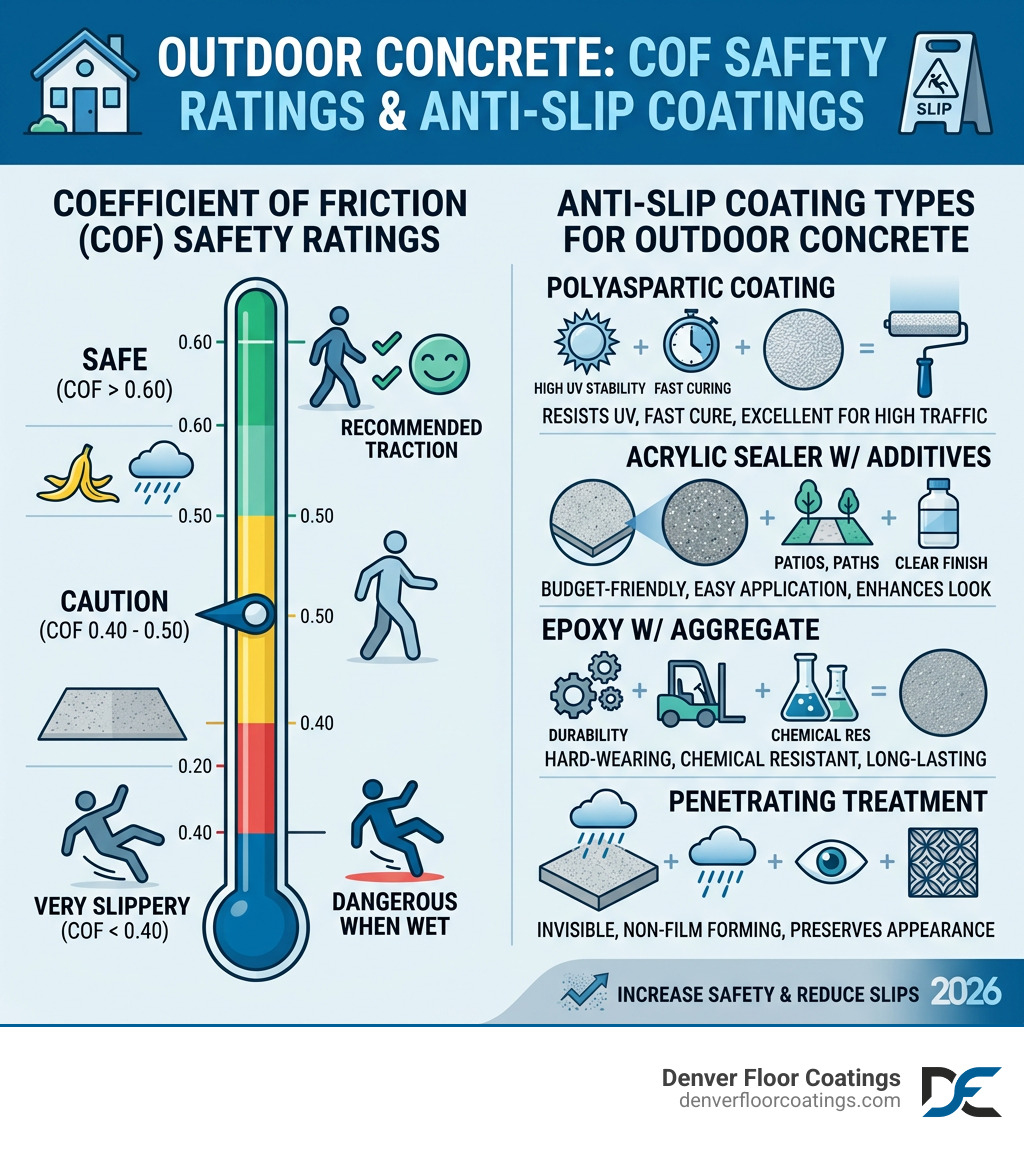
When evaluating floor safety, it helps to consider the traction standards that inform many safety programs. In commercial and industrial environments, maintaining safe walking and working surfaces can also overlap with regulatory expectations. The Occupational Safety and Health Administration (OSHA) provides guidance intended to keep walking-working surfaces safer for employees. As one widely referenced benchmark, a dynamic coefficient of friction (DCOF) of 0.42 or higher is often recommended for surfaces that are likely to be wet, because higher traction helps reduce the “hydroplaning” effect that can occur when a shoe loses contact with the floor. Our team at Denver Floor Coatings utilizes these benchmarks to help clients select the appropriate level of aggregate for their specific application.
Beyond traction, our high-performance concrete coatings also serve as a protective barrier for the underlying slab. Concrete is porous, which means it can absorb water and de-icing chemicals such as magnesium chloride. Over time, repeated exposure can contribute to surface wear and ongoing maintenance challenges. A professional coating system seals the slab’s pores and adds purpose-built texture, helping the surface stay more consistent through seasonal changes—especially in high-traffic areas such as commercial warehouses in Thornton or residential garages in Castle Rock. By preventing the penetration of moisture and salts, these coatings are intended to support the long-term structural integrity of the concrete while providing a safer environment for all users.
How Anti Slip Concrete Coating Works to Prevent Accidents
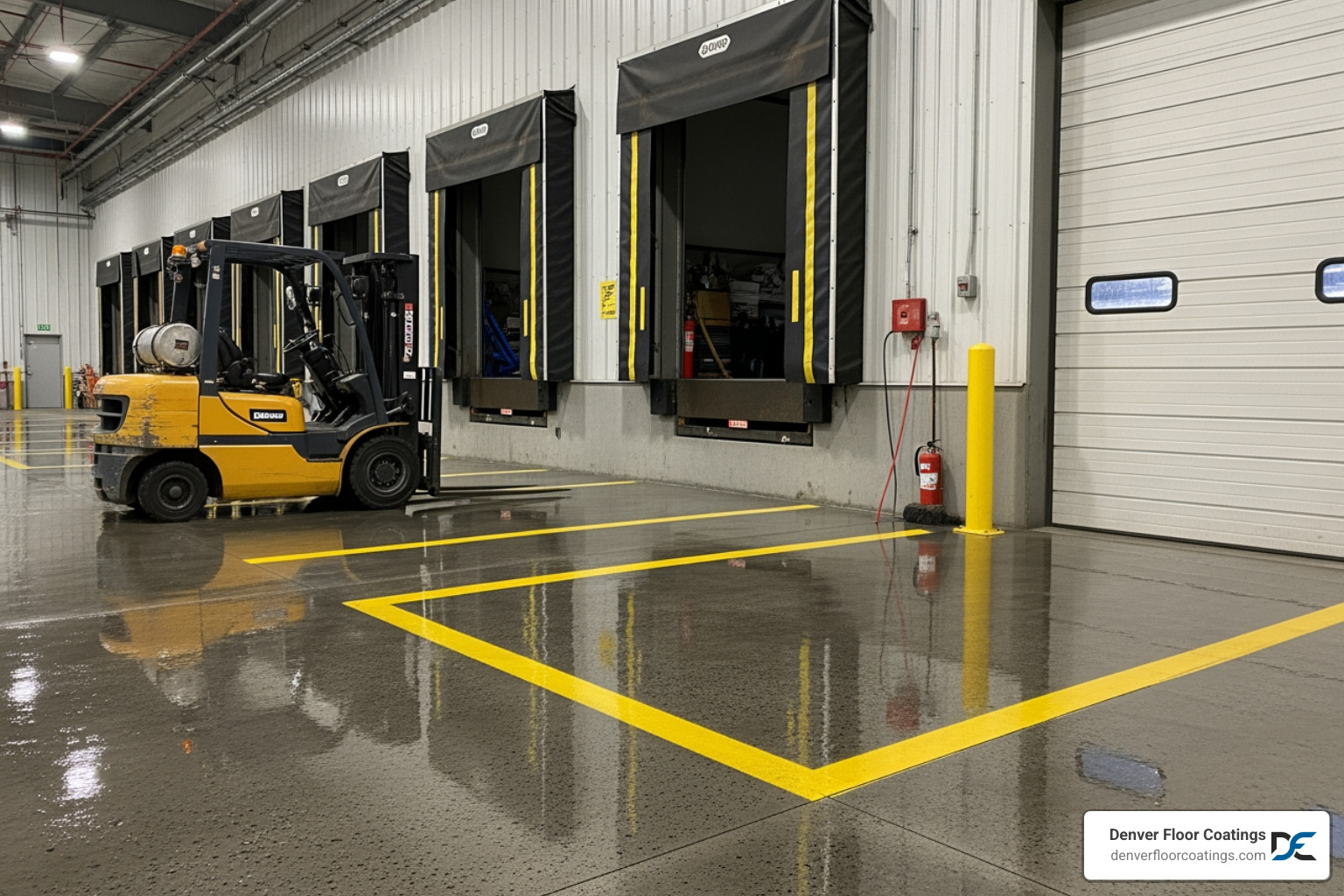
The core idea behind an anti slip concrete coating is straightforward: it changes the floor’s surface profile so shoes and tires have more to “bite” into, particularly when moisture is present. A polished or tightly troweled slab can behave a bit like glass once water is introduced, creating a lubricating layer that reduces contact between the sole and the surface. By integrating aggregate into resin layers, Denver Floor Coatings creates a controlled texture that breaks surface tension and supports more stable footing. This mechanical grip is essential in environments where spills or environmental moisture are common occurrences.
Aggregates may include materials such as aluminum oxide or polymer beads, suspended in the coating system at a level that matches the needs of the space. Under load, footwear engages those particles and the surrounding cured resin, increasing mechanical grip. In practical terms, this means traction can remain more predictable during everyday conditions like tracked-in snowmelt, light rain, or routine washdowns. The choice of aggregate is critical; for instance, aluminum oxide is known for its extreme hardness and durability, making it suitable for heavy industrial use, while polymer beads offer a more subtle texture that is often preferred in residential settings.
In and around Denver, we commonly tailor texture based on the actual use-case—whether that’s a busy commercial bay, a warehouse aisle that sees carts, or a residential garage that has regular winter moisture. For additional perspective on how textured systems perform in demanding applications, you can explore our notes on non-slip industrial flooring. Our goal is to provide a solution that addresses the specific risks of each environment, ensuring that the floor remains functional and safe throughout the year.
Regulatory Requirements for Commercial and Industrial Facilities
For facility managers in cities like Westminster and Arvada, slip resistance can be part of a broader safety and compliance strategy. In certain environments—such as food production, manufacturing, or automotive service—requirements may also extend to cleanability and sanitation. In these settings, a floor often needs to balance traction with a seamless, non-porous surface that supports thorough cleaning. This balance is difficult to achieve with standard concrete, which tends to trap contaminants in its pores, but it is a hallmark of the professional systems we install.
A professional anti slip concrete coating can provide that blend. Because the finished surface is continuous, it reduces the number of places where grime and moisture can linger, and it can be maintained with routine cleaning practices. When a facility needs a deeper look at options, performance characteristics, and texture choices, our anti-slip epoxy flooring ultimate guide provides additional detail. We work closely with facility managers to ensure that the chosen system meets both safety goals and operational requirements, providing a durable surface that stands up to the rigors of industrial activity.
Types of Slip-Resistant Systems for High-Traffic Environments
Selecting the appropriate coating system requires a detailed understanding of the specific environment and the types of traffic the floor will encounter. In the professional coating industry, we focus on systems that offer a balance of durability, chemical resistance, and safety. Using generic products often leads to premature failure, especially when subjected to the intense UV exposure found at high altitudes or the thermal stress of Colorado’s seasonal changes. At Denver Floor Coatings, we utilize industrial-grade resins that are specifically formulated to handle these local challenges, ensuring a bond that is designed to last.
Polyaspartic vs. Epoxy: Which is Better?
Two of the most prominent technologies in the high-performance coating market are epoxy and polyaspartic resins. Each has distinct characteristics that make it suitable for different applications within a home or business. Understanding the chemical differences between these two options is essential for making an informed decision about your flooring needs. Our team provides expert guidance to help you choose the resin technology that best aligns with your facility’s requirements and environmental exposure.
Epoxy systems have long been the standard for industrial and interior applications. They are known for their exceptional adhesion to concrete, often creating a bond that is stronger than the concrete itself. Epoxy is highly resistant to a wide range of chemicals, making it an excellent choice for interior warehouse floors or manufacturing zones. However, traditional epoxies can be sensitive to ultraviolet light, which may cause them to yellow or “amber” over time if they are located near large windows or open garage doors. For this reason, we often recommend epoxy for fully enclosed spaces where UV exposure is minimal.
Polyaspartic coatings represent a significant advancement in resin technology. These systems are inherently UV-stable, meaning they will maintain their clarity and color even when exposed to sunlight. Furthermore, polyaspartic resins are more flexible than epoxy, which allows them to better accommodate the natural expansion and contraction of a concrete slab during Denver’s frequent temperature swings. One of the most significant advantages of polyaspartic systems is their rapid cure time. In many cases, a full installation can be completed in a single day, allowing the floor to be returned to service much faster than with traditional methods. This efficiency is a major benefit for businesses that cannot afford extended downtime.
When considering a solution that combines aesthetic appeal with industrial-grade performance, it is beneficial to research professional epoxy floor coating options that utilize these advanced resin technologies. We often employ a hybrid approach, using the strengths of both materials to create a multi-layered system that provides maximum protection and safety.
Comparing Additives and Integrated Anti Slip Concrete Coating Textures
The level of traction in a floor is primarily determined by the type and amount of aggregate integrated into the system. We customize the texture based on the specific needs of the client and the intended use of the space. This customization allows us to provide a surface that is safe for its specific environment without being overly abrasive where it isn’t necessary. The integration of these additives is a precise process that ensures even distribution across the entire floor surface.
Aluminum oxide is one of the most durable additives available. It is an extremely hard mineral that provides a very aggressive texture, making it ideal for areas with heavy foot traffic or where rolling equipment is used, such as in a commercial garage or distribution center. Silica sand and quartz are also frequently used to provide a natural, rugged texture that is both effective and visually appealing. For areas where a more comfortable, barefoot-friendly surface is desired, such as a residential mudroom or a transition area, polymer beads can be used to provide a softer but still effective grip. Our team at Denver Floor Coatings carefully calibrates the volume of these additives to achieve the desired DCOF rating.
The Role of Decorative Flake in Traction Enhancement
One of the most popular and effective ways to achieve a slip-resistant surface in a residential garage is through the use of a multi-layered decorative flake system. This process involves broadcasting vinyl flakes into a wet base coat until the surface is completely saturated. This method not only provides a high degree of aesthetic customization but also creates a multi-dimensional surface that naturally aids in slip resistance.
These flakes do more than just provide a beautiful, granite-like appearance; they create a subtle “orange-peel” texture that naturally enhances traction. When sealed with a high-performance topcoat, the result is a floor that is durable, easy to clean, and significantly safer than bare concrete. This system is a cornerstone of our warehouse floor coating complete guide, as it provides a consistent finish over large areas while maintaining high safety standards. The flake system is particularly effective at hiding minor imperfections in the concrete slab, resulting in a uniform and professional appearance.
Key Benefits of Professional Grade Concrete Finishes
Investing in a professional anti slip concrete coating provides a comprehensive range of benefits that extend far beyond simple slip resistance. These systems are engineered to transform a standard concrete slab into a high-performance surface capable of withstanding years of heavy use. At Denver Floor Coatings, we focus on delivering systems that offer a significant return on investment through enhanced durability and reduced maintenance requirements.
One of the primary advantages is exceptional chemical resistance. In the Denver area, floors are frequently exposed to harsh substances, including road salts, magnesium chloride used for snow removal, gasoline, and motor oil. A professional coating acts as an impermeable shield, preventing these chemicals from staining or weakening the concrete. This is particularly important for maintaining the structural integrity of the slab over the long term, as chemical penetration can lead to internal degradation and costly repairs. Our coatings are designed to withstand prolonged exposure to these substances without losing their protective qualities.
Abrasion resistance is another critical factor. High-quality coatings are tested to ensure they can withstand the constant friction of vehicle tires and foot traffic without wearing thin. In technical evaluations, these systems often show minimal material loss even after hundreds of cycles on an industrial abrasion wheel. This durability ensures that the slip-resistant properties of the floor remain effective for a much longer period than lower-quality alternatives. For businesses in the Denver area, this means a floor that continues to perform safely even under the stress of heavy machinery and constant movement.
Furthermore, professional coatings offer superior thermal shock resistance. This is a vital characteristic in Colorado, where a garage floor might experience a temperature change of 50 degrees or more in a matter of minutes when a door is opened during the winter. Our systems are designed to remain flexible and bonded to the concrete even under these extreme conditions, preventing the cracking or peeling that can occur with less sophisticated products. For facility managers, these attributes are essential for industrial floor coatings that must perform reliably in demanding environments. The ability of the coating to expand and contract with the concrete is a key factor in its long-term success.
Maintenance is also significantly simplified with a coated floor. Because the surface is non-porous, dirt and spills sit on top of the coating rather than soaking into the concrete. This allows for easy cleaning with standard tools, ensuring the floor remains both safe and visually appealing with minimal effort. A clean floor is a safer floor, as it allows the anti-slip texture to remain fully engaged with footwear rather than being obscured by debris or oily residues.
Application and Surface Preparation for Lasting Traction
The longevity and performance of an anti slip concrete coating are almost entirely dependent on the quality of the surface preparation. Even the most advanced resin will fail to bond if it is applied to a surface that is contaminated or improperly profiled. At Denver Floor Coatings, we emphasize a meticulous preparation process to ensure every installation meets our high standards. We believe that the work done before the coating is applied is just as important as the application itself.
The Diamond Grinding Difference
We utilize heavy-duty industrial grinders equipped with diamond-segmented blades to prepare the concrete surface. This mechanical process is far superior to simple acid washing or pressure cleaning, which often fail to remove deep-seated contaminants or provide an adequate profile. Diamond grinding serves two essential purposes: it removes existing contaminants such as old paint, oil, and weak surface layers, and it creates a specific “profile” on the concrete. This profile, which feels similar to medium-grit sandpaper, provides the necessary surface area for the coating to achieve a strong mechanical bond with the slab. This mechanical anchor is what allows the system to resist delamination even under heavy loads.
Moisture and Temperature: The Invisible Enemies
Before any coating is applied, we conduct thorough testing to identify potential issues that could compromise the installation. Moisture vapor transmission is a common concern; if water is pushing up through the slab from the ground, it can cause the coating to delaminate or blister. We use specialized meters to measure the moisture content of the concrete and ensure it falls within the acceptable range for the specific resin being used. We also carefully monitor environmental conditions, including the ambient temperature and the dew point. Applying a coating when the slab is too cold or when humidity is too high can lead to improper curing and a loss of clarity in the finish.
Once the surface is prepared and tested, we address any existing damage. Cracks, pits, and spalled areas are repaired using high-strength menders that are compatible with the coating system. These repairs are essential for creating a smooth, uniform base for the anti slip concrete coating. We also treat expansion joints to ensure a clean, professional appearance that allows for the natural movement of the slab. This comprehensive approach to preparation is what allows us to provide floors that stand up to the rigors of the Colorado climate in areas like Arvada, Centennial, and Broomfield. Our commitment to these details is what sets Denver Floor Coatings apart in the industry.
Frequently Asked Questions about Anti-Slip Surfaces
Can anti slip concrete coating be applied to existing sealed floors?
This is a common question from property owners in Boulder and Golden. Generally, a new coating cannot be applied directly over an existing sealer, as the new material will not be able to form a proper bond. To ensure a successful installation, the existing sealer must be mechanically removed through diamond grinding. This process exposes the raw concrete, allowing the new anti slip concrete coating to penetrate and anchor itself into the surface. We always perform a compatibility check and surface assessment to determine the best course of action for each unique floor, ensuring that the final result is both durable and safe.
How do you clean a textured concrete surface without losing grip?
Maintaining a textured floor is straightforward if the correct methods are used. It is important to avoid using waxes or “mop-and-shine” products, as these can fill in the microscopic texture that provides slip resistance, making the floor dangerously smooth over time. Instead, we recommend using a pH-neutral cleaner and a soft-bristled broom or a microfiber mop to remove dirt and debris. For commercial spaces or garages with heavier buildup, a low-pressure wash can be very effective at restoring the floor’s appearance and traction. Regular cleaning ensures that the aggregate remains exposed and effective, providing the intended level of safety for years to come.
How do Denver Floor Coatings’ anti-slip systems ensure long-term performance and safety?
Our commitment to quality involves using only industrial-grade materials and following a rigorous installation protocol. We do not believe in shortcuts, as the safety of our clients depends on the integrity of our work. Each system is built in multiple layers, starting with a deep-penetrating primer and followed by a full broadcast of aggregate or decorative flake. By tailoring the choice of resin and texture to the specific environment—whether it is a high-traffic warehouse in Aurora or a residential garage in Fort Collins—we ensure that the floor provides reliable safety and durability. Our systems are designed to withstand the unique environmental challenges of the Denver area, providing a stable surface that property owners can rely on.
What is the expected lifespan of a professional anti-slip coating?
The lifespan of a coating system is influenced by several factors, including the volume of traffic, the types of chemicals it is exposed to, and the quality of ongoing maintenance. While no coating is permanent, our professional-grade systems are engineered to provide many years of reliable service. By using high-performance resins like polyaspartic and epoxy, and ensuring meticulous surface preparation, we provide a surface that is designed to resist the typical wear and tear of a busy Colorado property. Regular cleaning and avoiding the use of harsh abrasive tools will help maintain the integrity of the anti-slip texture for as long as possible.
Conclusion
At Denver Floor Coatings, we understand that your floors are a vital component of your property’s safety and functionality. We specialize in transforming standard concrete into high-performance, industrial-grade surfaces that are designed to last. Whether you are looking to upgrade your home’s garage with a showroom-quality finish or need to ensure your commercial facility meets the highest safety standards, our team has the expertise and the specialized equipment to deliver exceptional results. We take a tailored approach to every project, ensuring that the specific needs of your environment are met with the most effective resin and aggregate combinations.
We take great pride in our ability to provide efficient, high-quality installations across the entire Denver metropolitan area, from Fort Collins to Castle Rock. Our polyaspartic and epoxy systems are specifically chosen for their ability to withstand the unique environmental challenges of Colorado, providing you with a floor that is UV-stable, chemical-resistant, and reliably slip-resistant. By choosing Denver Floor Coatings, you are investing in a surface that is engineered for performance and safety, backed by years of local experience and technical expertise.
Ready to enhance the safety and durability of your concrete floors?
Contact Denver Floor Coatings today for a free estimate and discover how we can help you protect your investment with a professional anti slip concrete coating. Our team is ready to provide you with a detailed assessment and a customized solution that meets your specific safety and aesthetic goals.