

Why Every Crack in Your Garage Floor Deserves Immediate Attention
In the high-altitude environment of the Denver metropolitan area, a garage floor is far more than just a slab of cured cement; it is a critical structural component of the home that endures some of the most significant environmental stressors in the country. Concrete floor crack repair is a sophisticated engineering process that involves the meticulous cleaning, stabilization, and filling of fractures within a concrete slab. This process is designed to mitigate the progression of damage and restore the surface to a state that can support long-term protective systems. At Denver Floor Coatings, we view every crack not merely as a cosmetic blemish, but as a potential entry point for moisture and a signal of underlying movement that requires a professional, systematic response. The Front Range presents unique challenges, from the intense UV radiation at a mile high to the rapid temperature swings that can see a forty-degree shift in a single afternoon. These factors contribute to the dynamic nature of concrete, which is why our approach is rooted in technical precision rather than superficial fixes. We understand that a garage floor in Colorado is under constant duress, and our goal is to provide a solution that respects the physics of the material while enhancing the overall utility of the space.
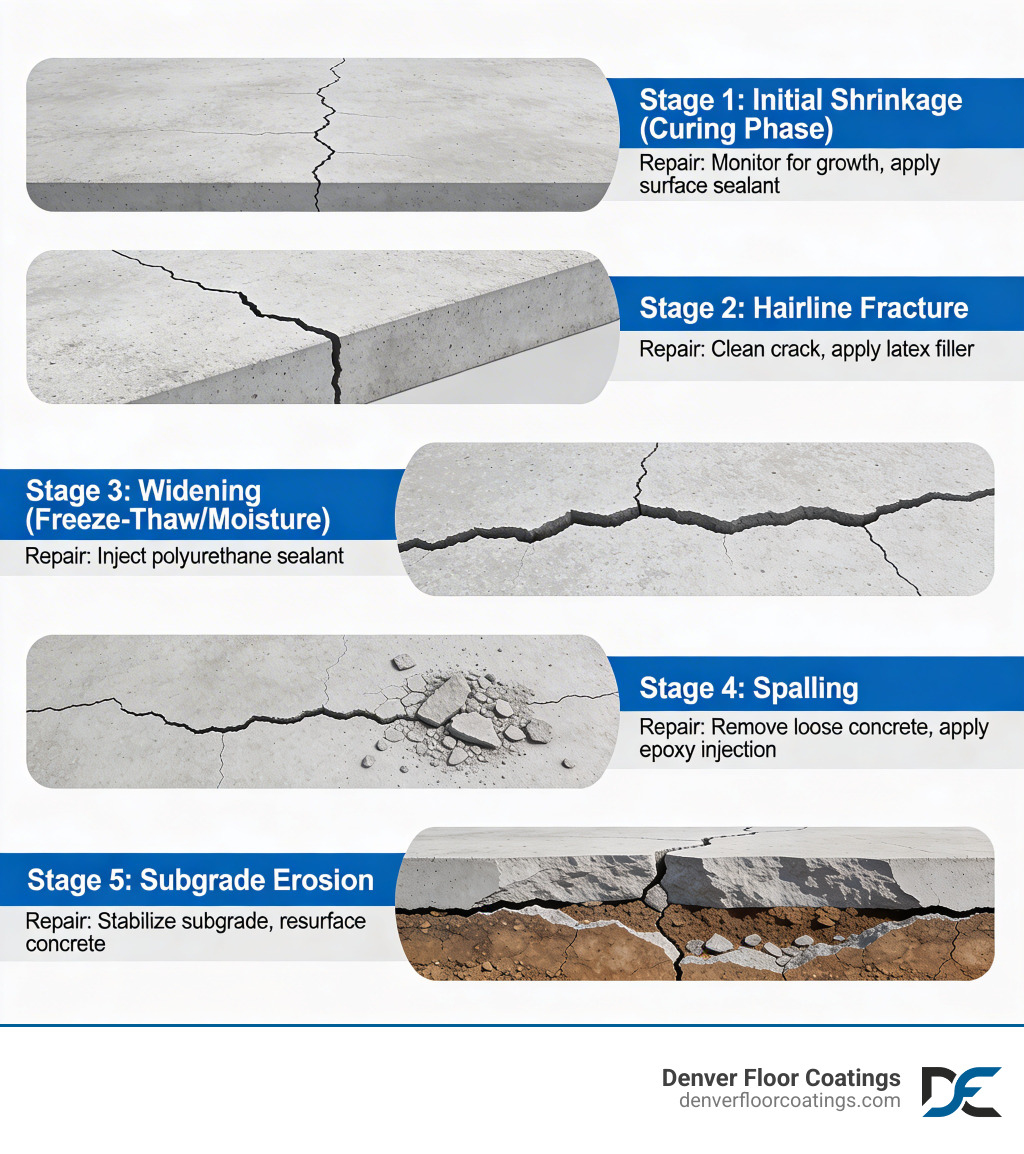
Spotting a new crack running across a garage floor can be a source of concern for property owners in Centennial or Boulder. What often begins as a seemingly harmless hairline fracture can evolve into a more complex structural concern if left unaddressed. In the Colorado climate, water is a primary factor in the degradation of concrete. When moisture seeps into these openings, the state’s notorious freeze-thaw cycles exert internal pressure, which can push the crack wider over successive winters. Before long, what appeared to be a minor eyesore can become a more significant liability, potentially compromising the subgrade and leading to uneven slabs or hazardous tripping points. Concrete is a remarkably durable material, yet it is not invincible. Even the most expertly installed slabs are subject to the laws of physics, developing fractures over time due to natural shrinkage, extreme temperature fluctuations, and the shifting of the expansive soils common throughout the Front Range. In Denver, these stressors are particularly aggressive. The good news is that when these issues are identified early, a professional intervention from Denver Floor Coatings can effectively stabilize the area. Ignoring a crack is rarely a sustainable strategy; moisture intrusion weakens the supporting soil below, which often leads to further cracking, spalling, and a loss of structural integrity.
I am Mike Wislinsky, the founder of Denver Floor Coatings. With over 20 years of experience in engineering and operations, I bring a data-driven, technical perspective to every concrete floor crack repair project we undertake. Our approach is rooted in understanding the “why” behind the failure, ensuring that the solutions we provide are not just temporary patches, but engineered repairs designed to integrate with our advanced coating systems. In the following sections, we will explore the technical nuances of assessing, repairing, and ultimately protecting your garage floor to ensure it remains a functional and aesthetic asset for years to come.
Understanding the Root Causes of Concrete Fractures in Colorado
To achieve a successful and lasting repair, it is essential to first diagnose the underlying forces that caused the concrete to fail. Concrete is a material characterized by high compressive strength but relatively low tensile strength. This means that while it can support the weight of heavy vehicles, it is susceptible to splitting when forces pull the slab apart. While many view a garage floor as a static, immovable object, it is actually a dynamic structure that is constantly responding to its environment, particularly in the volatile climate of the Denver area. The geology of the Front Range is particularly unforgiving. Many areas in Aurora, Thornton, and Centennial are built upon expansive soils, such as bentonite clay, which swell when wet and shrink when dry. This constant movement beneath the slab creates a cycle of stress that the concrete must absorb. When the stress exceeds the tensile capacity of the slab, a fracture occurs. These are not merely surface issues; they are often the result of deep-seated environmental pressures that require an engineered response to manage effectively.
Several primary factors contribute to the development of these fractures. Drying shrinkage is a frequent cause in relatively new residential floors. As the water used during the initial mixing and pouring process evaporates, the slab physically contracts. If this movement is restrained by foundation walls, support columns, or plumbing penetrations, the concrete may crack to relieve the internal tension. Furthermore, subgrade settlement is a significant concern in regions like Aurora and Thornton. If the soil beneath the floor was not properly compacted, or if drainage issues allow water to wash away the supporting earth, the slab may settle into the resulting void. This creates stress that can result in wide, uneven cracks that merit a more detailed evaluation before any coating system is installed. Thermal expansion and contraction also play a pivotal role. Concrete expands in the heat of a Colorado summer and contracts during frigid winter nights. Without properly designed and maintained control joints, the concrete often forms its own release points in the form of random, jagged cracks. Additionally, chemical exposure can accelerate surface degradation. Road salts and de-icers brought in by vehicles can penetrate the porous surface of untreated concrete, contributing to internal pressure and a flaking effect known as spalling.
At Denver Floor Coatings, we distinguish between active and dormant cracks because that distinction helps determine whether a rigid, structural resin or a more flexible joint material is appropriate. A dormant crack is one that has reached a state of relative equilibrium, often tied to initial shrinkage. An active crack, however, continues to move or widen in response to seasonal changes or ongoing soil settlement. Identifying these movement patterns is a critical step in our process because a repair that is too rigid for a moving crack can telegraph through a finished coating over time. Colorado’s freeze-thaw cycles act as a slow-motion wedge. When moisture enters even a hairline fracture and freezes, it expands with significant pressure, which can gradually widen the opening and disturb support conditions below the slab. For readers who want additional background on common crack types and repair principles in concrete slabs, the Concrete Network overview is a helpful resource: Concrete Crack Repair Guide: How to Fix Cracks in Concrete Slabs. Our role is to translate those broad concepts into a repair approach that fits the garage environment and is compatible with the high-performance coating systems we install across the Front Range, from Arvada and Littleton to Boulder and Centennial.
Professional Assessment: Distinguishing Structural from Cosmetic Damage
Not all fractures in a concrete slab indicate the same level of risk. At Denver Floor Coatings, our assessment process is designed to categorize damage into cosmetic, functional, or structural concerns, with an emphasis on how the slab will perform under vehicle loads and under a bonded coating system. Some issues, such as crazing, appear as fine, spiderweb-like lines on the surface. These are typically the result of the surface drying too quickly during curing and, while they may be aesthetically distracting, they often do not meaningfully change load-bearing performance. Deeper fractures, however, require a more rigorous evaluation before repair materials and coatings are selected. We look for signs of “lipping,” where one side of a crack has shifted vertically relative to the other. This often indicates a loss of subgrade support or a failure of the load-transfer mechanism within the slab. In the context of a high-performance garage environment, these offsets are more than just eyesores; they are potential failure points for any subsequent coating and can create significant challenges for the long-term maintenance of the floor.
A common benchmark used in the professional assessment of concrete is the 1/4-inch threshold. Generally, if a crack is narrower than 1/4 inch and the two sides of the fracture remain level with one another, it is often associated with minor settlement or shrinkage. However, once a crack approaches 1/2 inch in width, or if there is evidence of vertical displacement, where one side of the crack is higher than the other, it can suggest more significant movement or loss of support beneath the slab. These lipped cracks can become tripping hazards and, in a garage, may also create impact points that increase wear on tires and equipment. There are several indicators that merit a professional visit from Denver Floor Coatings. Widespread spalling, where the top layer of concrete is flaking off in larger sections, suggests the surface layer has been compromised, often due to chemical exposure or finishing variables. Active water seepage is another critical sign; if moisture is observed migrating up through the floor during heavy rain or snowmelt, a simple surface fill may not be enough for a durable, coated system. Furthermore, if rusty metal or rebar becomes visible within a crack, it indicates corrosion is underway. That condition deserves timely attention because expanding rust can damage surrounding concrete from within.
For property owners who have already invested in a high-quality floor and are seeing localized surface issues, our approach to preserving coated systems is outlined here: epoxy-floor-repair-minor-damage. The environment also shapes the repair plan. Indoor garage floors in areas like Highlands Ranch are shielded from direct weather but still face hot-tire exposure, seasonal moisture vapor transmission, and the abrasive grit that arrives with Colorado winters. We assess repairs with the end system in mind so the materials used are compatible with industrial-grade coatings and are capable of supporting daily garage use. For additional general guidance on evaluating cracks and selecting repair approaches, this building-diagnostics reference can provide useful context: InspectApedia Diagnose & Fix What’s Wrong at Your Building. Denver Floor Coatings uses that type of industry knowledge as a starting point, then applies a site-specific process aimed at stability, coating compatibility, and a clean, level surface that can be finished to a consistent, showroom-quality appearance.
Advanced Material Science in Concrete Restoration
The success of a concrete floor crack repair is heavily dependent on the chemistry of the materials used. At Denver Floor Coatings, we utilize industrial-grade resins and polymers that are engineered for specific performance characteristics. The selection of the correct material—whether it be an epoxy resin, a polyurethane, or a polyurea—is based on the width of the crack, the degree of expected movement, and the environmental conditions of the garage. Epoxy resins are often utilized for structural repairs in narrow, dormant cracks due to their high bond strength. However, because they are relatively rigid, they are best suited for cracks that have reached a state of equilibrium. For joints or cracks that experience seasonal expansion and contraction, we often utilize specialized polyureas. Polyurea is a remarkable material for the Denver climate; it offers a balance of high strength and moderate elongation, allowing it to move slightly with the slab without losing its bond. This flexibility is crucial for managing the thermal stresses common in Colorado, where a garage floor can experience significant temperature differentials between the interior and the exterior threshold.
A critical component of our repair philosophy is the science of bonding agents. A repair is only as effective as its adhesion to the original substrate. We target a bond strength that often exceeds the internal strength of the concrete itself, ensuring that the repair material becomes an integral part of the slab. This is achieved through chemical cross-linking, where the repair material creates a molecular bridge with the pores of the concrete. This “wetting out” process is vital; the material must soak into the concrete to create a mechanical key that prevents the repair from pulling away under the stress of vehicle traffic or temperature changes. Material selection also involves considering the long-term compatibility with topcoats. If a repair material is used that contains incompatible oils or silicones, it can prevent a future polyaspartic coating from adhering correctly. We ensure that every filler and sealant we use is part of a cohesive system. For those interested in the nuances of maintaining these high-performance surfaces, our guide on how-to-fix-minor-damage-on-your-epoxy-floor-without-breaking-a-sweat provides context on how we handle surface-level maintenance. Ultimately, we match the elongation properties of our materials to the specific needs of the Denver climate, ensuring that the repair can withstand the weight of a heavy vehicle while remaining resilient through a sub-zero Colorado night.
The Denver Floor Coatings Methodology for Permanent Repairs
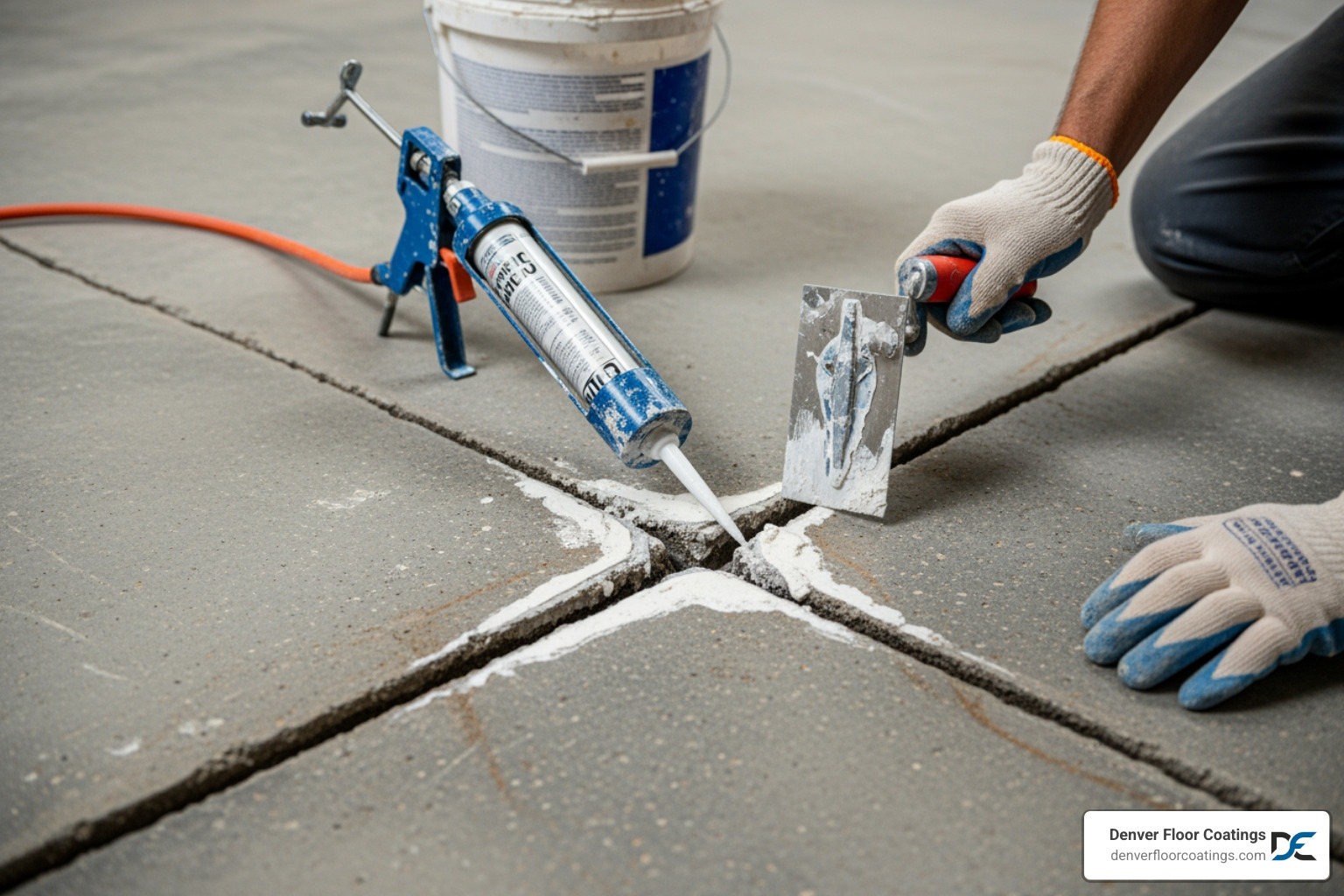
Our approach to concrete floor crack repair is a rigorous, multi-step mechanical process that prioritizes long-term stability. We do not simply “fill” a crack; we engineer a solution that addresses the geometry of the fracture and the cleanliness of the substrate. The most common reason for the failure of conventional repairs is inadequate preparation. If a repair material is applied over dust, oil, or loose debris, it will fail to bond, leading to a repair that eventually peels or cracks again. Our process begins with precision cleaning and “crack chasing.” We utilize diamond-bladed grinders to follow the path of the crack, widening it into a clean V-groove or U-shape. This mechanical preparation removes the weak, weathered edges of the crack and exposes fresh, porous concrete that is ideal for bonding. This also creates a “mechanical key”—an inverted shape that physically locks the repair material into the slab. Throughout this process, dust mitigation is a top priority. We utilize industrial-grade HEPA filtration vacuums connected directly to our grinding equipment to ensure that the workspace remains clean and that no microscopic dust remains in the pores of the concrete, which is essential for achieving the high-strength bond we require for our coating systems.
For floors that have had previous treatments, we may need to perform a more extensive preparation, as detailed in our overview of how-to-remove-epoxy-from-concrete, to ensure we are working with a raw, receptive substrate. For deeper fractures, we implement stabilization techniques to ensure the repair material performs as intended. If a crack is particularly deep, we may use a backer rod—a specialized foam rope—or industrial-grade sand to create a base for the repair. This prevents the liquid resin from simply flowing through the crack and into the soil below. By controlling the depth of the repair, we allow the sealant to bond specifically to the vertical walls of the crack, which optimizes its ability to stretch and contract. Once the crack is prepared and stabilized, we proceed with the injection or gravity-feed application of our high-performance resins. For narrow, deep fissures, we use low-viscosity materials that penetrate deep into the slab. For wider gaps, a thicker gel consistency is used to ensure the material stays in place and can be troweled flush. After the material has cured, we use floor grinders to level the repair perfectly with the surrounding concrete. This ensures that the transition is completely seamless. When our final polyaspartic coating is applied over the top, the original crack is not just filled—it is virtually invisible and structurally integrated into the reinforced floor system.
Long-Term Protection and the Lifecycle of Repaired Concrete
Completing a professional concrete floor crack repair is a significant step in preserving a home’s value, but the repair itself is only part of a comprehensive protection strategy. Once the cracks are stabilized and leveled, the area must be protected from the very elements that caused the damage in the first place. While the high-performance resins we use are typically ready for foot traffic within a few hours, they continue to chemically harden and reach their full structural potential over several days. The long-term benefits of a professional repair are substantial. By “stitching” the slab back together with high-strength polymers, we aim to restore the floor’s ability to distribute weight more evenly. This helps to prevent the localized pressure that often leads to further cracking. Furthermore, a properly sealed repair creates a barrier against moisture intrusion. This is crucial in preventing the subgrade erosion and hydrostatic pressure that can cause slabs to sink or heave over time. In the competitive real estate markets of Fort Collins, Greeley, and Denver, a garage floor that has been professionally repaired and coated is a significant asset that demonstrates a high level of property maintenance and attention to detail.
At Denver Floor Coatings, we believe the most effective way to manage future fractures is to move beyond localized repairs and seal the entire floor with an industrial-grade system. Untreated concrete is inherently porous, acting like a sponge for moisture, automotive fluids, and corrosive road salts. By applying a multi-layer polyaspartic coating, we create a non-porous, UV-stable shield that protects the concrete from the inside out. This system significantly reduces the temperature-related expansion and contraction that is the primary driver of cracking in the Colorado climate. Our residential systems are designed to be more than just a surface treatment; they are a comprehensive floor reinforcement strategy. By integrating the repair process with a high-performance coating, we provide a surface that is resistant to chemicals, impact, and the wear and tear of daily life. For property owners looking to transform their garage into a clean, durable, and functional extension of their living space, you can find More info about residential services on our dedicated service page. This holistic approach ensures that the repairs we perform today are protected by a resilient barrier that can withstand the challenges of the seasons for years to come.
Technical Considerations for Colorado Homeowners
When considering concrete floor crack repair, homeowners often have questions regarding the timeline and the technical requirements of the process. One of the most frequent inquiries involves the cure time of the materials. In the Denver climate, temperature and humidity can influence the chemical reaction of the resins. However, the advanced polyurea and epoxy products utilized by Denver Floor Coatings are engineered for efficiency. Most of our structural repairs are “tack-free” within a few hours, and in many cases, we can proceed with the application of a full coating system on the same day. While the floor may be ready for foot traffic quickly, we typically recommend a 24-hour waiting period before subjecting the repaired areas to the weight of a vehicle to ensure the material has reached sufficient compressive strength. Another common technical consideration is the difference between a simple filler and a structural sealant. A filler, such as a standard acrylic or latex caulk, is primarily a cosmetic solution. It occupies the space within a crack and may keep out some debris, but it offers no structural reinforcement and has a tendency to shrink or pull away from the concrete over time.
In contrast, the structural resins we use at Denver Floor Coatings are ASTM-compliant materials that bond the concrete together. This is a critical distinction for garage floors that must support the dynamic loads of moving vehicles. Our materials are designed to restore the slab’s integrity, ensuring that it functions as a single, cohesive unit. Moisture vapor transmission (MVT) is another factor that we carefully monitor. In many Colorado homes, moisture can migrate from the soil through the porous concrete slab. If a repair or coating is applied without considering this vapor pressure, it can lead to delamination or bubbling. Our team performs moisture testing as part of our professional assessment to ensure that the repair strategy is compatible with the specific conditions of your site. By addressing these technical variables with an engineering-focused mindset, we provide a level of precision that ensures the repair is not just a temporary fix, but a durable component of a high-performance flooring system. This attention to detail is what allows us to deliver results that stand up to the unique demands of the Front Range environment, providing a surface that is intended to last for the long term.
Conclusion
At Denver Floor Coatings, we believe your garage should function as a durable, high-performing extension of your home. Across the Denver metro area and Northern Colorado, including Centennial, Greeley, and Boulder, concrete cracks are a common reality due to temperature swings, moisture movement, and the natural behavior of slabs over time. With a professional, engineering-informed approach, these fractures can often be stabilized, leveled, and integrated into a complete flooring system that supports daily use. Our team focuses on concrete floor crack repair as a critical first step toward a finished surface that looks consistent and performs reliably under vehicle traffic. When appropriate, we pair repairs with industrial-grade polyaspartic coating systems designed for garage interiors, helping reduce moisture intrusion, improve cleanability, and deliver a bright, finished look that holds up well through Colorado seasons. If you have noticed a new crack, widening separation, spalling, or uneven edges, the most productive next step is a professional assessment so you can understand the severity and the options for a long-term result.